

 Electronics
The AKG N90Q is a fully active electronic headphone; it can not be used passively when the battery runs out after about 10 hours. That included storage battery will come in handy on trans-oceanic flights. Documentation for the AKG N90Q is currently very slim; only the Spec Sheet and very basic Quick Start Guide are publicly available. It is quite early on in the introduction of this product at this writing, I expect we'll see a more in-depth manual in the near future. Fortunately, I was put in contact with Dr. Ulrich Horbach, Engineering Fellow, Harman CoC Audio, who is one of the chief engineers on the N90Q, and who graciously answer a number of questions from me.
We have other hardware platforms where noise canceling is digital, like JBL Everest, but it requires a separate DSP core running at high speed (sample rates > 384kHz), and special, low latency A/D and D/A converters. In the N90 we didn’t want any sonic compromises, that’s why we designed a high quality, fully balanced, class A/B headphone amplifier along with discrete ANC circuitry (audiophile opamps only – no standard chip solution).I did find the isolation of the N90Q very close to the Bose QC35, which means very good, measuring only 1dB less broadband isolation. It did seem a little less disorienting however. Sometimes when you turn a noise canceling headphone on you can get a slight experience of vertigo...kind of a mild dizzy feeling, some people feel it as a pressure in their ears. This has gotten less so with the good noise cancelers recently, but I have to say the N90Q does a particularly good job of canceling noise without feeling weird. The noise floor is audible but fairly low when powered on.
USB audio has been implemented for 16 and 24 bit samples at 44.1, 48, and 96 KHz. Other resolutions and sampling rates are not supported. It is recommended to set the default sample rate of your audio player at 48 or 96 KHz (not 44.1).The only sampling rate I had trouble with was 24/88.2, which I could not get to play at all. When the headphone received an unplayable format it makes a couple of buzzing noises, then silently waits for a recognizable digital signal. Going back and forth between playable and unplayable formats didn't seem to phase the N90Q, whenever it saw a a signal it liked, it played it reliably.
A trained listener is able to detect frequency response deviations of a loudspeaker from flat within few decibels. Thinking further, this leads to the conclusion that humans largely eliminate the influence of their external ear features by inverse filtering in the brain. We should therefore attempt to characterize acoustic sources such as headphones before the sound enters the pinna. This is the main objective of the paper.Once the listener has the headphones comfortably placed on the head, a long push on the multi-function button begins the TruNote calibration process. The listener will hear two very fast tone sweeps. Inside the headphone, placed in the grill in front of the driver, are two microphones that record the tone sweeps within the headphone cup. A computer then analyses the recorded signals for acoustic resonances and modes to develop a DSP filter to compensate for the acoustics of the cup space including the individual listeners particular pinna. The research posits that this is all that's needed to account for individual variety of pinna shapes. I should add here that a great deal of effort was spent designing a microfiber (paper in this case) driver that acts as linear and pistonic as possible, and a dual density foam earpad with very well controlled acoustic properties in an effort to reduce as much as possible non-linear distortions that would be difficult to compensate for with DSP techniques.
 Numerous times I would place the headphones over my thigh to calibrate them without pinnas on the cups, then would wear them to listen for sound quality. When I recalibrate to my ears the sound got noticeably smoother and more coherent. The above plot shows the frequency response of the headphones after using the TruNote calibration on my leg (orange and red) and then after TruNote calibration on the measurement head (blue and light blue). Obviously, the TruNote calibration does significant modification to response, and does a really good job of calibrating both ears for very similar response. To my ears, this TruNote did work quite well.
Tone Controls - The AKG N90Q has a Tone Control actuated by the control ring on the left ear. This control is able to increase and decrease bass and treble response simultaneously making and exciting U-shaped response or a more mid-centric response. The control has 25 steps. The graph below shows the control at maximum, minimum, and at its mid-point.
Numerous times I would place the headphones over my thigh to calibrate them without pinnas on the cups, then would wear them to listen for sound quality. When I recalibrate to my ears the sound got noticeably smoother and more coherent. The above plot shows the frequency response of the headphones after using the TruNote calibration on my leg (orange and red) and then after TruNote calibration on the measurement head (blue and light blue). Obviously, the TruNote calibration does significant modification to response, and does a really good job of calibrating both ears for very similar response. To my ears, this TruNote did work quite well.
Tone Controls - The AKG N90Q has a Tone Control actuated by the control ring on the left ear. This control is able to increase and decrease bass and treble response simultaneously making and exciting U-shaped response or a more mid-centric response. The control has 25 steps. The graph below shows the control at maximum, minimum, and at its mid-point.
 The control can be rotated continuously, so tones are use to indicate when the control reaches maximum, minimum, and it's mid-point. The high pitched beep means the control is at its maximum; a low pitched beep for its minimum; and a mid-pitched beep when at its mid-point.
 The plot above shows interaural time difference as a function of angle and frequency. For a speaker 30 degrees off to the side of the head, the ITD at 10kHz is about 250uSec. However, the ITD at 2kHz is almost 300uSec; and at 500Hz is about 410uSec. This occurs because the sound at longer wavelengths form a standing wave against the surface of the head, and therefore has to travel slightly farther as it goes around the head. In my experience, the most oft quoted ITD number for a speaker 30 degrees of axis is 300-350uSec.
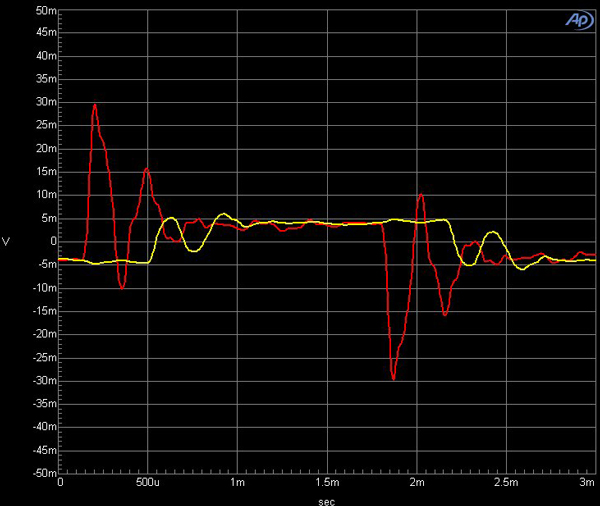 In the above 300Hz square wave plot, I applied the signal to the left ear only (red trace) and also measured the right ear output (yellow). This is the synthesized crossfeed signal. You can see the right ear begins its leading edge accent about 320uSec after the initial left ear transient. You can also see the leading edge rises less quickly, indicating it has less high frequency responce due to the high frequency shadowing of the head. I would say the Studio Mode on the N90Q is operating as I expected—essentially mimicking two speakers in an anechoic chamber. Not really a great listening environment, but theoretically one step closer to natural than one channel straight into each ear.
 I was not able to get confirmation of this, but I assume the notch at 700Hz is the IAD showing the acoustic shadow of the head, and the smaller notch at 1.6kHz is the comb filter effect of the ITD signal time delay. I've heard a lot of similar crossfeed filters over the years—including a lot of time tweaking and tuning the HeadRoom crossfeed filters—and they all seem to create too much tonal change. I have to say I think the N90Q does it very well; I hear very little tonal change. More so than many, I do hear a significant amount of spatial coherence apear that ties the audio image and spatial position of the various sounds nicely in an imaginary space. It does not, just like all my previous experience with these circuits, get the image out of my head. I does seem to move the image up and forward in an imaginary space, but it doesn't project outwards and map to real space.
Surround Mode - This mode adds an artificial room response to the ITD and IAD signals of the Studio Mode. When switching to this mode, I hear the sound jump a bit farther away and gain some mild room colorations. In the plot above, you can clearly see a lot of artifacts appear in surround mode. I assume these are comb filter effects from resonances in the artificial room. To my ear, this artificial room sounds something like a modest sized, somewhat but not particularly well damped, home theater room. It sounds a little muffled in the high frequencies, but lower frequency modes are apparent. Personally, I think they dialed in a bit too much of this, but it's hard to tell if the spatial distance effect would be reduced if so. In other words, making the room somewhat obvious forces you subconsciously to think your in a room; you notice it at first, but eventually you subconsciously accept you're in that particular room. And I didn't think it was a particularly great room, acoustically speaking.
I was not able to get confirmation of this, but I assume the notch at 700Hz is the IAD showing the acoustic shadow of the head, and the smaller notch at 1.6kHz is the comb filter effect of the ITD signal time delay. I've heard a lot of similar crossfeed filters over the years—including a lot of time tweaking and tuning the HeadRoom crossfeed filters—and they all seem to create too much tonal change. I have to say I think the N90Q does it very well; I hear very little tonal change. More so than many, I do hear a significant amount of spatial coherence apear that ties the audio image and spatial position of the various sounds nicely in an imaginary space. It does not, just like all my previous experience with these circuits, get the image out of my head. I does seem to move the image up and forward in an imaginary space, but it doesn't project outwards and map to real space.
Surround Mode - This mode adds an artificial room response to the ITD and IAD signals of the Studio Mode. When switching to this mode, I hear the sound jump a bit farther away and gain some mild room colorations. In the plot above, you can clearly see a lot of artifacts appear in surround mode. I assume these are comb filter effects from resonances in the artificial room. To my ear, this artificial room sounds something like a modest sized, somewhat but not particularly well damped, home theater room. It sounds a little muffled in the high frequencies, but lower frequency modes are apparent. Personally, I think they dialed in a bit too much of this, but it's hard to tell if the spatial distance effect would be reduced if so. In other words, making the room somewhat obvious forces you subconsciously to think your in a room; you notice it at first, but eventually you subconsciously accept you're in that particular room. And I didn't think it was a particularly great room, acoustically speaking.
 While it's obvious the signal has significantly changed in this mode, and may look very poor to the eye, when heard, these cues do add up to a coherent subjective impression of space. In listening, I generally found the Surround mode most useful for movies when the mix is somewhat dry and too close in the other modes. Otherwise, I found the colorations and artificial room a listening distraction.
My preferences was more evenly split when considering the Standard and Studio modes. In general, music that had a lot of spatial information seemed better untouched in Standard mode, while dry mixes seemed more natural with Studio mode engaged.
While it's obvious the signal has significantly changed in this mode, and may look very poor to the eye, when heard, these cues do add up to a coherent subjective impression of space. In listening, I generally found the Surround mode most useful for movies when the mix is somewhat dry and too close in the other modes. Otherwise, I found the colorations and artificial room a listening distraction.
My preferences was more evenly split when considering the Standard and Studio modes. In general, music that had a lot of spatial information seemed better untouched in Standard mode, while dry mixes seemed more natural with Studio mode engaged.















