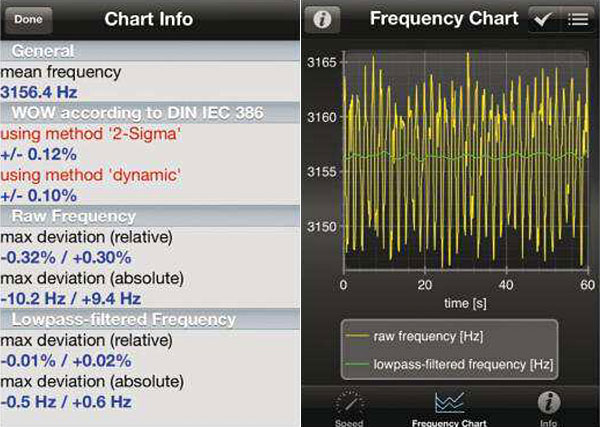
I used Dr. Feickert Analogue's PlatterSpeed app, running on an old iPhone 4, to measure the RP10's accuracy and consistency. The results were superb: The PlatterSpeed test record's 3150Hz tone measured 3154.4Hz—too fast by only 4.4Hz—while the 2-Sigma wow was ±0.12% and dynamic wow was ±0.10%. All three measurements (figs.1 & 2) are among the most consistent and best I've measured, including of the direct-drive Technics SL-12000G.
Rega's RP10 turntable retails for $5495, or $6595 with Rega's Apheta 2 MC cartridge preinstalled In April 2014, when I reviewed the Rega RP8, the review sample came packaged with the original and wholly unique Apheta cartridge—Rega's first moving-coil (footnote 3). While the Apheta had some mighty enticing qualities, especially transparency and a rhythmic urgency that kept me up listening many long nights, it was just too in-my-face bright, even after a long period of break-in.
Perhaps, I thought then, the Apheta's brightness was related to its less-than-stellar build quality, which put the stylus rake angle (SRA) at around 85°. It seemed to me that if you're going to supply a cartridge with a turntable whose tonearm can't be adjusted for SRA, that cartridge's SRA should at least be close to 92°. So I reviewed the RP8 using other, more familiar cartridges.
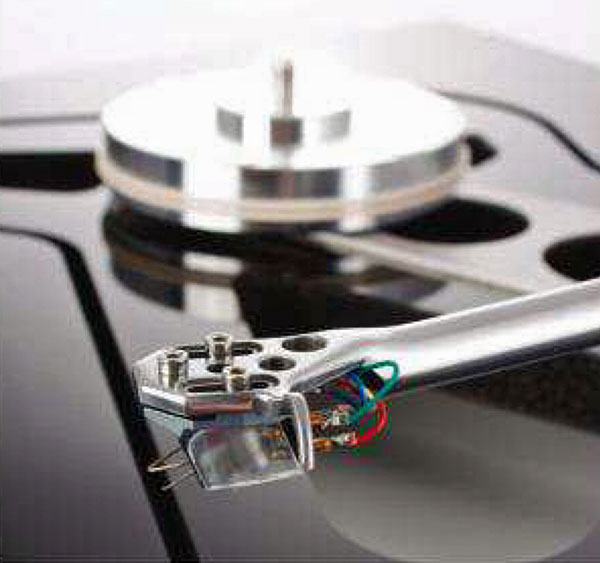
That said, Rega surprised me by factory-fitting my RP10 review sample with their new flagship cartridge, the Aphelion ($4995). Like the Apheta 2, the Aphelion retains the original Apheta's unique suspension, which dispensed with tie wires and foam dampers—but here, according to Rega, virtually every aspect of the cartridge's design has been taken to the next level of fine-tuning. Also as in the Apheta 2, the Aphelion's motor is a good bit smaller than the original Apheta's and much lower in mass, and the iron-cross armature on which the copper-wire coils are hand-wound is 50% lighter than the Apheta's. This alone should provide greater resolution of detail.
The Aphelion is supplied with a boron cantilever—instead of the Apheta's and Apheta 2's aluminum—held in place by a high-tech elastomer grommet, fitted into an opening on the cartridge's front plate. Attached to the cantilever's business end is a Vital stylus. The Aphelion's powerful, focused neodymium magnet produces a nominal output of 0.35mV. Other specs include an internal impedance of 10 ohms and at least 29dB of channel separation. Rega recommends loading the Aphelion with 100 ohms, and suggests a vertical tracking force (VTF) range of 1.75–2.0gm.
Setup and Use
To play in Rega's sandbox, you have to accept that you're not in control of azimuth: the cartridge designer is. Ditto SRA. Rega will say that neither is as important as the tonearm's rigidity, which would be compromised were user adjustment of such parameters made possible. I measured the Aphelion's SRA, and it was very close to the ideal of 92°. The Aphelion came preinstalled on the RB2000 using Rega's three-bolt mount, which establishes a Stevenson-like alignment that puts the inner tracking-angle null point closer to the record label than does either the Baerwald or the Lofgren geometry. While this reduces the horizontal tracking error (HTE) closer to the inner groove area, it increases HTE across most of the rest of the record's playing area. The Stevenson alignment is more useful if you mostly play older records, which tended to be cut closer to the label than are newer ones. I'm not a fan of the Stevenson alignment even with older LPs, but in this case I figured I'd go Rega's way. That meant leveling the RP10's plinth using the feet of either the outer frame (if using the dustcover), or of the plinth that supports the arm and platter, then placing the press-fit tungsten counterweight on the arm's rear stub and, with the spring-coil VTF adjuster set to "0," balancing the arm to float horizontal to the record surface, then applying the VTF using the integral gauge. It got me close, but I prefer using an external digital scale.
 I ended up with the Aphelion's VTF set to 1.85gm, then I set the RB2000's magnetic-repulsion antiskating to the appropriate amount of force. Done.
Even a novice can easily set up this high-performance turntable. I felt duty bound to first listen using the supplied record mat of white wool, but it quickly reminded me why I'm no fan: Not only did Rega's mat collect dust; when I lifted off a record, the mat clung to the record's underside. I ended up using Funk Firm's 3mm-thick Achromat, which improved the sound without appreciably changing the SRA.
Sound
I ended up with the Aphelion's VTF set to 1.85gm, then I set the RB2000's magnetic-repulsion antiskating to the appropriate amount of force. Done.
Even a novice can easily set up this high-performance turntable. I felt duty bound to first listen using the supplied record mat of white wool, but it quickly reminded me why I'm no fan: Not only did Rega's mat collect dust; when I lifted off a record, the mat clung to the record's underside. I ended up using Funk Firm's 3mm-thick Achromat, which improved the sound without appreciably changing the SRA.
Sound
I let the Aphelion cartridge break in with about 40 hours of silent play before I began my listening: first with Rega's own Aria phono preamplifier, then CiAudio's PEQ-1 Mk.II). Finally I moved the 'table into the main listening room so that the RB2000 arm's high-quality, low-capacitance, German-made cable could reach the CH Precision P1 current-amplification phono equalizer.
I first played, straight through, all three LPs of Cécile McLorin Salvant's Dreams and Daggers (Mack Avenue MAC 1120LP), recorded you-are-there live at the Village Vanguard. Even with a cartridge unfamiliar to me, the RP10 clearly produced ultralow levels of coloration, especially in the lower midbass, where many turntables add a cushiony warmth that some find attractive but that, to me, is an annoyance that detracts from every important characteristic of low- and midbass sound.
The transparency of the RP10-RB2000-Aphelion as they played these LPs was remarkable—more what I expect to hear from record players costing far more. The sound was fast, nimble, and as exciting as "live" on record gets. You don't want even a tiny bit of sludge added to Salvant's effervescent voice, and the Rega rig completely avoided doing so. But it was a bit more forward and bright than I'd become used to—or, as a dealer recently described to me another turntable-tonearm-cartridge combo, "not enough flesh and too much bone."
Nonetheless, Salvant's voice floated convincingly in space, as free as it was rock-solid, behind the trio of pianist Aaron Diehl, double bassist Paul Sikivie, and drummer Lawrence Leathers. Sikivie's bass was well articulated, reasonably well fleshed out harmonically, and exhibited the nimble, precise attacks, natural sustain, and believable decays that, in my experience, only the best-tuned turntables can manage.
Within a few hours of listening, it was clear to me that the Rega RP10 competes with turntables costing well into five figures, especially in terms of detail retrieval, low coloration, and total lack of mechanical artifacts. The RB2000 tonearm alone sounded as if it could cost close to the RP10's admission price, so surely did it track, so free was its sound of colorations and resonances. Depending on the cartridge used, the bottom end reproduced by this arm was exemplary, and was audible only when those frequencies were actually stamped in the groove.
With the Aphelion, however, the RP10-RB2000's overall tonal balance was consistently forward, and somewhat bright in the upper midrange, reminding me of how my system sounded with a full set of Nordost Valhalla 2 cables: fast, articulate, and exciting, but lean on the bottom—and I couldn't turn up the volume because of the wide bubble of in-my-face brightness.
The sound of this combo worked incredibly well with Trouble No More: The Bootleg Series Vol.13/1979–1981, a compilation of previously unreleased live performances from Bob Dylan's gospel period (4 LPs + 2 CDs, Columbia/Legacy 88985454661). The Rega's speed, articulation, and imaging solidity, combined with its forward but not etchy tonal balance, produced a sensation of "live" that made me feel I was sitting in the audience. I played through all four LPs with great pleasure.
But when I returned to more familiar records, such as an excellent reissue of Joni Mitchell's Blue (Reprise/Rhino MS 2038), her dulcimer and James Taylor's guitar in "All I Want," while breathtakingly well-articulated and precisely rendered, lacked the familiar warmth that should be produced by those resonating bodies, Mitchell's included.
That's not to suggest that the Aphelion-RP10 combo sounded at all etchy, harsh, or grainy. I'm preparing a review of the vinyl edition of Sasha Matson's Tight Lines (Stereophile STPH022-1), produced by John Atkinson and recorded in Frank Sinatra's old EastWest studios by Michael C. Ross, with digital mastering and postproduction by John Atkinson and Mike Marciano, and vinyl mastering by Joe Harley and Kevin Gray. The music was digitally recorded at 32-bit/96kHz, then transferred to analog tape to cut this sensational-sounding LP. The string tones of this pickup chamber orchestra are "ear delicious" (thank you, Neil Sedaka).
Through the Aphelion, the strings were somewhat spotlit but not at all thin and bright, though lushness and suppleness were in short supply. In my system and for my tastes, this combo was seat-of-the-pants exciting, but too lean, too fast, just plain too much. It was time to try other cartridges.
I first chose Lyra's Helikon SL ($3995, discontinued), which is known for sounding less than fleshy and harmonically rich. But it transformed the Rega rig's sound. I began to realize that the RP10 is, essentially, a neutral carrier. Added to the sounds of all four albums mentioned was now a pleasing dose of flesh.
So I went all out and installed Grado Labs' Epoch ($12,000, footnote 4). This cartridge transformed the RP10's sound, with no surprises. This was as it should be. A turntable and tonearm should add the least—preferably nothing—to the sonic picture, letting the choice of cartridge do the talking.
Conclusions
No doubt about it—the RP10 is Rega Research's best turntable to date. More than that, in every way it's up there with the best I've reviewed, and better than many turntables costing more. You have to be willing to let go of the adjustability offered by other designs and let your ears lead the way. And you can always use record mats to lower the SRA, or washers to raise it. (I recommend Acoustic Signature's washers; they're easy to use, and don't require that you uninstall the tonearm.)
The RP10 and RB2000 do everything well, nothing badly, and let the cartridge do the talking. And you might even like the RP10-RB2000-Aphelion combo, especially through Rega's warmish-sounding Aria phono preamp.
Put the RP10 in the biggest rigs and you won't lack for detail retrieval, bottom-end extension and control, dead-"black" backgrounds, impressive dynamics, image stability, and transparency. Spending a lot more can get you more quality of sound—but if you're not careful, it might get you a great deal less.
Footnote 3: Read Art Dudley's instructive review of the Rega Apheta in the December 2006 issue. Footnote 4: I reviewed the Grado Epoch in the December 2017 "Analog Corner."
Rega RP10, speed stability data (left). Rega RP10, speed stability (raw frequency yellow; low-pass filtered frequency green).
Rega Research Aphelion moving-coil cartridgeRega's RP10 turntable retails for $5495, or $6595 with Rega's Apheta 2 MC cartridge preinstalled In April 2014, when I reviewed the Rega RP8, the review sample came packaged with the original and wholly unique Apheta cartridge—Rega's first moving-coil (footnote 3). While the Apheta had some mighty enticing qualities, especially transparency and a rhythmic urgency that kept me up listening many long nights, it was just too in-my-face bright, even after a long period of break-in.
To play in Rega's sandbox, you have to accept that you're not in control of azimuth: the cartridge designer is. Ditto SRA. Rega will say that neither is as important as the tonearm's rigidity, which would be compromised were user adjustment of such parameters made possible. I measured the Aphelion's SRA, and it was very close to the ideal of 92°. The Aphelion came preinstalled on the RB2000 using Rega's three-bolt mount, which establishes a Stevenson-like alignment that puts the inner tracking-angle null point closer to the record label than does either the Baerwald or the Lofgren geometry. While this reduces the horizontal tracking error (HTE) closer to the inner groove area, it increases HTE across most of the rest of the record's playing area. The Stevenson alignment is more useful if you mostly play older records, which tended to be cut closer to the label than are newer ones. I'm not a fan of the Stevenson alignment even with older LPs, but in this case I figured I'd go Rega's way. That meant leveling the RP10's plinth using the feet of either the outer frame (if using the dustcover), or of the plinth that supports the arm and platter, then placing the press-fit tungsten counterweight on the arm's rear stub and, with the spring-coil VTF adjuster set to "0," balancing the arm to float horizontal to the record surface, then applying the VTF using the integral gauge. It got me close, but I prefer using an external digital scale.
I ended up with the Aphelion's VTF set to 1.85gm, then I set the RB2000's magnetic-repulsion antiskating to the appropriate amount of force. Done.
Even a novice can easily set up this high-performance turntable. I felt duty bound to first listen using the supplied record mat of white wool, but it quickly reminded me why I'm no fan: Not only did Rega's mat collect dust; when I lifted off a record, the mat clung to the record's underside. I ended up using Funk Firm's 3mm-thick Achromat, which improved the sound without appreciably changing the SRA.
SoundI let the Aphelion cartridge break in with about 40 hours of silent play before I began my listening: first with Rega's own Aria phono preamplifier, then CiAudio's PEQ-1 Mk.II). Finally I moved the 'table into the main listening room so that the RB2000 arm's high-quality, low-capacitance, German-made cable could reach the CH Precision P1 current-amplification phono equalizer.
No doubt about it—the RP10 is Rega Research's best turntable to date. More than that, in every way it's up there with the best I've reviewed, and better than many turntables costing more. You have to be willing to let go of the adjustability offered by other designs and let your ears lead the way. And you can always use record mats to lower the SRA, or washers to raise it. (I recommend Acoustic Signature's washers; they're easy to use, and don't require that you uninstall the tonearm.)
Footnote 3: Read Art Dudley's instructive review of the Rega Apheta in the December 2006 issue. Footnote 4: I reviewed the Grado Epoch in the December 2017 "Analog Corner."