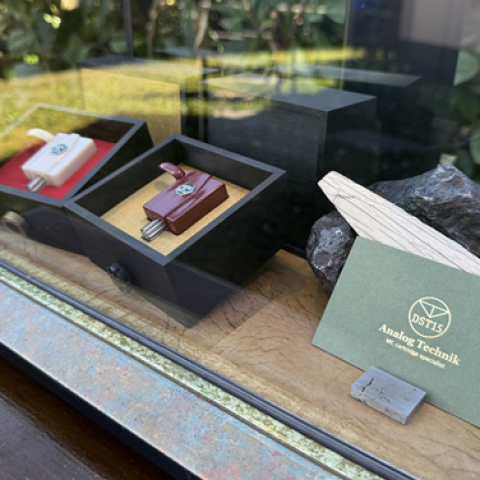
Kuzma specifies the parts—coils, wire, stylus, cantilever—and the OEM builds them. then Kuzma machines, from anodized aluminum, the various generator housings, topping each with a brass coupling plate. Currently, Kuzma's line comprises six models, ranging from the CAR-20 to the CAR-60 (footnote 3). Yes, for comedy albums he should build a special CAR-54, but I bet Franc will read that and have no idea what that means or who are Toody and Muldoon (maybe you don't either!).
With the exception of the high-output CAR-20H, all Kuzma cartridges share very similar specifications, though their component materials differ. All are moving-coil designs. The entry-level CAR-20 ($1695) features standard copper-wire coils and an aluminum cantilever, to which is fitted an elliptical stylus. The materials get more exotic as you ascend the line.
Kuzma sent me samples of their former and present flagship models, the CAR-50 ($5895) and CAR-60 ($12,995). The CAR-50 has coils of 4N silver (99.99% pure), and a MicroRidge stylus fitted to a sapphire cantilever. The CAR-60 has a diamond cantilever but otherwise shares the CAR-50's specifications. The frequency range is 10Hz–45kHz; vinyl theoretically can go that high but usually doesn't, because soft filtering is usually applied above 15kHz to protect the cutter head's coils. The output is 0.3mV. Other specs include a channel balance at 1kHz of less than 1dB, channel separation of more than 30dB, and compliance of 10×10–6cm/dyne. All of Kuzma's new cartridges seem to share the same body, which contributes to an usually high total weight of 17gm (more about that shortly). Basically, you're paying more than twice as much to get the diamond cantilever and associated components.
All cartridges in the CAR line are specced to track at 2.0gm with "trackability" of greater than 70µm—except the CAR-20H, whose trackability is cited as >60µm. Despite the low internal impedance of 6 ohms, Kuzma, unusually, suggests a loading in excess of 100 ohms.
Kuzma's pivoted tonearms, including the Stogi and the 4Point (the latter now available in 9", 11", and 14" versions), have comfortably high effective masses of 11 to 14gm, and are all exceptionally rigid designs. Despite the cartridges' unusually high mass, Kuzma's CARs and 4Points were, unsurprisingly, matches made in audio heaven, the resultant resonant frequencies falling comfortably in the preferred range of 8–12Hz. The Hi-Fi News & Record Review Test Record (LP, Hi-Fi News HFN 001) confirmed the result.
Every Kuzma cartridge has three pairs of tapped and threaded mounting holes, to ensure compatibility with just about every tonearm made, at least in terms of overhang. The 17gm mass means you might need to hang your counterweight at the far end of the arm's stub, and/or use an extra weight.
The Kuzma 4Point's counterweight system, which lets you add multiple counterweights to essentially form a single massive counterweight, with final fine-tuning via a small, independently adjustable, secondary counterweight, proved an ideal mate for the CARs. Franc Kuzma has even machined a hefty stylus guard of anodized aluminum that locks in place with two small machine screws. The problem is, if you rely on a stylus guard to protect your cartridge from the cat or the house cleaner, this one is hardly practical.
The sounds produced by the two CARs I listened to were more similar than different, despite the CAR-60's price being more than twice the CAR-50's. Both were real smoothies, and coherent from top to bottom within that smoothness and wholeness. But they sounded smooth without ever sounding soft—smooth like skating on ice.
The visual perspective was on the distant side, with small, finely drawn, delicate images. Transients were super-clean on top, delicately drawn on bottom. Delicacy trumped muscularity in every item on my sonic checklist.
While the aural picture was 100% free of etch, edge, and grain, the prevailing smoothness prevented percussive transients on top and bottom from developing excitement-generating bite and textural grip. This translated into a somewhat bland, inoffensive, hardly compelling sound from the CAR-50, though its excellent measured channel separation delivered a wide soundstage—wider than the Lyra Atlas SL's—and its nimble tracking produced no unpleasant mechanical artifacts. If Lyra cartridges sound too analytical for you, maybe you should head for a Kuzma CAR-50 or -60.
As I've said, listening to the CARs was like pleasantly gliding along on smooth ice. The CAR-50 never offended, while delivering overall transparency, impressively neutral tonal balance, and wide bandwidth—but it also didn't carve out images in space, or present much in the way of visceral immediacy or dynamic slam. The bottom end was all there, but only in a very polite way—impacts developed slowly, as if heard from a distance. The CAR-50 is designed more to give you a coherent, "whole" experience rather than indulge in any of the high-performance checklist attributes today's best cartridges are capable of delivering.
Whenever I review a new cartridge, I like to play some totally unfamiliar recordings—and recently, on vacation in Maui, I found a copy of Loudon Wainwright III's I'm Alright, produced in 1985 by Wainwright and Richard Thompson, and recorded at Olympic Studios in London (Rounder 3096). I figured it would be musically worth the $2 I paid for it, and would probably sound good, too. Correct on both counts! It's not Wainwright's best, but there are some great moments, like the acidic "How Old Are You?," and a few clunkers, such as "Not John," about the assassination of John Lennon.
Through the CAR-50, Wainwright's voice on "How Old Are You?" was well presented at center stage with great transparency, though it sounded as if the mixer had applied too much reverb, which somewhat softened transient attack and reduced image solidity. But . . . compared to what? So I played the track again, this time with the Transfiguration Proteus D cartridge (footnote 4) mounted in the Swedish Analog Technologies tonearm, which produced far greater image solidity and body for both Wainwright's voice and his acoustic guitar, and, in the mix, separated the reverb element from the direct vocal and guitar.
Normally, I'd cite more examples to back up my conclusions, but to save space: I think that, at $5895, the CAR-50 can't compete—in speed, detail, imaging, or, especially, dynamic slam—with either the Ortofon A95 ($6500) or the Transfiguration Proteus ($6000), both of which excel at detail retrieval, transient speed, and, especially, dynamic wallop, as well as produce sharper high-frequency transients, and more air and detail.
If I had to describe the CAR-50's sound in one word, it would be bland. Over the long haul, bland might be preferable to a cartridge whose stronger personality might at some point become overbearing. If you find Lyra cartridges too analytical and Koetsu's wood-bodied cartridges too stuffy, the CAR-50 might be for you.
When I compared Kuzma's CAR-50 with Transfiguration's Proteus D using Steppenwolf's "Born to Be Wild," from Analogue Productions' slammin' reissue of the group's eponymous debut album (MCA/APP 50029), the difference in favor of the Proteus D was startling in terms of dynamics, image solidity, bass punch, and every other performance parameter other than soundstage width, where the CAR-50 was equally good.
The difference in price, too, is great. The only fair thing to do was to compare the diamond-cantilevered CAR-60 ($12,995) with the diamond-cantilevered Proteus D ($10,500).
Kuzma CAR-60 vs Transfiguration Proteus D
Overall, the CAR-60 was more similar to the CAR-50 than it was different, clarifying and solidifying all of the CAR-50's strengths while ameliorating some of its weaknesses. Like the CAR-50, the CAR-60 produced a spectacularly wide and appropriately deep if distant soundstage, and met its spec of 30dB channel separation. It upped the CAR-50's already impressive transparency and produced faster, cleaner high-frequency transients, while retaining the CAR-50's gliding smoothness.
Recording engineer Jim Anderson had kindly sent me a recording he'd recently recorded and mixed: Brahms's Symphony 2, with violinist Thomas Zehetmair conducting the Stavanger Symphony Orchestra, recorded in the Stavanger Concert Hall of Stavanger, Norway (SSO Recordings 3816-1). This lovely recording sets up an intensely well-focused, supremely stable, three-dimensional orchestral picture.
During the first playing, I thought, This recording was made for the CAR-60 in the same way the CAR-60 was made for the Kuzma 4Point arm. This LP played to all of the cartridge's strengths: transparency, liquidity, freedom from additive artifacts, and a wide, deep soundstage. The entire sound was deeply satisfying, and, as with the Wainwright recording, I had no reference for it because I'd never heard it before. I imagined a somewhat dry hall.
But when I switched to the Proteus D, orchestral colors were more fully developed, the individual sections of the orchestra were more clearly "visible" and separated in space, and the textures had greater vibrancy, especially the pizzicato counterpoint and the interplay of the various woodwinds. It was like listening to a different recording. I also heard more reverb, though the hall still sounded relatively dry. Some might listen to both cartridges and find the CAR-60's sound more in line with what you'd hear sitting in the hall, and the Proteus D's sound more analytical and hi-fi, but that wouldn't be me.
Next I played, for the first time in years, "Bargain," from a 2005 reissue of the Who's Who's Next (Decca/Classic DL79182). It was astonishing through the Proteus D. John Entwistle's bass thundered, Keith Moon's tom smacks slammed me back in my chair—even the tambourine was a "wow"—and I'd never heard the handclaps in such relief, or so much reverb "wetness" bathing Roger Daltrey's voice. The Proteus D is the Proteus on steroids.
Admittedly, much in my system had changed since I'd last played that edition of Who's Next—especially the addition of the CH Precision P1 phono preamplifier, which has dynamics to beat anything else I've heard. But when I played "Bargain" again, this time with the CAR-60, it became clear that the Kuzma lacked the slam or bass grip or low-end extension to do rock'n'roll justice—unless you prefer a distant balcony seat.
I haven't yet heard all of Kuzma's CAR models, but I'd wager that the real bargains are at the lower end of the line, and that, as you pay more, the improvements come only in small increments (footnote 5).
Footnote 3: Kuzma Ltd., Hotemaze 17/a, SI-4205 Preddvor, Slovenia. Tel: (386) 4-253-54-50. Fax: (386) 4-253-54-54. Web: kuzma.si. US distributor: Elite Audio Video Distribution, PO Box 93896, Los Angeles, CA 90093-0896. Tel: (323) 466-9694 x22. Fax: (323) 466-9825. Web: eliteavdist.com. Footnote 4: Read my review of the original Transfiguration Proteus in the October 2014 issue. The Proteus D is identical to the Proteus, aside from special dampers designed for the D's diamond cantilever. Footnote 5: MF returned to the Kuzma CAR cartridges in his April 2018 column.—Ed.
Overall, the CAR-60 was more similar to the CAR-50 than it was different, clarifying and solidifying all of the CAR-50's strengths while ameliorating some of its weaknesses. Like the CAR-50, the CAR-60 produced a spectacularly wide and appropriately deep if distant soundstage, and met its spec of 30dB channel separation. It upped the CAR-50's already impressive transparency and produced faster, cleaner high-frequency transients, while retaining the CAR-50's gliding smoothness.
Footnote 3: Kuzma Ltd., Hotemaze 17/a, SI-4205 Preddvor, Slovenia. Tel: (386) 4-253-54-50. Fax: (386) 4-253-54-54. Web: kuzma.si. US distributor: Elite Audio Video Distribution, PO Box 93896, Los Angeles, CA 90093-0896. Tel: (323) 466-9694 x22. Fax: (323) 466-9825. Web: eliteavdist.com. Footnote 4: Read my review of the original Transfiguration Proteus in the October 2014 issue. The Proteus D is identical to the Proteus, aside from special dampers designed for the D's diamond cantilever. Footnote 5: MF returned to the Kuzma CAR cartridges in his April 2018 column.—Ed.