The Kuzma 4Point 9 ($3995, footnote 3) is indeed 9" long, with an effective length of 229mm: 212mm from pivot to spindle, plus 17mm of overhang. The headshell's offset angle is 23°, while the arm's effective mass is specified as 13gm. Its total mass is 920gm—which, because it doesn't include the "tower" housing the 11" 4Point's mechanism for adjusting a cartridge's vertical tracking angle (VTA), is less than half that arm's mass of 2050gm. This makes the 4Point 9 more compatible with spring-suspended turntables like the Linn Sondek LP12.
Nonetheless, VTA and stylus rake angle (SRA) are easily adjustable on the 4Point 9, thanks to an arrangement similar to those on SME tonearms: a slender, barely visible, threaded shaft that can be screwed down through the arm's support structure to contact the base plate of the arm mount, below. Once that's done, you loosen the grub screws that lock the arm pillar in place. Then, by screwing the threaded shaft up or down, you can smoothly raise or lower the arm to adjust SRA and VTA.
The 4Point's unique bearing system, as used in the 9, is the same as in the longer 4Points (please read my September 2011 review for more details), as is the system for adjusting azimuth. A worm gear, unlocked by loosening a pair of grub screws, is used to smoothly rotate the tapered armtube, which is split about 1" from the horizontal pivot tower. Also as in the other 4Points, the 9's removable headshell features a securely locking hex-head shaft that fits into the armtube, with the four wires and cartridge clips (Crystal Cable silver/gold) emerging from under the arm, so there's no break in the wire from clips to RCA plugs.
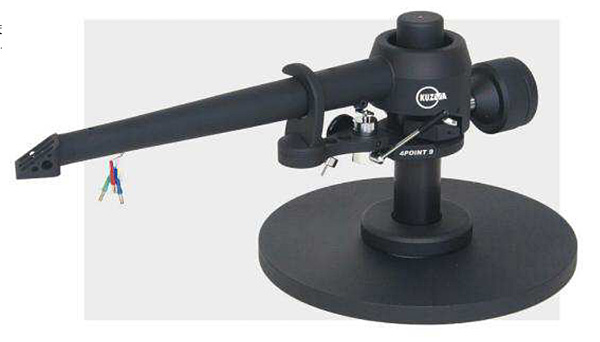 There's a single threaded counterweight shaft in place of the dual-shaft system of the longer, more expensive 4Point tonearms, but overall, the 4Point 9 is more similar to than different from the longer arms. One difference is a new, circular arm rest that doesn't hold the arm in place; if you bump the arm, it can more easily fly across the platter or record. No big deal—just be careful! Another difference is the lack of silicone damping, which is more of an issue with the 4Points than with some other arms.
Ideally, a tonearm should be neutrally balanced. That occurs when, because of the distribution of mass, the pivot point and the arm's center of gravity are in the same plane. When they are, raising or lowering the arm doesn't produce an opposing inertial force, which is important as the groove is pulled past the stylus, which must trace its ups and downs. Most gimbaled-bearing arms are neutrally balanced.
Unipivot arms, which achieve stability by putting the mass well below the pivot point, are stably balanced. That's good for laboratory scales, but not for tonearms: Vertically displace the stable-balance arm from its preferred resting position on the record surface (or below, if it could get there!) and it immediately produces an opposing force as it attempts to return to that position.
That's why, when setting the vertical tracking force (VTF) on a stable-balance arm, it's important to measure the VTF as close to the record surface as possible. The farther above the record surface it's measured, the greater will be the actual VTF at the record surface, because the arm produces a greater downforce to return to its preferred resting position.
Because the 4Point's two vertical bearing points and the cups they pivot in are well below the arm and thus its mass, the arm's center of gravity is above the vertical pivot point—the opposite of stable balance. This produces what's called negative balance, in which the VTF decreases as the arm is raised from the record surface. Clearly, tonearms that are stably/negatively balanced will have a harder time tracking warped records than neutrally balanced arms. It can be argued that even the tracking of flat records is negatively affected, but my experience with the original 11" 4Point indicated that is a nonissue. Then again, my platter has vacuum hold-down, and the longer 4Points have both horizontal and vertical damping troughs—the 4Point 9 has none. Of course, shorter arms have the advantage of lower moments of inertia.
For the 4Point 9's price of $3995, you get a tonearm that includes all of the longer 4Points' adjustability, and a smoother, cosmetically improved finish that will, over time, be used on all 4Points. I'll skip the installation and setup, which are similar but not identical to that of the longer 4Points, and get right to the performance.
Experience has convinced me that whatever advantages longer tonearms offer in terms of lower lateral tracking error (LTE) are more than offset by their disadvantages, which include problems related to arm rigidity, magnified errors in setup, and poorer dynamic performance in the groove, the latter related to moment of inertia where the rubber meets the road. This is especially true if you don't have a vacuum hold-down platter but nonetheless play warped LPs that cause the arm to move in unintended ways. Longer arms have more trouble tracking records with off-center holes. Using their finger lifts, you can raise tonearms of various lengths and feel the increasing awkwardness of motion the farther your finger is from the pivot. It's especially revealing if the arms are identical in every way but length, as with the 9", 11", and 14" Kuzma 4Points.
The first cartridge I tried with the Kuzma 4Point 9 was Lyra's Atlas SL mono ($12,995), a special-order "true mono" Atlas with a low output (0.24mV). Its tonal neutrality and, especially, its transparency are truly exceptional. The Atlas SL mono's coil former is a permeable square plate oriented parallel/vertical to the record surface (rather than at 45°/45°), and the coils are wound to generate a signal when the stylus/cantilever moves horizontally. There are two electrically separate monaural coils, one atop the other, which is especially useful in stereo systems to avoid the ground loops and hum that often result when a single-coil design is plugged into a two-channel preamp. In short, the Atlas SL mono sends identical signals to the preamp's two channels. Lyra says you can play stereo records using the Atlas mono, but of course you won't hear stereo.
I listened to a number of recordings, to ascertain the 4Point 9's reproduction of bass and its lower-midrange clarity, and its ability to track the groove—although, of course, a mono groove, which is modulated in only the lateral plane, is far more easy for a stylus to track than a stereo groove, which is modulated in both the lateral and vertical planes.
There's a single threaded counterweight shaft in place of the dual-shaft system of the longer, more expensive 4Point tonearms, but overall, the 4Point 9 is more similar to than different from the longer arms. One difference is a new, circular arm rest that doesn't hold the arm in place; if you bump the arm, it can more easily fly across the platter or record. No big deal—just be careful! Another difference is the lack of silicone damping, which is more of an issue with the 4Points than with some other arms.
Ideally, a tonearm should be neutrally balanced. That occurs when, because of the distribution of mass, the pivot point and the arm's center of gravity are in the same plane. When they are, raising or lowering the arm doesn't produce an opposing inertial force, which is important as the groove is pulled past the stylus, which must trace its ups and downs. Most gimbaled-bearing arms are neutrally balanced.
Unipivot arms, which achieve stability by putting the mass well below the pivot point, are stably balanced. That's good for laboratory scales, but not for tonearms: Vertically displace the stable-balance arm from its preferred resting position on the record surface (or below, if it could get there!) and it immediately produces an opposing force as it attempts to return to that position.
That's why, when setting the vertical tracking force (VTF) on a stable-balance arm, it's important to measure the VTF as close to the record surface as possible. The farther above the record surface it's measured, the greater will be the actual VTF at the record surface, because the arm produces a greater downforce to return to its preferred resting position.
Because the 4Point's two vertical bearing points and the cups they pivot in are well below the arm and thus its mass, the arm's center of gravity is above the vertical pivot point—the opposite of stable balance. This produces what's called negative balance, in which the VTF decreases as the arm is raised from the record surface. Clearly, tonearms that are stably/negatively balanced will have a harder time tracking warped records than neutrally balanced arms. It can be argued that even the tracking of flat records is negatively affected, but my experience with the original 11" 4Point indicated that is a nonissue. Then again, my platter has vacuum hold-down, and the longer 4Points have both horizontal and vertical damping troughs—the 4Point 9 has none. Of course, shorter arms have the advantage of lower moments of inertia.
For the 4Point 9's price of $3995, you get a tonearm that includes all of the longer 4Points' adjustability, and a smoother, cosmetically improved finish that will, over time, be used on all 4Points. I'll skip the installation and setup, which are similar but not identical to that of the longer 4Points, and get right to the performance.
Experience has convinced me that whatever advantages longer tonearms offer in terms of lower lateral tracking error (LTE) are more than offset by their disadvantages, which include problems related to arm rigidity, magnified errors in setup, and poorer dynamic performance in the groove, the latter related to moment of inertia where the rubber meets the road. This is especially true if you don't have a vacuum hold-down platter but nonetheless play warped LPs that cause the arm to move in unintended ways. Longer arms have more trouble tracking records with off-center holes. Using their finger lifts, you can raise tonearms of various lengths and feel the increasing awkwardness of motion the farther your finger is from the pivot. It's especially revealing if the arms are identical in every way but length, as with the 9", 11", and 14" Kuzma 4Points.
The first cartridge I tried with the Kuzma 4Point 9 was Lyra's Atlas SL mono ($12,995), a special-order "true mono" Atlas with a low output (0.24mV). Its tonal neutrality and, especially, its transparency are truly exceptional. The Atlas SL mono's coil former is a permeable square plate oriented parallel/vertical to the record surface (rather than at 45°/45°), and the coils are wound to generate a signal when the stylus/cantilever moves horizontally. There are two electrically separate monaural coils, one atop the other, which is especially useful in stereo systems to avoid the ground loops and hum that often result when a single-coil design is plugged into a two-channel preamp. In short, the Atlas SL mono sends identical signals to the preamp's two channels. Lyra says you can play stereo records using the Atlas mono, but of course you won't hear stereo.
I listened to a number of recordings, to ascertain the 4Point 9's reproduction of bass and its lower-midrange clarity, and its ability to track the groove—although, of course, a mono groove, which is modulated in only the lateral plane, is far more easy for a stylus to track than a stereo groove, which is modulated in both the lateral and vertical planes.
 I began with Duke Ellington's Masterpieces by Ellington (2 45rpm LPs, Columbia Masterworks ML 4118/Analogue Productions AAPJ 4418-45), then moved on to an original mono pressing of Miles Davis's Kind of Blue (Columbia CL 1355). After that came cellist János Starker, with Walter Susskind and the Philharmonia Orchestra, in Dvorák's Cello Concerto and Fauré's Elégie for Cello and Orchestra (French Columbia FCX 725). I followed those with some 10" reissue gems from the Electric Recording Company: pieces by J.S. Bach performed by pianist Yvonne Lefébure (Pathé Marconi/EMI FBLP 1079/ERC011); and two discs of Chopin recorded by pianist Yura Guller in 1956: Mazurkas Favorites (Ducretet/EMI 255 C039/ERC035) and Nocturnes Favoris (Ducretet/EMI 255 C040/ERC036) (originals of these rarely go for under $1000). For a chaser, I played a mono reissue of Bob Dylan's John Wesley Harding (2 45rpm LPs, Columbia/Mobile Fidelity Sound Lab MFSL 2-464).
I have an original mono pressing of JWH, as well as Columbia/Legacy's superb boxed set of mono reissues of this and other Dylan classics—but when I played the MoFi, my mind boggled as I heard details I'd never heard before. Dylan pops more than few p's on this album, and Charlie McCoy's bass can sound oddly blobby. MoFi's reissue hides nothing, giving you all of it. The 4Point didn't manage the weight and power of the Swedish Analog Technologies tonearm—no arm I've heard does—but it reproduced everything cleanly, with excellent recovery time and, especially, midbass clarity free from any overhang or warmth that's not on the record.
I could make a case for preferring the 4Point 9 to the 11" 4Point. The 4Point 9 is somewhat faster and more responsive, and leaner on the bottom, though not by much. It's possible that some of the improved responsiveness is due to its lack of damping—but I'd still want to mate it with a turntable that has a record-clamping system, and it's probably not going to be the best tracker of warped records.
I think Franc Kuzma could improve the adjustability of VTA and SRA by silk-screening or etching numbers and rules on the 4Point 9's arm pillar. Otherwise, for $3995, the 4Point 9 offers performance very close to that of the basic version of the 11" 4Point, for $2600 less.
But at any length, the Kuzma 4Point is still one of my favorite tonearms—and now, at $3995 for the 4Point 9, it's more affordable than ever, and in a lighter weight that makes it more easily adaptable to a wider range of turntables, particularly those with spring suspensions.
I began with Duke Ellington's Masterpieces by Ellington (2 45rpm LPs, Columbia Masterworks ML 4118/Analogue Productions AAPJ 4418-45), then moved on to an original mono pressing of Miles Davis's Kind of Blue (Columbia CL 1355). After that came cellist János Starker, with Walter Susskind and the Philharmonia Orchestra, in Dvorák's Cello Concerto and Fauré's Elégie for Cello and Orchestra (French Columbia FCX 725). I followed those with some 10" reissue gems from the Electric Recording Company: pieces by J.S. Bach performed by pianist Yvonne Lefébure (Pathé Marconi/EMI FBLP 1079/ERC011); and two discs of Chopin recorded by pianist Yura Guller in 1956: Mazurkas Favorites (Ducretet/EMI 255 C039/ERC035) and Nocturnes Favoris (Ducretet/EMI 255 C040/ERC036) (originals of these rarely go for under $1000). For a chaser, I played a mono reissue of Bob Dylan's John Wesley Harding (2 45rpm LPs, Columbia/Mobile Fidelity Sound Lab MFSL 2-464).
I have an original mono pressing of JWH, as well as Columbia/Legacy's superb boxed set of mono reissues of this and other Dylan classics—but when I played the MoFi, my mind boggled as I heard details I'd never heard before. Dylan pops more than few p's on this album, and Charlie McCoy's bass can sound oddly blobby. MoFi's reissue hides nothing, giving you all of it. The 4Point didn't manage the weight and power of the Swedish Analog Technologies tonearm—no arm I've heard does—but it reproduced everything cleanly, with excellent recovery time and, especially, midbass clarity free from any overhang or warmth that's not on the record.
I could make a case for preferring the 4Point 9 to the 11" 4Point. The 4Point 9 is somewhat faster and more responsive, and leaner on the bottom, though not by much. It's possible that some of the improved responsiveness is due to its lack of damping—but I'd still want to mate it with a turntable that has a record-clamping system, and it's probably not going to be the best tracker of warped records.
I think Franc Kuzma could improve the adjustability of VTA and SRA by silk-screening or etching numbers and rules on the 4Point 9's arm pillar. Otherwise, for $3995, the 4Point 9 offers performance very close to that of the basic version of the 11" 4Point, for $2600 less.
But at any length, the Kuzma 4Point is still one of my favorite tonearms—and now, at $3995 for the 4Point 9, it's more affordable than ever, and in a lighter weight that makes it more easily adaptable to a wider range of turntables, particularly those with spring suspensions.
Footnote 3: Kuzma Ltd., Hotemaze 17/a, SI-4205 Preddvor, Slovenia. Tel: (386) 4-253-54-50. Fax: (386) 4-253-54-54. Web: www.kuzma.si. US distributor: Elite AV Distribution, 1027 N. Orange Avenue, Los Angeles, CA 90038. Tel: (323) 466-9694. www.eliteavdist.com
There's a single threaded counterweight shaft in place of the dual-shaft system of the longer, more expensive 4Point tonearms, but overall, the 4Point 9 is more similar to than different from the longer arms. One difference is a new, circular arm rest that doesn't hold the arm in place; if you bump the arm, it can more easily fly across the platter or record. No big deal—just be careful! Another difference is the lack of silicone damping, which is more of an issue with the 4Points than with some other arms.
Ideally, a tonearm should be neutrally balanced. That occurs when, because of the distribution of mass, the pivot point and the arm's center of gravity are in the same plane. When they are, raising or lowering the arm doesn't produce an opposing inertial force, which is important as the groove is pulled past the stylus, which must trace its ups and downs. Most gimbaled-bearing arms are neutrally balanced.
Unipivot arms, which achieve stability by putting the mass well below the pivot point, are stably balanced. That's good for laboratory scales, but not for tonearms: Vertically displace the stable-balance arm from its preferred resting position on the record surface (or below, if it could get there!) and it immediately produces an opposing force as it attempts to return to that position.
I began with Duke Ellington's Masterpieces by Ellington (2 45rpm LPs, Columbia Masterworks ML 4118/Analogue Productions AAPJ 4418-45), then moved on to an original mono pressing of Miles Davis's Kind of Blue (Columbia CL 1355). After that came cellist János Starker, with Walter Susskind and the Philharmonia Orchestra, in Dvorák's Cello Concerto and Fauré's Elégie for Cello and Orchestra (French Columbia FCX 725). I followed those with some 10" reissue gems from the Electric Recording Company: pieces by J.S. Bach performed by pianist Yvonne Lefébure (Pathé Marconi/EMI FBLP 1079/ERC011); and two discs of Chopin recorded by pianist Yura Guller in 1956: Mazurkas Favorites (Ducretet/EMI 255 C039/ERC035) and Nocturnes Favoris (Ducretet/EMI 255 C040/ERC036) (originals of these rarely go for under $1000). For a chaser, I played a mono reissue of Bob Dylan's John Wesley Harding (2 45rpm LPs, Columbia/Mobile Fidelity Sound Lab MFSL 2-464).
I have an original mono pressing of JWH, as well as Columbia/Legacy's superb boxed set of mono reissues of this and other Dylan classics—but when I played the MoFi, my mind boggled as I heard details I'd never heard before. Dylan pops more than few p's on this album, and Charlie McCoy's bass can sound oddly blobby. MoFi's reissue hides nothing, giving you all of it. The 4Point didn't manage the weight and power of the Swedish Analog Technologies tonearm—no arm I've heard does—but it reproduced everything cleanly, with excellent recovery time and, especially, midbass clarity free from any overhang or warmth that's not on the record.
I could make a case for preferring the 4Point 9 to the 11" 4Point. The 4Point 9 is somewhat faster and more responsive, and leaner on the bottom, though not by much. It's possible that some of the improved responsiveness is due to its lack of damping—but I'd still want to mate it with a turntable that has a record-clamping system, and it's probably not going to be the best tracker of warped records.
Footnote 3: Kuzma Ltd., Hotemaze 17/a, SI-4205 Preddvor, Slovenia. Tel: (386) 4-253-54-50. Fax: (386) 4-253-54-54. Web: www.kuzma.si. US distributor: Elite AV Distribution, 1027 N. Orange Avenue, Los Angeles, CA 90038. Tel: (323) 466-9694. www.eliteavdist.com