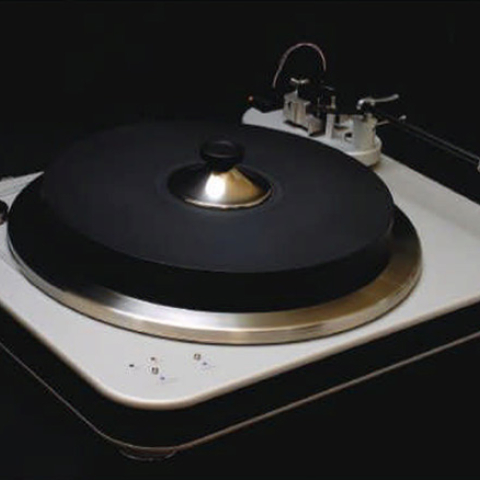
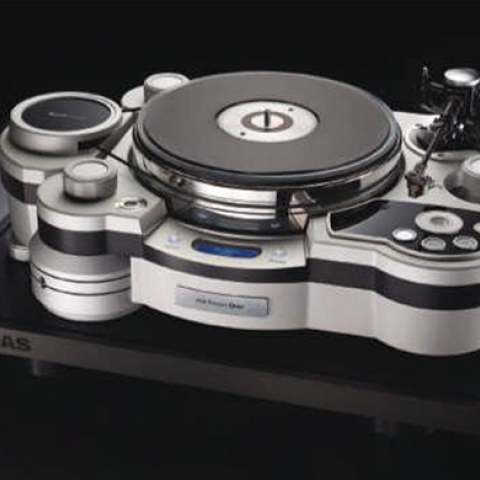
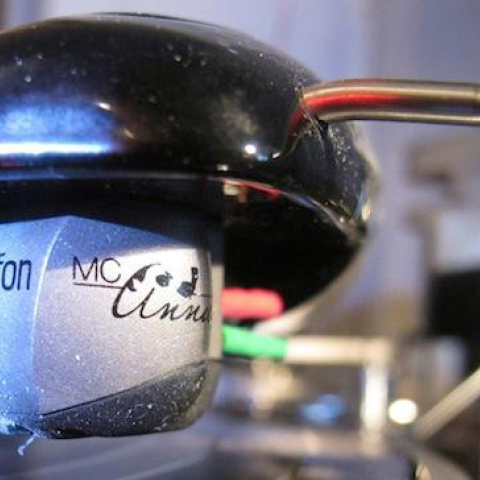
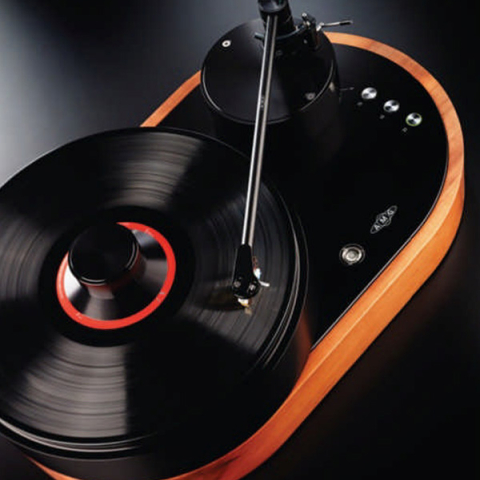
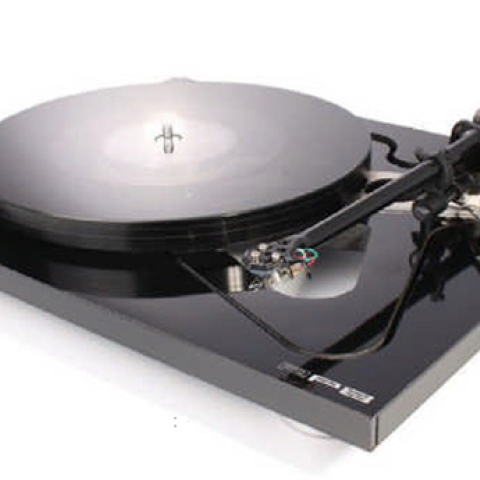
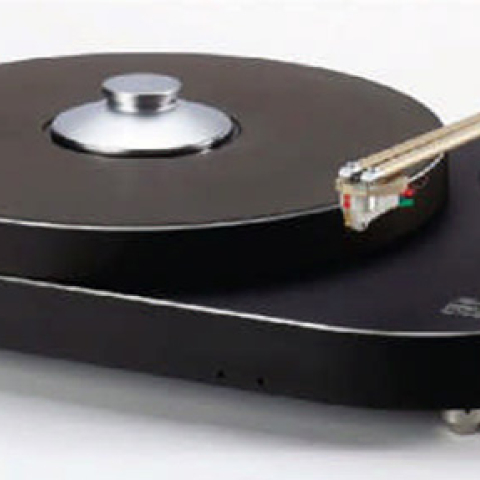
OMA's Jonathan Weiss hoisted the plinth, fitted with an armboard for a Schröder CB tonearm, atop my Harmonic Resolution Systems M3 isolation base. I set up the CB (the initials stand for captive bearing) arm, with which I'm well familiar—it's the same Thrax-built arm supplied with the Döhmann Helix 1 turntable—and installed an Ortofon MC Century cartridge. This particular Schröder CB was 11" long, with an armtube of carbon fiber instead of the more typical ebony, grenadilla, or cocobolo wood.
The Schröder CB arm costs $4500. Add the costs of the SP-10R and OMA plinth and you're listening to a package costing about $24,000. Add $465 for OMA's graphite mat, machined from high-grade, polycrystalline graphite, not the more usual amorphous carbon (graphite dust in resin).
Lower the stylus into the groove and perform a "tap test" with this combo and you'll know the meaning of dead. The OMA plinth was one super energy sink. Tapping the HRS base or the plinth itself only occasionally produced the faintest impulse through my speakers.
The Sound of Deep, Dark, and Luxurious: Having spun in the preceding weeks many dozens of LPs on the SP-10R–equipped SL-1000R, I had certain sonic expectations, few of which were met. The one that was met was that the SP-10R's solid grip on pitch and speed stability was limited only by each record's concentricity or eccentricity.
Beyond that, all else was different and far superior to the sound of the SL-1000R, especially the certainty and clarity of instrumental attacks and image three-dimensionality and stability, behind which were velvet-"black" backgrounds that I can describe only as serene—they rivaled, if not equaled, those of the Continuum Audio Labs Caliburn, which the SL-1000R had been incapable of producing. The overall sound was very similar to what I remember from my first, memorable listening session with the Caliburn 13 years ago, which immediately set it apart from every other turntable I'd ever owned or listened to.
Cradled in the highly damped energy sink that is OMA's SP10 plinth, the SP-10R produced speed-stability–based sonic serenity and intense excitement as music poured forth from the "blackest" backdrops.
How good was it? I don't mean to pick on the Ikeda 9Gss cartridge but with it installed in the SAT CF1-09 arm mounted on the Continuum Caliburn 'table, and the Ortofon MC Century in the Schröder CB arm on the Technics SP-10R with OMA plinth, the latter combo's sound was clearly superior—something both I and Jonathan Weiss heard, as became clear as soon as we switched between them and exclaimed about the improvement simultaneously.
Later, swapping cartridges between the two 'tables demonstrated that what we'd really been hearing was the MC Century's superior transparency, image specificity, precision of transient attacks, dynamic expression, and most other aspects of sound. The sounds of the 'tables themselves, with their respective tonearms, though not identical, were more similar than different. This let both cartridges fully reveal their strengths—and, in the case of the Ikeda 9Gss, its deficiencies relative to its competitors at the $10,000+ price point.
Next, I reinstalled the MC Century in the Schröder CB and the Lyra Atlas SL in the SAT, compared them, then swapped them back again. Yes, a lot of work! While the Lyra Atlas SL and Ortofon MC Century sound different, and the Schröder ($6500) isn't the sonic equal of the SAT CF1-09 ($48,000), the playing field was now more level.
I concluded that, were my reference front end to disappear, I could happily live with the Schröder CB on the Technics SP-10R on the OMA SP10 plinth. Though its sound was somewhat harder and more austere, it was also rhythmically taut and, overall, "together" from top to bottom. Its bass wasn't as texturally supple or as muscular, attacks were slightly sharp, and sustains and decays were stingy. I thought back to Weiss's remark that he preferred Schröder's wooden-tubed CB arms . . .
Swedish Analog Technologies' CF1-12 tonearm arrives
With SAT's 12"-long CF1-12 arm (footnote 2) installed in place of the Schröder CB, there was one fewer variable in the comparison, though SAT designer Marc Gomez says his 9" and 12" arms don't sound identical, and that he, like some other tonearm designers, prefers his 9" arm for its superior in-the-groove dynamic behavior. Like other designers, Gomez makes the longer arm to meet the needs of his customers—such as those who own Air Force turntables, on which the installation of a second tonearm requires one 12" long. I hesitate to call adding the 12" SAT arm to this mix "the icing on the cake"—at $53,000, that's some pricey frosting, and frosty hardly describes the change in sound.
Compared to the Schröder CB's super-tight, well-organized, but somewhat mechanical sound, the CF1-12 produced a more explosive, a warmer, and definitely a fuller sound that resulted with smoother, more natural attacks, more generous sustain, longer decay, and the bottom-end wallop and control I'd noted in my review of the CF1-09 last November.
I immediately heard better resolution of fine detail, especially at the rear of the soundstage, with Cousins: Polkas, Waltzes & Other Entertainments for Cornet & Trombone, with cornetist Gerard Schwarz, trombonist Ronald Barron, and pianist Kenneth Cooper (LP, Nonesuch H-71341)—and also from the Ataulfo Argenta Edition (6 LPs, Alto Analogue AA006). (It's interesting how records can sit unplayed on a shelf for a decade or more—and then I can't stop playing them!) In Rodrigo's Concierto de Aranjuez, with Argenta conducting the National Orchestra of Spain, the CF1-12 put soloist Narciso Yepes's finely focused guitar well in front of the orchestra, with believable string attacks and guitar-body sustain, but with none of the milky overlay produced by lesser tonearms, including the one Technics supplies in the SL-1000R. The CB got attacks just about right, but a bit sharp, and skimped on the sustains and decays. Overall, the SAT CF1-12 produced a sound that was similar to that of the 9" CF1-09, but somewhat fuller in the lower midbass.
The power supply of my Continuum Audio Labs Caliburn turntable is starting to fail, and its oil pump has a very slow leak. Should that $150,000 system (the price includes Continuum's Cobra tonearm, no longer in use) give up the ghost after 13 years of dependable, trouble-free use and abuse from me, I could definitely live happily with the ca-$20,000 combo of Technics SP-10R and OMA SP10 plinth with OMA graphite mat (though I'd sorely miss the Caliburn's vacuum hold-down)—and, of course, that replacement system would have to include a SAT CF1 arm. I don't think I've written that about any other turntable that's been here since the summer of 2005.
Doshi Audio V3.0 Phono Stage
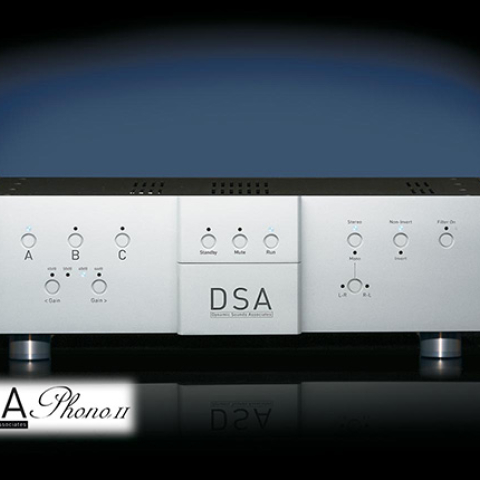
Nick Doshi's handsome and compact V3.0 phono stage ($16,995, footnote 3) is one of a series of tubed products from Doshi Audio that include line and tape preamps as well as power amps. It's always sounded smooth and refined in difficult audio-show conditions. The V3.0 update of the hybrid Phono Stage includes convenient microprocessor remote-control functionality. Its moving-coil circuit includes a JFET transistor differential input that provides 26dB of gain, followed by a pair of monaural step-down transformers that lower the gain by 6dB. Nick Doshi says that using the transformers to step down rather than up produces three major benefits: it provides pre-preamp galvanic isolation from the rest of the circuit; it converts the cartridge's inherently balanced input (no reference to ground) to single-ended, which allows the use of his "Zero-Feedback" tube circuit; and it steps down the impedance 4:1, thus increasing bandwidth.
The V3.0's tube complement is: two dual-triode ECC83/12AX7s for the first gain stage, two ECC81/12AT7s for EQ/buffering, and two 12DW7s for the final gain stage and line-out buffering. Doshi provides either NOS or OS tubes, and encourages buyers to swap out tubes as desired. I listened using the supplied tubes.
The V3.0 Phono Stage's gain is 50dB into either MM input, and 72dB into the single MC input. Hum and noise are specified as "at least 80dB below 0dBV."
A total of 512 cartridge loadings, from 10 ohms to 10k ohms, are selectable via the front panel or the hefty remote control's unlabeled pushbuttons. Both front panel and remote include a switch for reversing absolute phase.
Other features include a large, massive, outboard power supply connected via an umbilical to the main enclosure, which is made of 14-gauge stainless steel damped with a top plate of solid Corian. Inside are vibration-isolation grommets for the circuit board and Teflon tube sockets fitted with gold-plated copper contacts, transformers custom-made in the US by the Toroid Corporation, and custom ClarityCap coupling capacitors.
Super-quiet, ultra-transparent: I'm not sure why some phono preamps are free of hum as soon as I plug them in, while others just never stop humming. Doshi's V3.0 Phono Stage was one of the quiet ones. I think the JFET/tube combo makes complete sense.
Aural memories are supposed to be short, but the first time I heard the Doshi V3.0 at home, I was reminded of what had attracted me to the built-in phono stage of Hovland's HP-100 preamplifier, which I reviewed in the November 2000 issue. I've just reread that review for the first time in almost 20 years, and it perfectly describes the Doshi's sound, especially on top: Like the Hovland HP-100, the Doshi V3.0 "served the ebb and flow of music . . . It breathed music with a rare effortlessness, perfectly balancing tube warmth and solid-state clarity while moving dynamically up and down the scale in both large and small steps with exceptional continuity and cohesiveness."
The Doshi's star quality was its ability to unravel upper-octave information and reproduce it with finely dialed-in transient clarity and speed, all completely free of edginess, etch, or grain. It was these qualities that so reminded me of what the Hovland did so well.
The Doshi hasn't got the midrange creaminess of the Ypsilon VPS-100, or the Audio Research REF Phono 3's almost sinful overall richness, or the slam and low-frequency drive of the CH Precision P1/X1 (two of which are far more costly)—but plug in a rich-sounding cartridge with super-low output, like the Ortofon MC Century I mostly used with the Doshi, and $16,995 will buy you a taut, fast, exciting, well-detailed ride on every kind of music. I'm out of room, but if your phono-preamp budget stretches that far, do consider the Doshi. It was clear to me that it was designed by an electrical engineer who loves music, and who listened as he smartly designed.
Nick Doshi says that using the transformers to step down rather than up produces three major benefits: it provides pre-preamp galvanic isolation from the rest of the circuit; it converts the cartridge's inherently balanced input (no reference to ground) to single-ended, which allows the use of his "Zero-Feedback" tube circuit; and it steps down the impedance 4:1, thus increasing bandwidth.
The V3.0's tube complement is: two dual-triode ECC83/12AX7s for the first gain stage, two ECC81/12AT7s for EQ/buffering, and two 12DW7s for the final gain stage and line-out buffering. Doshi provides either NOS or OS tubes, and encourages buyers to swap out tubes as desired. I listened using the supplied tubes.
The V3.0 Phono Stage's gain is 50dB into either MM input, and 72dB into the single MC input. Hum and noise are specified as "at least 80dB below 0dBV."
A total of 512 cartridge loadings, from 10 ohms to 10k ohms, are selectable via the front panel or the hefty remote control's unlabeled pushbuttons. Both front panel and remote include a switch for reversing absolute phase.
Other features include a large, massive, outboard power supply connected via an umbilical to the main enclosure, which is made of 14-gauge stainless steel damped with a top plate of solid Corian. Inside are vibration-isolation grommets for the circuit board and Teflon tube sockets fitted with gold-plated copper contacts, transformers custom-made in the US by the Toroid Corporation, and custom ClarityCap coupling capacitors.
Super-quiet, ultra-transparent: I'm not sure why some phono preamps are free of hum as soon as I plug them in, while others just never stop humming. Doshi's V3.0 Phono Stage was one of the quiet ones. I think the JFET/tube combo makes complete sense.
Aural memories are supposed to be short, but the first time I heard the Doshi V3.0 at home, I was reminded of what had attracted me to the built-in phono stage of Hovland's HP-100 preamplifier, which I reviewed in the November 2000 issue. I've just reread that review for the first time in almost 20 years, and it perfectly describes the Doshi's sound, especially on top: Like the Hovland HP-100, the Doshi V3.0 "served the ebb and flow of music . . . It breathed music with a rare effortlessness, perfectly balancing tube warmth and solid-state clarity while moving dynamically up and down the scale in both large and small steps with exceptional continuity and cohesiveness."
The Doshi's star quality was its ability to unravel upper-octave information and reproduce it with finely dialed-in transient clarity and speed, all completely free of edginess, etch, or grain. It was these qualities that so reminded me of what the Hovland did so well.
The Doshi hasn't got the midrange creaminess of the Ypsilon VPS-100, or the Audio Research REF Phono 3's almost sinful overall richness, or the slam and low-frequency drive of the CH Precision P1/X1 (two of which are far more costly)—but plug in a rich-sounding cartridge with super-low output, like the Ortofon MC Century I mostly used with the Doshi, and $16,995 will buy you a taut, fast, exciting, well-detailed ride on every kind of music. I'm out of room, but if your phono-preamp budget stretches that far, do consider the Doshi. It was clear to me that it was designed by an electrical engineer who loves music, and who listened as he smartly designed.
Footnote 2: Swedish Analog Technologies, Gothenburg, Sweden. Tel: (46) 736-846-452. Web: www.swedishat.com Footnote 3: Doshi Audio, Manassas, VA. Tel: (917) 952-2758. Web: www.doshiaudio.com
With SAT's 12"-long CF1-12 arm (footnote 2) installed in place of the Schröder CB, there was one fewer variable in the comparison, though SAT designer Marc Gomez says his 9" and 12" arms don't sound identical, and that he, like some other tonearm designers, prefers his 9" arm for its superior in-the-groove dynamic behavior. Like other designers, Gomez makes the longer arm to meet the needs of his customers—such as those who own Air Force turntables, on which the installation of a second tonearm requires one 12" long. I hesitate to call adding the 12" SAT arm to this mix "the icing on the cake"—at $53,000, that's some pricey frosting, and frosty hardly describes the change in sound.
Nick Doshi's handsome and compact V3.0 phono stage ($16,995, footnote 3) is one of a series of tubed products from Doshi Audio that include line and tape preamps as well as power amps. It's always sounded smooth and refined in difficult audio-show conditions. The V3.0 update of the hybrid Phono Stage includes convenient microprocessor remote-control functionality. Its moving-coil circuit includes a JFET transistor differential input that provides 26dB of gain, followed by a pair of monaural step-down transformers that lower the gain by 6dB.
Nick Doshi says that using the transformers to step down rather than up produces three major benefits: it provides pre-preamp galvanic isolation from the rest of the circuit; it converts the cartridge's inherently balanced input (no reference to ground) to single-ended, which allows the use of his "Zero-Feedback" tube circuit; and it steps down the impedance 4:1, thus increasing bandwidth.
Footnote 2: Swedish Analog Technologies, Gothenburg, Sweden. Tel: (46) 736-846-452. Web: www.swedishat.com Footnote 3: Doshi Audio, Manassas, VA. Tel: (917) 952-2758. Web: www.doshiaudio.com