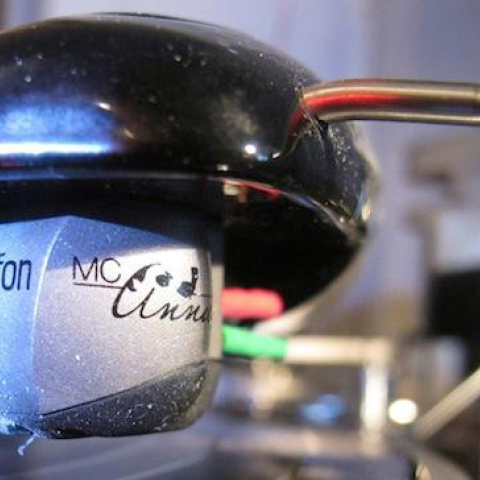
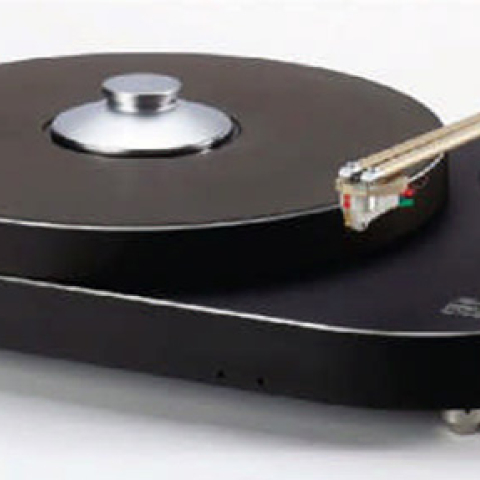
The Red Sparrow's design is apparently unique, and so was its sound, in a very good way: smooth, airy, velvety, and vivid, with a particularly rich midrange that I wanted to sink my ears into. It was only the second cartridge of my experience to produce this much harmonic and textural generosity, in combination with exceptional transparency, quiet groove tracing, and a secure sense that all of this was being produced at the expense of very little or nothing elsewhere in the sound. That other cartridge was Grado Labs' Lineage Epoch, which costs $12,000, and which I wrote about in my December 2017 column. $16,500? $12,000? Who's counting?
Impressive resolution of low-level detail and an airy top end didn't make me think "moving magnet," nor did the Red Sparrow have the sluggishness usually associated with MMs. Nor did it produce the edgy, mechanical sound of some MCs (though none at this price). On the other hand, while the Red Sparrow's rhythm'n'pace were fast and exciting, its transient attacks were, overall, more polite than direct and immediate. Cymbals steamed more than they sizzled, but since the top-to-bottom presentation was consistent, it all sounded coherent and correct.
As I type this I'm listening to a new reissue of jazz pianist Chick Corea's Now He Sings, Now He Sobs (LP, Solid State/Tone Poet/Blue Note B00293673-01). It's one of Blue Note's Tone Poet releases, a series of reissues overseen by Joe Harley, of Music Matters and AudioQuest, and cut by Kevin Gray directly from the original master tapes of these sessions, recorded in March 1968 at Phil Ramone's A&R Studios by Don Hahn, whose résumé ranges from the Band's Music from Big Pink to Shirley Bassey's Live At Carnegie Hall.
It's useful to play an unfamiliar record after one you know well—hearing similarities between them gives you an idea of the cartridge's personality. The piano sound, at center stage, had more wood than it did in-your-face transients—more sustain and decay than attack. In Roy Haynes's drumming I heard more stick than cymbal, and his tom resonated more convincingly than did the impacts themselves—though those, too, were good. It will be interesting to hear this record with a familiar cartridge.
Next up was John Williams's Liberty Fanfare (it's similar to the theme he wrote for NBC's Nightly News), from the late Dave Wilson's sonic spectacular Winds of War and Peace, performed by Lowell Graham and the National Symphonic Winds (LP, Wilson Audio/Analogue Productions W/APP 8823). This one I'm very familiar with. The mallet-of-death bass-drum thwacks were delivered with great speed and generous sustain, but not with ultimate stomach-socking punch. The sound of the hall was generously and convincingly reproduced behind the strings and brass, which had all of the extension and air, but somewhat less of the possible bite.
Another sonic spectacular, a collection of music for brass ensemble by Morera, Bartók, and Rameau, performed by Equale Brass (45rpm LP, Nimbus 45010), confirmed the above as well as this: The Red Sparrow's reproduction of soundstage width, depth, and height—of space—was generous.
This cartridge was all about instrumental colors and textures, somewhat less about hard transients and bright lights. But once I'd acclimated to its sound, it was transportive and convincing. And because its sound was fast and effervescent, it was exciting as hell—though in the wrong system it could probably sound "squooshy."
That's all I have to say about this interesting cartridge, other than: If you like the Ben Webster's tenor-saxophone sound, its reproduction by the Top Wing Suzaku (Red Sparrow) will give you chills. But if you prefer electric blues guitar and hard-edged rock, it's probably not the ideal cartridge for you—although, if paired with a somewhat edgy-sounding phono preamp, maybe it would be. In the right system with the right phono preamp and reproducing the right music (acoustic jazz and classical), the Red Sparrow will make some well-off audiophiles very happy.
HiFiction Thales Statement tonearm
In the early 2000s, Swiss watchmaker Micha Huber decided to use his skills to design a tangential-tracking pivoted tonearm, and in 2004 he was granted a patent for his original design. I reviewed that arm in my October 2010 column as part of the Audiostone, a complete system of turntable, tonearm, and rack. The general design principles of the first Thales arm also hold true for Huber's latest arm, the Statement (footnote 2).
Huber's first attempt at tangential tracking was in some ways as kludgy as Peter Cheon's Klaudio KD-ARM-AG12 tangential tracker, which I wrote about in my January 2019 column. An odd contraption, the HiFiction Thales AV had a main structure that resembled a seal balancing on its nose the arm's complex main Cardanic pivot. The Thales AV looked like a normal pivoted tonearm to whose headshell a more slender, auxiliary arm had been grafted, at an approximate 45° angle. That auxiliary arm was articulated, with a vertical segment terminating in a secondary Cardanic bearing hidden below plinth level—all of this to properly angle the headshell to produce perfect tangency between stylus and groove across a record's entire playing surface. It was a beginning, if an awkward one.
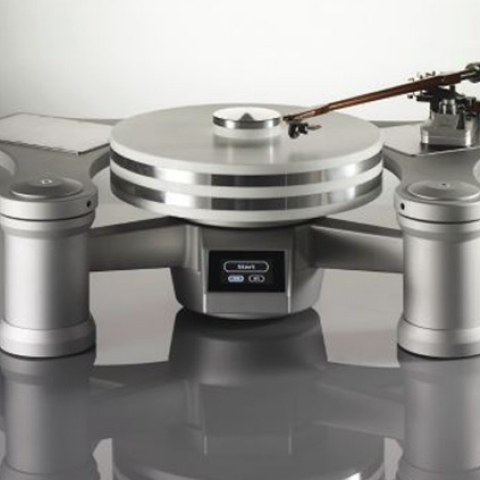
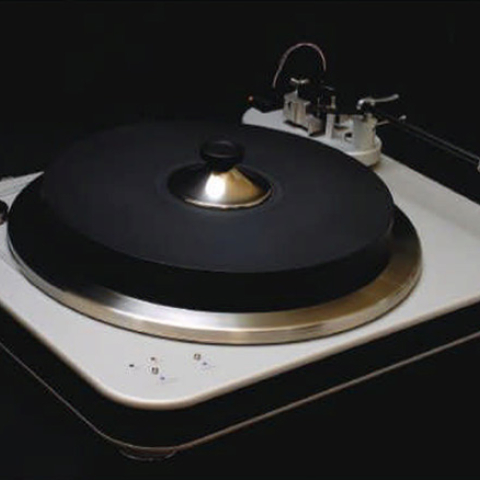
 Over time, Huber developed more elegant pivoted tangential trackers, as well as his own compact, high-precision turntables, including the battery-powered TTT-Compact II, one of which was supplied for this review of the Statement arm.
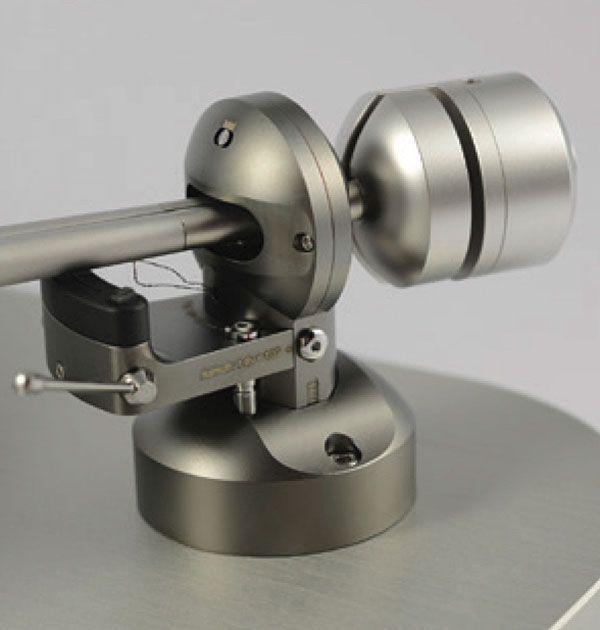
The first thing to notice about the elegant-looking Statement ($21,090) is that, unlike other Thales arms, its complex Cardanic bearing is encapsulated within a doubly convex housing, which is claimed to increase its mechanical rigidity by a factor of 100. The new bearing, said to ensure "low impedance connection points," is a five-axis design using 10 micro ball bearings. Its twin armtubes are made of a special, "steel-strength" aluminum alloy claimed to provide 10 times the internal damping of steel. These are "naturally aged," then "relaxed," before being attached, at the front, to an articulated headshell, while two counterweights at the rear end of the arm move as the two armtubes slide by each other to accommodate the headshell's correct and constantly changing angle of orientation—tangency—to the groove. The maximum tracking error is a claimed 0.006°.
Fine vernier adjustments for both VTA (0.1mm increments) and azimuth (1/3° increments) and a precision stylus-overhang gauge make possible precise, repeatable setup of all parameters. The Statement's effective length is 9", and its effective mass is 25gm. A newly designed clamping mechanism built into the arm base allows for accurate on-the-fly VTA adjustments. If you didn't know this complex yet compact system was designed by a watchmaker, you might have guessed it anyway.
Despite its simple exterior, the Statement comprises 288 finely machined parts sourced from various Swiss vendors, including five different counterweights designed to accommodate cartridges weighing from 7 to 20gm. The armtubes, headshell, and counterweights of the supplied Statement Silver—the arm's standard level of finish—were all coated with rhodium; the base ring, shaft, and bearing unit were coated with ruthenium. There's also a Gold edition ($22,780). The packing is what you'd expect at these prices.
Setting up and precisely optimizing the Thales Statement is relatively easy, even pleasurable, especially if you've ever wrestled with coarser, more fumbly designs—and Thales includes high-quality tools. Still, whenever tiny screws are involved, a deft, light touch helps.
Over time, Huber developed more elegant pivoted tangential trackers, as well as his own compact, high-precision turntables, including the battery-powered TTT-Compact II, one of which was supplied for this review of the Statement arm.
The first thing to notice about the elegant-looking Statement ($21,090) is that, unlike other Thales arms, its complex Cardanic bearing is encapsulated within a doubly convex housing, which is claimed to increase its mechanical rigidity by a factor of 100. The new bearing, said to ensure "low impedance connection points," is a five-axis design using 10 micro ball bearings. Its twin armtubes are made of a special, "steel-strength" aluminum alloy claimed to provide 10 times the internal damping of steel. These are "naturally aged," then "relaxed," before being attached, at the front, to an articulated headshell, while two counterweights at the rear end of the arm move as the two armtubes slide by each other to accommodate the headshell's correct and constantly changing angle of orientation—tangency—to the groove. The maximum tracking error is a claimed 0.006°.
Fine vernier adjustments for both VTA (0.1mm increments) and azimuth (1/3° increments) and a precision stylus-overhang gauge make possible precise, repeatable setup of all parameters. The Statement's effective length is 9", and its effective mass is 25gm. A newly designed clamping mechanism built into the arm base allows for accurate on-the-fly VTA adjustments. If you didn't know this complex yet compact system was designed by a watchmaker, you might have guessed it anyway.
Despite its simple exterior, the Statement comprises 288 finely machined parts sourced from various Swiss vendors, including five different counterweights designed to accommodate cartridges weighing from 7 to 20gm. The armtubes, headshell, and counterweights of the supplied Statement Silver—the arm's standard level of finish—were all coated with rhodium; the base ring, shaft, and bearing unit were coated with ruthenium. There's also a Gold edition ($22,780). The packing is what you'd expect at these prices.
Setting up and precisely optimizing the Thales Statement is relatively easy, even pleasurable, especially if you've ever wrestled with coarser, more fumbly designs—and Thales includes high-quality tools. Still, whenever tiny screws are involved, a deft, light touch helps.
 Micha Huber's goal for the Statement was to improve his basic design's dynamics, lower its noise floor, and make the whole thing more mechanically precise. Using a special phono-cartridge jig that puts a stylus in contact with the bearing housing and other vibration-sensitive areas, he was able to measure parasitic vibrations produced by various design changes while playing a high-amplitude test record (of course, using a different cartridge installed in the headshell). The Statement's measured improvements show a higher-Q resonance, down about 10dB, to –61dB, compared to the previous design.
I did most of my listening to the Thales Statement with a Lyra Etna SL cartridge installed, paying particular attention to bass extension, weight, image solidity, and other aspects of sound that might suffer due to the Statement's "floppy" articulated headshell. I also listened for any benefits!
A recording of an arrangement of Holst's The Planets for brass quintet and pipe organ, performed by the Buzz Ensemble and organist Mélanie Barney (2 45rpm LPs, Fidelio FALP028), proved ideal for gauging this turntable and tonearm's bottom-end response. The low organ notes in Jupiter, the bringer of Jollity were well extended, powerful, and tightly gripped, while the well-focused picture of the brass ensemble, spread across the stage, never wavered or was ever swallowed by the cavernous hall.
The Jamie Saft Quartet's superbly recorded Blue Dream (2 LPs, Rare Noise RNR095LP) delivered the warm, rich, dark, yet solid "old-school" quartet imagery one assumes its producer intended. Bradley Christopher Jones's deep, powerful double-bass lines contrasted nicely with drummer Nasheet Waits's cymbal work, splayed cleanly and precisely between the channels, while tenor saxophonist Bill McHenry's round, breathy blasts solidly filled center stage, and Saft's piano off to the right had clean, solid, well-articulated attacks and convincing sustains.
It's been years since I heard the previous top-of-the-line Thales tonearm from HiFiction—way too long for me to make any credible comparisons of its sound with the Statement's. However, considering the Statement's ability to reproduce bottom-end power, weight, and solidity with indiscernible coloration, it seems the question of insufficient rigidity in a tonearm with complex bearings and an articulated headshell has been reduced to a nonissue.
As for the suggested lower-distortion benefits of tangential tracking, at least compared to my reference 9" arm, I just don't hear them!
Micha Huber's goal for the Statement was to improve his basic design's dynamics, lower its noise floor, and make the whole thing more mechanically precise. Using a special phono-cartridge jig that puts a stylus in contact with the bearing housing and other vibration-sensitive areas, he was able to measure parasitic vibrations produced by various design changes while playing a high-amplitude test record (of course, using a different cartridge installed in the headshell). The Statement's measured improvements show a higher-Q resonance, down about 10dB, to –61dB, compared to the previous design.
I did most of my listening to the Thales Statement with a Lyra Etna SL cartridge installed, paying particular attention to bass extension, weight, image solidity, and other aspects of sound that might suffer due to the Statement's "floppy" articulated headshell. I also listened for any benefits!
A recording of an arrangement of Holst's The Planets for brass quintet and pipe organ, performed by the Buzz Ensemble and organist Mélanie Barney (2 45rpm LPs, Fidelio FALP028), proved ideal for gauging this turntable and tonearm's bottom-end response. The low organ notes in Jupiter, the bringer of Jollity were well extended, powerful, and tightly gripped, while the well-focused picture of the brass ensemble, spread across the stage, never wavered or was ever swallowed by the cavernous hall.
The Jamie Saft Quartet's superbly recorded Blue Dream (2 LPs, Rare Noise RNR095LP) delivered the warm, rich, dark, yet solid "old-school" quartet imagery one assumes its producer intended. Bradley Christopher Jones's deep, powerful double-bass lines contrasted nicely with drummer Nasheet Waits's cymbal work, splayed cleanly and precisely between the channels, while tenor saxophonist Bill McHenry's round, breathy blasts solidly filled center stage, and Saft's piano off to the right had clean, solid, well-articulated attacks and convincing sustains.
It's been years since I heard the previous top-of-the-line Thales tonearm from HiFiction—way too long for me to make any credible comparisons of its sound with the Statement's. However, considering the Statement's ability to reproduce bottom-end power, weight, and solidity with indiscernible coloration, it seems the question of insufficient rigidity in a tonearm with complex bearings and an articulated headshell has been reduced to a nonissue.
As for the suggested lower-distortion benefits of tangential tracking, at least compared to my reference 9" arm, I just don't hear them!
 Analysis Plus Silver Apex interconnect
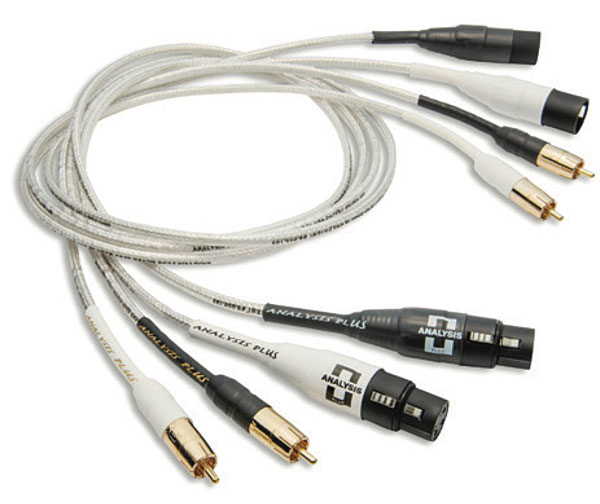
When Jonathan Weiss of Oswalds Mill Audio dropped off his company's cast-iron turntable plinth, which I reviewed in my February 2019 column, he found me whining about hum issues involving the interconnects I was using between various step-up transformers and my Ypsilon VPS-100 phono preamp. He suggested Analysis Plus's Silver Apex interconnect (footnote 3). Its conductor is pure silver over a stabilizing strand of oxygen-free copper. Analysis Plus describes the geometry as "a hollow oval cable inside a hollow oval cable inside a hollow oval cable for a double shielded design for a noise floor so low you can hear your amp breath [sic]." It's sonically transparent—as good as the best of those other cables I've tried (that still hum in this situation)—and absolutely dead quiet. Plus it costs $1106 for a 1m pair (RCA–RCA). Highly recommended, and so reasonably priced!
Footnote 2: Thales/HiFiction AG, Tösstalstrasse 14, 8488 Turbenthal, Switzerland. Tel: (41) 52-202-43-12. Web: www.tonarm.ch. US: Thales USA. Tel: (212) 826-1111. Web: www.thales-audio.com. Footnote 3: Analysis Plus, 106 E. Main Street, Flushing, MI 48433. Tel: (810) 659-6448. Fax: (810) 659-3303. Web: www.analysis-plus.com
In the early 2000s, Swiss watchmaker Micha Huber decided to use his skills to design a tangential-tracking pivoted tonearm, and in 2004 he was granted a patent for his original design. I reviewed that arm in my October 2010 column as part of the Audiostone, a complete system of turntable, tonearm, and rack. The general design principles of the first Thales arm also hold true for Huber's latest arm, the Statement (footnote 2).
Over time, Huber developed more elegant pivoted tangential trackers, as well as his own compact, high-precision turntables, including the battery-powered TTT-Compact II, one of which was supplied for this review of the Statement arm.
The first thing to notice about the elegant-looking Statement ($21,090) is that, unlike other Thales arms, its complex Cardanic bearing is encapsulated within a doubly convex housing, which is claimed to increase its mechanical rigidity by a factor of 100. The new bearing, said to ensure "low impedance connection points," is a five-axis design using 10 micro ball bearings. Its twin armtubes are made of a special, "steel-strength" aluminum alloy claimed to provide 10 times the internal damping of steel. These are "naturally aged," then "relaxed," before being attached, at the front, to an articulated headshell, while two counterweights at the rear end of the arm move as the two armtubes slide by each other to accommodate the headshell's correct and constantly changing angle of orientation—tangency—to the groove. The maximum tracking error is a claimed 0.006°.
Micha Huber's goal for the Statement was to improve his basic design's dynamics, lower its noise floor, and make the whole thing more mechanically precise. Using a special phono-cartridge jig that puts a stylus in contact with the bearing housing and other vibration-sensitive areas, he was able to measure parasitic vibrations produced by various design changes while playing a high-amplitude test record (of course, using a different cartridge installed in the headshell). The Statement's measured improvements show a higher-Q resonance, down about 10dB, to –61dB, compared to the previous design.
I did most of my listening to the Thales Statement with a Lyra Etna SL cartridge installed, paying particular attention to bass extension, weight, image solidity, and other aspects of sound that might suffer due to the Statement's "floppy" articulated headshell. I also listened for any benefits!
A recording of an arrangement of Holst's The Planets for brass quintet and pipe organ, performed by the Buzz Ensemble and organist Mélanie Barney (2 45rpm LPs, Fidelio FALP028), proved ideal for gauging this turntable and tonearm's bottom-end response. The low organ notes in Jupiter, the bringer of Jollity were well extended, powerful, and tightly gripped, while the well-focused picture of the brass ensemble, spread across the stage, never wavered or was ever swallowed by the cavernous hall.
Analysis Plus Silver Apex interconnectWhen Jonathan Weiss of Oswalds Mill Audio dropped off his company's cast-iron turntable plinth, which I reviewed in my February 2019 column, he found me whining about hum issues involving the interconnects I was using between various step-up transformers and my Ypsilon VPS-100 phono preamp. He suggested Analysis Plus's Silver Apex interconnect (footnote 3). Its conductor is pure silver over a stabilizing strand of oxygen-free copper. Analysis Plus describes the geometry as "a hollow oval cable inside a hollow oval cable inside a hollow oval cable for a double shielded design for a noise floor so low you can hear your amp breath [sic]." It's sonically transparent—as good as the best of those other cables I've tried (that still hum in this situation)—and absolutely dead quiet. Plus it costs $1106 for a 1m pair (RCA–RCA). Highly recommended, and so reasonably priced!
Footnote 2: Thales/HiFiction AG, Tösstalstrasse 14, 8488 Turbenthal, Switzerland. Tel: (41) 52-202-43-12. Web: www.tonarm.ch. US: Thales USA. Tel: (212) 826-1111. Web: www.thales-audio.com. Footnote 3: Analysis Plus, 106 E. Main Street, Flushing, MI 48433. Tel: (810) 659-6448. Fax: (810) 659-3303. Web: www.analysis-plus.com