Amplifier hum was banished when I banished that amplifier, but the front end of my system sometimes does have ground-related hum issues, probably in part due to the several turntables, cartridges, and phono preamps I typically have in the system at one time. It's way more than most audiophiles have to deal with.
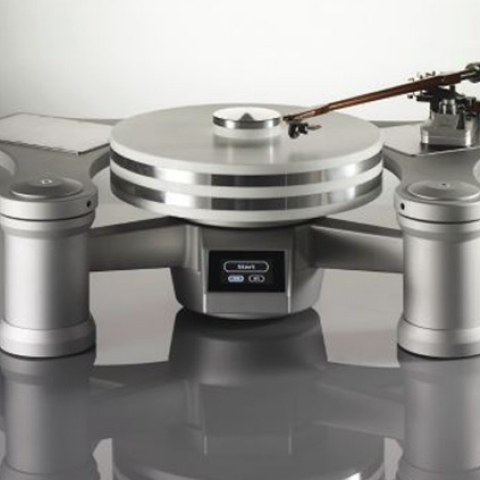
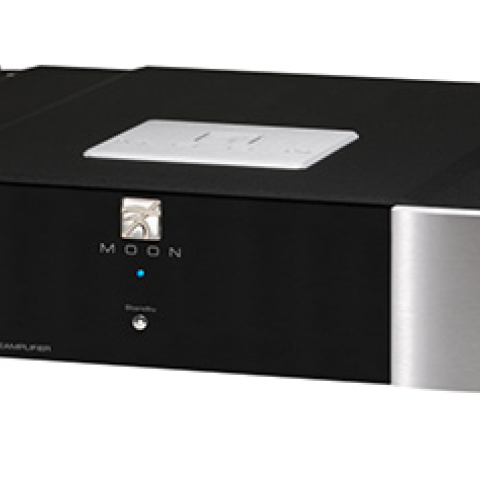
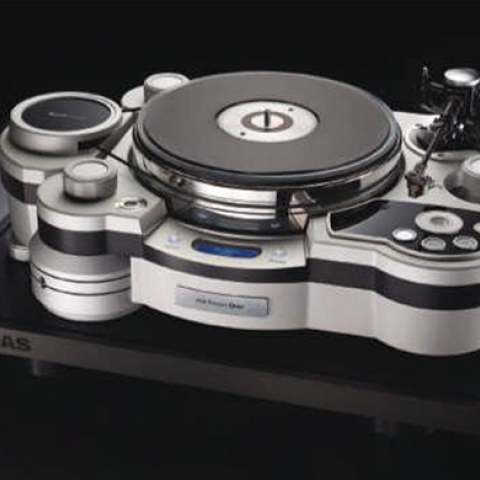
Recently, I've run into a turntable-grounding issue related to the Continuum Caliburn's outboard motor controller, which produces an occasional "pop" through the CH Precision P1/ X1. I was unable to get rid of it, but it was easy to ignore until it got to where it would shut down the P1/X1 after a few minutes with a loud "POP."
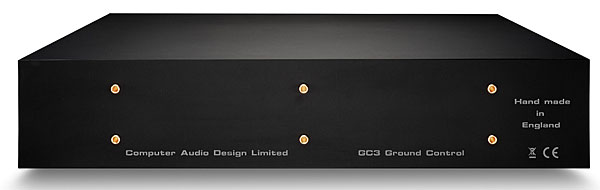
CAD's (Computer Audio Design, footnote 2) Ground Control devices were recommended to me by a manufacturer, though as it turns out, it's not really intended to get rid of 60Hz hum. Instead, this passive system is designed to greatly reduce a broad range of high-frequency noise picked up by and created by electronics, and also noise that gets into connecting cables via radiation and into components from the AC mains. In these Wi-Fi/Bluetooth days, there can be a lot of noise.
Scott Berry, the UK-based US expatriate who runs CAD with his British wife Isabel Whitley, figured the best way to "drain" the noise that infects the signal ground would be to utilize unused inputs.
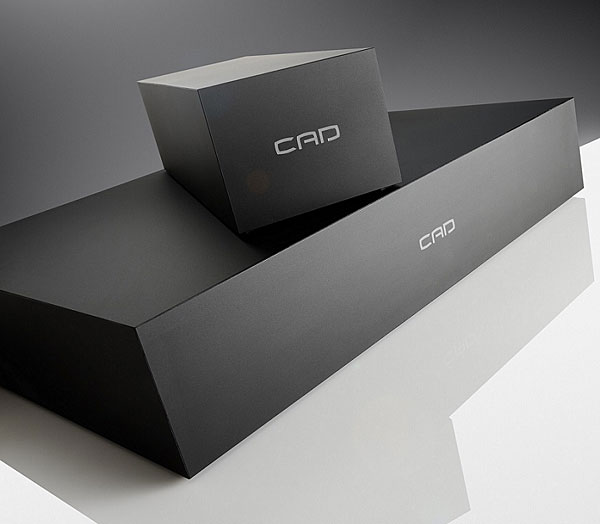 The company offered to send me a pair of its smaller dual-socket GC1 units ($1995 each) and one preamplifier-sized, six-socket GC3 block ($4500). There's also a much larger six-socket GC-R ($21,500), which includes eight connecting cables that on the other units cost $350 each. CAD offers cables that connect on one end with 4mm banana plugs to the GC1 and GC3 terminated on the other end with RCA, USB, XLR, Spade, and 4mm bananas. Others are available upon request.
These plain matte-gray boxes are attractive enough. Inside are "laminate structures of specialised materials which are designed to reduce high frequency noise by absorbing and converting the noise into heat."
Scott Berry had watched the Stereophile video tour of my listening room, so he already knew much of what's in my system. He was prepared with a list of connecting cables he would send and a rough guide to how they should be used; when I told him about the pops from the Caliburn's motor controller, he wasn't sure his Ground Control would work there.
The company offered to send me a pair of its smaller dual-socket GC1 units ($1995 each) and one preamplifier-sized, six-socket GC3 block ($4500). There's also a much larger six-socket GC-R ($21,500), which includes eight connecting cables that on the other units cost $350 each. CAD offers cables that connect on one end with 4mm banana plugs to the GC1 and GC3 terminated on the other end with RCA, USB, XLR, Spade, and 4mm bananas. Others are available upon request.
These plain matte-gray boxes are attractive enough. Inside are "laminate structures of specialised materials which are designed to reduce high frequency noise by absorbing and converting the noise into heat."
Scott Berry had watched the Stereophile video tour of my listening room, so he already knew much of what's in my system. He was prepared with a list of connecting cables he would send and a rough guide to how they should be used; when I told him about the pops from the Caliburn's motor controller, he wasn't sure his Ground Control would work there.
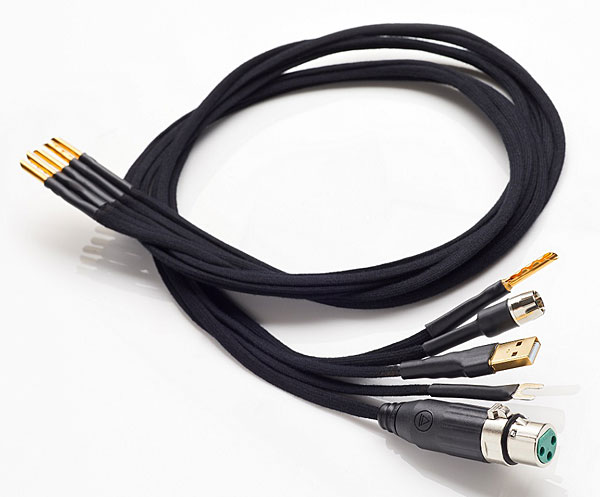 The Ground Control connects to unused inputs, all of which of course are tied to ground. For the CH Precision P1, for instance, he recommended using the input used for USB software updates, because it's close to the operating system's noise-producing digital hardware and is rarely used.
He also sent a BNC cable to connect to a S/PDIF connector on the dCS Vivaldi One—which I finally paid off!—a cable terminated with a male XLR connector, spade connectors for the turntable motor controller and the turntable itself, a pair of cables fitted with banana plugs, and a pair fitted with US mains plugs. (Only the ground jack connects to the Ground Control.)
I ended up tying together the turntable and motor controller first, using an on-hand grounding cable between the controller chassis and the turntable and connecting the turntable to a GC-1 input. The P1 USB cable went to that GC-1's second input. The second GC-1 was connected to the Vivaldi One and the Ypsilon VPS100's XLR "convenience" input, which is tied directly to the RCA input.
I placed the bigger GC-3 closer to the amplifiers, connected with a pair of cables to the unused RCA inputs of whichever amplifiers I was using, either the darTZeel NHB-468s or the big VAC 452 iQ amps I had in for review. One of the mains plugs went directly into the wall socket, and the other went into the Niagara 7000 power conditioner.
Berry suggested numerous other connection options; what works best in one system, he told me, may not work in another. Given the many options and my time constraints, I decided to give it a shot in just one configuration, connecting everything as described and then evaluating rather than doing it a piece at a time. What happened was the loud "POP" from the Caliburn's outboard motor controller went away. Completely.
Other than that, at first, apart from the popping issue, I wasn't sure I heard any immediate differences playing Lori Lieberman's lovely The Girl and the Cat (Drive on Productions 115115 17) on which she's accompanied by The Matangi (string) Quartet, engineered by her hubby Joseph Cali and mixed by Bob Clearmountain. The recording is pristine, natural, and intimate. I don't know what I was expecting, but I got nothing.
I played a few other records, including a few sides of the new Analogue Productions reissue of János Starker's legendary Mercury Living Presence Bach Suites for Unaccompanied Cello (Mercury SR3-9016/ Analogue Productions AAPC 3-9016-45), and heard no differences there, either.
I left everything on overnight and the next day picked up where I left off on the Starker Cello Suites. Immediately it sounded fundamentally different. Had the amplifier warmed up? Had the atmospheric pressure changed? It could have been a wide range of things other than the Ground Control.
The Ground Control connects to unused inputs, all of which of course are tied to ground. For the CH Precision P1, for instance, he recommended using the input used for USB software updates, because it's close to the operating system's noise-producing digital hardware and is rarely used.
He also sent a BNC cable to connect to a S/PDIF connector on the dCS Vivaldi One—which I finally paid off!—a cable terminated with a male XLR connector, spade connectors for the turntable motor controller and the turntable itself, a pair of cables fitted with banana plugs, and a pair fitted with US mains plugs. (Only the ground jack connects to the Ground Control.)
I ended up tying together the turntable and motor controller first, using an on-hand grounding cable between the controller chassis and the turntable and connecting the turntable to a GC-1 input. The P1 USB cable went to that GC-1's second input. The second GC-1 was connected to the Vivaldi One and the Ypsilon VPS100's XLR "convenience" input, which is tied directly to the RCA input.
I placed the bigger GC-3 closer to the amplifiers, connected with a pair of cables to the unused RCA inputs of whichever amplifiers I was using, either the darTZeel NHB-468s or the big VAC 452 iQ amps I had in for review. One of the mains plugs went directly into the wall socket, and the other went into the Niagara 7000 power conditioner.
Berry suggested numerous other connection options; what works best in one system, he told me, may not work in another. Given the many options and my time constraints, I decided to give it a shot in just one configuration, connecting everything as described and then evaluating rather than doing it a piece at a time. What happened was the loud "POP" from the Caliburn's outboard motor controller went away. Completely.
Other than that, at first, apart from the popping issue, I wasn't sure I heard any immediate differences playing Lori Lieberman's lovely The Girl and the Cat (Drive on Productions 115115 17) on which she's accompanied by The Matangi (string) Quartet, engineered by her hubby Joseph Cali and mixed by Bob Clearmountain. The recording is pristine, natural, and intimate. I don't know what I was expecting, but I got nothing.
I played a few other records, including a few sides of the new Analogue Productions reissue of János Starker's legendary Mercury Living Presence Bach Suites for Unaccompanied Cello (Mercury SR3-9016/ Analogue Productions AAPC 3-9016-45), and heard no differences there, either.
I left everything on overnight and the next day picked up where I left off on the Starker Cello Suites. Immediately it sounded fundamentally different. Had the amplifier warmed up? Had the atmospheric pressure changed? It could have been a wide range of things other than the Ground Control.
 I was up to side 5, which is Suite No.5. I learned from the liner notes that, while most of these performances were recorded in two 2-day sessions separated by three months (September and December 1965), Suites 2 and 5 were recorded at a different time and had been released previously on a single LP, so it was no surprise that it sounded different than Suite 4 where I'd left off.
So then I went back to the Lori Lieberman record's tearjerker title track, which is like the movie Beautiful Boy but about an addicted daughter. It opens with just piano, and it sounded fundamentally different: more delicate (but the attack was still well-articulated) and against a blacker background. The strings had more luster. Lieberman's voice was smoother; the sibilants were more cleanly expressed so that it sounded more "there" and less recorded. When she sings, "In a dream she comes to me, puts her arms around me once again," there's a barely noticeable percussive "bell tree" tinkle; now it stood out in greater relief.
There's more to explore with these interesting products, but that's all the space I've got for them now.
DS Audio Vinyl Ionizer-001
I was up to side 5, which is Suite No.5. I learned from the liner notes that, while most of these performances were recorded in two 2-day sessions separated by three months (September and December 1965), Suites 2 and 5 were recorded at a different time and had been released previously on a single LP, so it was no surprise that it sounded different than Suite 4 where I'd left off.
So then I went back to the Lori Lieberman record's tearjerker title track, which is like the movie Beautiful Boy but about an addicted daughter. It opens with just piano, and it sounded fundamentally different: more delicate (but the attack was still well-articulated) and against a blacker background. The strings had more luster. Lieberman's voice was smoother; the sibilants were more cleanly expressed so that it sounded more "there" and less recorded. When she sings, "In a dream she comes to me, puts her arms around me once again," there's a barely noticeable percussive "bell tree" tinkle; now it stood out in greater relief.
There's more to explore with these interesting products, but that's all the space I've got for them now.
DS Audio Vinyl Ionizer-001
Static electricity is a vinyl playback issue year-round but especially during dry winter months. Cleaning records with a vacuum-operated "lip" type machine produces a lot of rubbing and so causes static buildup. You can buy a "Milty" Zerostat gun for around $100 (they used to be really cheap), or you can buy a $325 curling stone–like, battery-powered, fan-equipped Furutech Destat III or the similarly priced ORB Sakura. These are all handheld devices.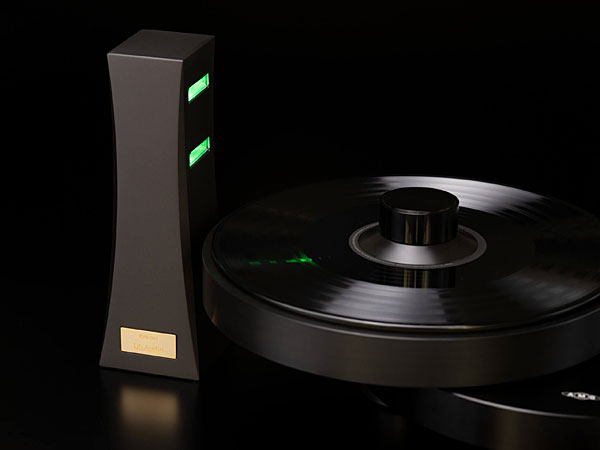 DS Audio's ION-001 is more of a "watchdog"; put it near—very near—your turntable and leave it on all the time, and it will reduce static electricity in the area. DS Audio (footnote 3) claims it removes 100% of static electricity within 50mm—that's about 2"—and "at least 90%" between 50mm and 100mm. There's also a height requirement: If your platter is too tall, you'll need a stand of some kind to raise it so that the ionizer is at the right height.
The Vinyl Ionizer ION-001 is powered by a wall wart. It includes a ground wire you can connect to your phono preamp's ground lug. The ionizer output isn't adjustable—it's either on or off—but you might think it is because you can change the illumination from the green light that accompanies the ions. The unit's half-life is approximately 10,000 hours, or almost 3 hours per day for 10 years. It costs $1795.
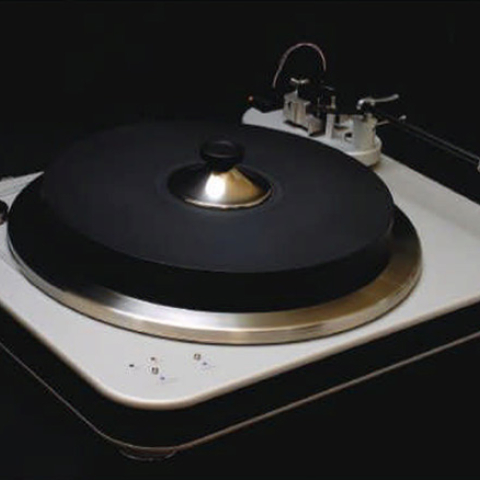
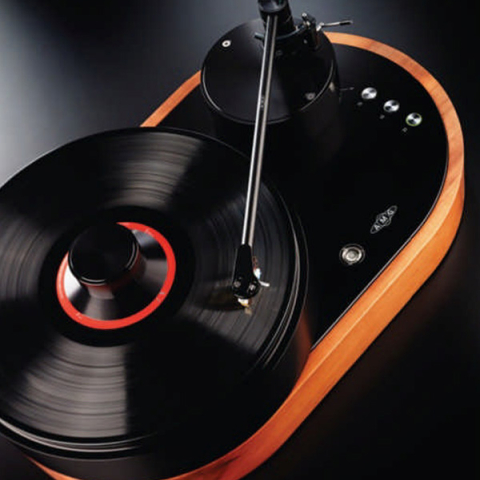
I had it around over the dry winter. It works silently and well, plus it looks really cool. However, you need to be able to get it really close to the platter, which isn't always possible. I couldn't use it with the Continuum Caliburn because it sits on a suspension; I was able to use it with the recently reviewed Reed Muse 1C turntable.
DS Audio's ION-001 is more of a "watchdog"; put it near—very near—your turntable and leave it on all the time, and it will reduce static electricity in the area. DS Audio (footnote 3) claims it removes 100% of static electricity within 50mm—that's about 2"—and "at least 90%" between 50mm and 100mm. There's also a height requirement: If your platter is too tall, you'll need a stand of some kind to raise it so that the ionizer is at the right height.
The Vinyl Ionizer ION-001 is powered by a wall wart. It includes a ground wire you can connect to your phono preamp's ground lug. The ionizer output isn't adjustable—it's either on or off—but you might think it is because you can change the illumination from the green light that accompanies the ions. The unit's half-life is approximately 10,000 hours, or almost 3 hours per day for 10 years. It costs $1795.
I had it around over the dry winter. It works silently and well, plus it looks really cool. However, you need to be able to get it really close to the platter, which isn't always possible. I couldn't use it with the Continuum Caliburn because it sits on a suspension; I was able to use it with the recently reviewed Reed Muse 1C turntable.
Footnote 2: Computer Audio Design Ltd. Tel: +44 20 3397 0334. US importer: Computer Audio Design LLC, Bend, OR 97703. Tel: (541) 728-3199 Web: computeraudiodesign.com.
Footnote 3: DS Audio, 4-50-40, Kamitsuruma-Honcho Minami-ku, Sagamihara Kanagawa 252-0318, Japan Tel: (81) 427-47-0900. Web: ds-audio-w.biz. US distributor: Musical Surroundings, 5662 Shattuck Avenue, Oakland, CA 94609. Tel: (510) 547-5006. Fax: (510) 547-5009. Web: musicalsurroundings.com.
The company offered to send me a pair of its smaller dual-socket GC1 units ($1995 each) and one preamplifier-sized, six-socket GC3 block ($4500). There's also a much larger six-socket GC-R ($21,500), which includes eight connecting cables that on the other units cost $350 each. CAD offers cables that connect on one end with 4mm banana plugs to the GC1 and GC3 terminated on the other end with RCA, USB, XLR, Spade, and 4mm bananas. Others are available upon request.
These plain matte-gray boxes are attractive enough. Inside are "laminate structures of specialised materials which are designed to reduce high frequency noise by absorbing and converting the noise into heat."
The Ground Control connects to unused inputs, all of which of course are tied to ground. For the CH Precision P1, for instance, he recommended using the input used for USB software updates, because it's close to the operating system's noise-producing digital hardware and is rarely used.
He also sent a BNC cable to connect to a S/PDIF connector on the dCS Vivaldi One—which I finally paid off!—a cable terminated with a male XLR connector, spade connectors for the turntable motor controller and the turntable itself, a pair of cables fitted with banana plugs, and a pair fitted with US mains plugs. (Only the ground jack connects to the Ground Control.)
I was up to side 5, which is Suite No.5. I learned from the liner notes that, while most of these performances were recorded in two 2-day sessions separated by three months (September and December 1965), Suites 2 and 5 were recorded at a different time and had been released previously on a single LP, so it was no surprise that it sounded different than Suite 4 where I'd left off.
So then I went back to the Lori Lieberman record's tearjerker title track, which is like the movie Beautiful Boy but about an addicted daughter. It opens with just piano, and it sounded fundamentally different: more delicate (but the attack was still well-articulated) and against a blacker background. The strings had more luster. Lieberman's voice was smoother; the sibilants were more cleanly expressed so that it sounded more "there" and less recorded. When she sings, "In a dream she comes to me, puts her arms around me once again," there's a barely noticeable percussive "bell tree" tinkle; now it stood out in greater relief.
There's more to explore with these interesting products, but that's all the space I've got for them now.
Static electricity is a vinyl playback issue year-round but especially during dry winter months. Cleaning records with a vacuum-operated "lip" type machine produces a lot of rubbing and so causes static buildup. You can buy a "Milty" Zerostat gun for around $100 (they used to be really cheap), or you can buy a $325 curling stone–like, battery-powered, fan-equipped Furutech Destat III or the similarly priced ORB Sakura. These are all handheld devices.
DS Audio's ION-001 is more of a "watchdog"; put it near—very near—your turntable and leave it on all the time, and it will reduce static electricity in the area. DS Audio (footnote 3) claims it removes 100% of static electricity within 50mm—that's about 2"—and "at least 90%" between 50mm and 100mm. There's also a height requirement: If your platter is too tall, you'll need a stand of some kind to raise it so that the ionizer is at the right height.
Footnote 2: Computer Audio Design Ltd. Tel: +44 20 3397 0334. US importer: Computer Audio Design LLC, Bend, OR 97703. Tel: (541) 728-3199 Web: computeraudiodesign.com.