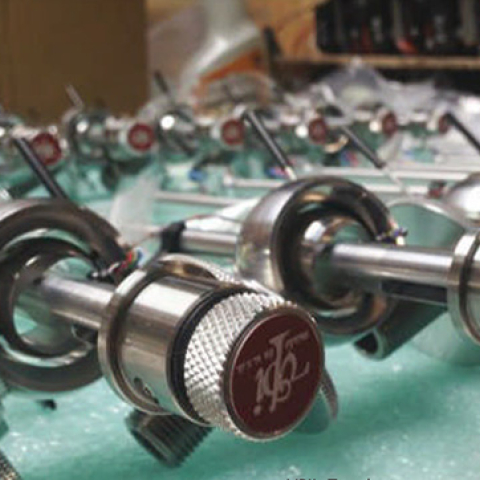
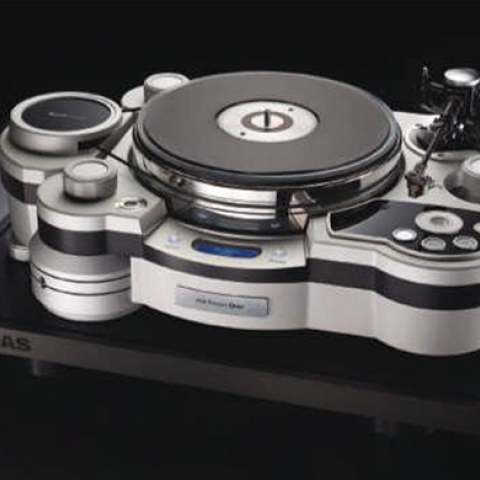
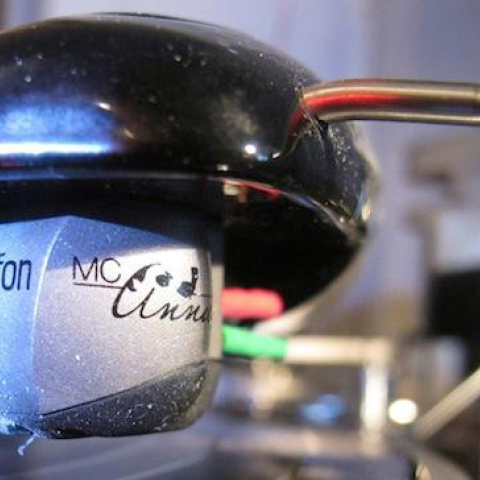
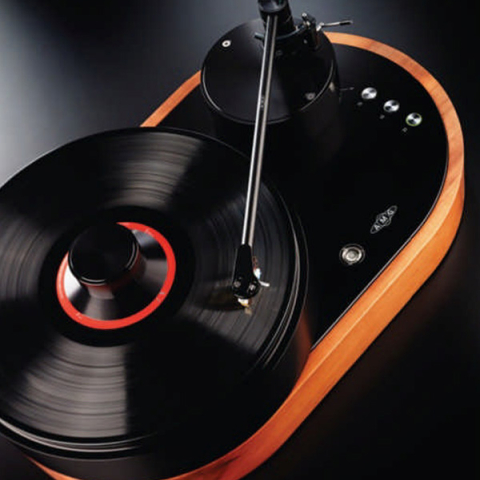
The X-quisite produced thrilling, pinpoint, delicate images on a giant, well-organized soundstage. Roy Orbison's "Running Scared" from Roy Orbison's Greatest Hits (Monument SLP18000) begins with just an acoustic guitar insistently strumming a Bolero-like rhythmic figure behind Roy's voice. Each strum became a fully formed event as the pick hit the strings, of sustain as the guitar resonated, and then of decay in a relatively dry sonic space. The guitar's image was tightly compact and so timbrally clarified that "Gibson L-5, Hank Garland" popped into my mind. (Was it? I'm not sure.) Roy sounded as if he was in a different space—because he was. He'd been placed in an improvised "isolation booth" so he could be heard above the orchestra. I've played this track 100 times, but this presentation still startled.
Then the drummer (Buddy Harman?) picks up the beat on the toms and the other instruments fall in line including strings, brass, and way-backup vocals. (Engineer Bill Porter pioneered this effect, closely miking the backup singers, having them sing sotto voce, and placing their voices way back in the mix.) All the instruments are attacking that Bolero beat, but each element was so resolved in time and space that I could choose to hear them massed or individually. When the drummer attacks the cymbal at the song's climax (as Roy sings "then all at once"), it rang with a chiming authority, separated in space, more clearly articulated than I'd ever heard it.
Sometimes (as when I heard that cymbal), I thought the cartridge's timbral balance—a wideband upper-midrange "ledge"—produced the excitement. Yet, when I played the Bruckner Symphony No.7 Direct-to-Disc recording with Haitink conducting the Berlin Philharmonic Orchestra, massed strings that can sound strident through other cartridges sounded sweet and sonorous. Woodwinds and brass, too, sounded as convincing as I've ever heard them on that recording, especially the oboes and bassoons.
The X-quisite produced smooth, clean, distortion-free sibilants that flowed naturally.
The very familiar track "The Man Who Sold the World," from the sensational-sounding 1972 UK RCA reissue (LSP-4816) of the album of the same name (by David Bowie of course), produced a major sonic event in my listening room, so powerful it left me slumped in my chair. Each of the coda's many haunting vocal overdubs had a distinct place on the stage, and each was presented in three dimensions and "reach out and touch it" transparent. The güiro that enters shortly after the song begins, which usually sounds more raspy and less "organic" than the instrument really sounds, was reproduced as convincingly as I've ever heard it.
Many familiar records delivered new and unexpected sonic rewards that added meaning, not razzle-dazzle, to the music. Late every evening, I'd come back upstairs and say to Sharon, "I can't believe what I just heard." You'd think that after doing this for 30 years, that thrill would be gone, but no, not yet!
The record that had me, my wife, and a COVID-safe neighbor bowled over was the Mobile Fidelity reissue of Little Feat's Waiting for Columbus (MFSL 2-013). My neighbor—always the skeptic—stared at the focused, palpable center fill on the opening track, "Fatman in the Bathtub," pointed, and said, mouth agape, "It's hanging right there!" Sharon, the Little Feat fan, had said the same thing a few nights earlier. The sound was as big, pleasingly loud, 3D, dynamic, and gut-busting as being at an actual Little Feat arena show.
You could hear it coming as the guys picked up their instruments and tested the sound. Other cartridges have made valiant attempts, but the X-quisite delivered it, reminding me of that Maxell poster Boomers know well.
Faults? Perhaps the bottom end wasn't as robust as that produced by some other top-shelf cartridges. Those who like rich and warm will not like the X-quisite—especially in that upper-mids area. Maybe there are other cartridges that can deliver a little more slam and midbass comfort. But for sheer musical excitement, across all genres, Mr. Huber's X-quisite ST tightens the musical screws and delivers to your room a dose of real you won't soon get over. As a fellow Stereophile writer who (safely) visited concluded after hearing The Who's "Baba O'Reilly": "That changed my life!"
And Then It Was Gone
One afternoon a few weeks ago, the greatest (and most costly) system my room has ever hosted vanished.
No, it wasn't stolen, and I didn't break another X-quisite cantilever. After years of frequent power outages due to wind and snowstorms, we decided we were done with losing power and that gasoline-powered generators were a royal pain in heavy snow. We—my wife and I—bit the bullet and ordered a 22kW natural gas–powered generator. A few days ago, the workers arrived to install it.
For the same $13,000 that Generac generator cost (with installation), I could have had a nice pair of 1m interconnects. Instead, I chose heat, hot water, and lights.
 Power was out for half a day while they installed the generator and the transfer switch—a large box on the side of the house that, when the power from the street goes out, automatically shifts the household electricity to the generator. Think of it as a giant A/B/X switch.
With the install complete and the power restored, I went back to work, ie, listening, but the super–high-performance system that the day before had effortlessly disappeared leaving me suspended in time and space—the space the recording engineers created—was sounding like a giant ungainly boombox.
I love telling people, "The music you listen to on your stereo system is a modulated version of the AC coming into your home," and yet I never imagined that installing a generator would destroy my precious sound.
At first, I thought the sound would eventually return, as it had after Hurricane Sandy. But days later, my system's sound was still gone—and that's not hyperbole. Flat, against the speaker imaging, zero three-dimensionality, dark halos around muffled vocals, soft to almost nonexistent high-frequency transients. I could go on.
I pulled out key records trying to diagnose exactly what I was hearing. I played an original green-label Warner Brothers edition of Van Morrison's Moondance (WS 1835, then a "SuperDisk" (Direct Disk Lab's SD16604) half-speed mastered version. Finally, I streamed the album. I got the same washed-out sound from all three sources: The bass was soft and rubbery, Van's voice was hooded, and the cymbals were soft. The pristine solo-guitar link between verses, and then when Van sings "And it stoned me," shocked the most: The metallic excitement of each string being plucked was replaced with an AM-radio version. Waiting for Columbus sounded like I was hearing it from outside the stadium.
What had changed? Please note: The generator was not providing the power: It was installed, but it was not turned on. The power was the same, except now it arrived via that transfer switch. How could that do this?
Whatever was going on, it was not "confirmation bias," the favorite bugaboo of the Audiophiles - North America crowd; I wasn't expecting to hear anything different when the power was restored. I was shocked by what I heard.
I consulted Garth Powell, senior director of engineering at AudioQuest. In the email header, I asked: "Am I Hearing Things?"
"You are most certainly not imagining things!," Powell responded. He told me that he's gotten similar panicked emails and calls from others who have installed backup AC power systems of various kinds and whose sonically damaged systems he helped diagnose.
I did not ask his permission to quote what he told me, so I won't, but he provided me with some reasons why installing a transfer switch could destroy the sound. Apparently, auxiliary generator systems can induce various kinds of noise into the AC and block induced RF noise from returning to earth ground. "Code only concerns itself with fire and electrocution," he wrote. "Noise is not a parameter that's even considered."
The only solution, he concluded, was a discrete power line for my audio system. That turns out to be against code, so the utility won't run a separate line from the pole. But with a double-tap meter, a second line can run to a second breaker box, bypassing the transfer switch and powering just the audio system and my similarly sound-compromised home theater system upstairs.
So, that's on order. Meanwhile, I asked PS Audio (footnote 5) to send me two of their DirectStream Power Plants, which are claimed to "regenerate new, safe, pure AC, delivering over twenty times the available peak energy for unrestricted dynamics." I got a P20 ($9999) for my amplifiers and a P15 ($7499) for my "front end."
Could there be a more challenging test of PS Audio's claims? I installed the massive P20 first and listened. YES! YES! YES! I installed the P15 and listened: "I'll have what she's having!"
I'm out of time and space, but next time I'll begin with detailed coverage of these two system savers.
Power was out for half a day while they installed the generator and the transfer switch—a large box on the side of the house that, when the power from the street goes out, automatically shifts the household electricity to the generator. Think of it as a giant A/B/X switch.
With the install complete and the power restored, I went back to work, ie, listening, but the super–high-performance system that the day before had effortlessly disappeared leaving me suspended in time and space—the space the recording engineers created—was sounding like a giant ungainly boombox.
I love telling people, "The music you listen to on your stereo system is a modulated version of the AC coming into your home," and yet I never imagined that installing a generator would destroy my precious sound.
At first, I thought the sound would eventually return, as it had after Hurricane Sandy. But days later, my system's sound was still gone—and that's not hyperbole. Flat, against the speaker imaging, zero three-dimensionality, dark halos around muffled vocals, soft to almost nonexistent high-frequency transients. I could go on.
I pulled out key records trying to diagnose exactly what I was hearing. I played an original green-label Warner Brothers edition of Van Morrison's Moondance (WS 1835, then a "SuperDisk" (Direct Disk Lab's SD16604) half-speed mastered version. Finally, I streamed the album. I got the same washed-out sound from all three sources: The bass was soft and rubbery, Van's voice was hooded, and the cymbals were soft. The pristine solo-guitar link between verses, and then when Van sings "And it stoned me," shocked the most: The metallic excitement of each string being plucked was replaced with an AM-radio version. Waiting for Columbus sounded like I was hearing it from outside the stadium.
What had changed? Please note: The generator was not providing the power: It was installed, but it was not turned on. The power was the same, except now it arrived via that transfer switch. How could that do this?
Whatever was going on, it was not "confirmation bias," the favorite bugaboo of the Audiophiles - North America crowd; I wasn't expecting to hear anything different when the power was restored. I was shocked by what I heard.
I consulted Garth Powell, senior director of engineering at AudioQuest. In the email header, I asked: "Am I Hearing Things?"
"You are most certainly not imagining things!," Powell responded. He told me that he's gotten similar panicked emails and calls from others who have installed backup AC power systems of various kinds and whose sonically damaged systems he helped diagnose.
I did not ask his permission to quote what he told me, so I won't, but he provided me with some reasons why installing a transfer switch could destroy the sound. Apparently, auxiliary generator systems can induce various kinds of noise into the AC and block induced RF noise from returning to earth ground. "Code only concerns itself with fire and electrocution," he wrote. "Noise is not a parameter that's even considered."
The only solution, he concluded, was a discrete power line for my audio system. That turns out to be against code, so the utility won't run a separate line from the pole. But with a double-tap meter, a second line can run to a second breaker box, bypassing the transfer switch and powering just the audio system and my similarly sound-compromised home theater system upstairs.
So, that's on order. Meanwhile, I asked PS Audio (footnote 5) to send me two of their DirectStream Power Plants, which are claimed to "regenerate new, safe, pure AC, delivering over twenty times the available peak energy for unrestricted dynamics." I got a P20 ($9999) for my amplifiers and a P15 ($7499) for my "front end."
Could there be a more challenging test of PS Audio's claims? I installed the massive P20 first and listened. YES! YES! YES! I installed the P15 and listened: "I'll have what she's having!"
I'm out of time and space, but next time I'll begin with detailed coverage of these two system savers.
Footnote 5: PS Audio, 4865 Sterling Drive, Boulder, CO 80301 Tel: 1-800-PSAUDIO Web: psaudio.com.
One afternoon a few weeks ago, the greatest (and most costly) system my room has ever hosted vanished.
Power was out for half a day while they installed the generator and the transfer switch—a large box on the side of the house that, when the power from the street goes out, automatically shifts the household electricity to the generator. Think of it as a giant A/B/X switch.
Footnote 5: PS Audio, 4865 Sterling Drive, Boulder, CO 80301 Tel: 1-800-PSAUDIO Web: psaudio.com.