Atmospheric pressure maintains a special grade of viscous oil at bearing height within the pressurized inverted bearing upon which the 14", 30lb platter rides.
The "high tech" bearing sleeve, which is fabricated from a newer, more advanced material related to PTFE (think Teflon), requires no lubrication. The bearing is not of the typical polished variety but instead has a microscopically rough surface, because the Teflon sleeve is designed to ablate under pressure and shed microscopic particles that then become embedded in the bearing shaft, producing a smooth, durable mating surface that over time improves the turntable's sound and lowers the already low noise floor.
Indeed, the new production model sounded "transient-sharp" when first delivered but then mellowed out to sound like the well-broken-in prototype.
The viscous oil and the carefully calculated platter weight produce a precise "pre-drag" load designed to resist speed changes; tight coupling between the rotor and stator field helps produce a "stiff" motor that also minimizes microscopic speed changes.
The "state of the art" motor control system used in the K3 is said to include an automated diagnostic and optimization procedure, but the design team found it sufficed only to get them "in the ballpark." Two years of programming and tweaking including blind testing totaling in excess of 1000 hours helped produce the final rotational performance. Weiss and Krebs found that, "much to their astonishment," the most minute speed changes were audible—"down to arc seconds of rotation." There are 1,296,000 arc seconds in one rotation.
A Bucknell representative stated in a letter to OMA that, based on FEA analysis, "platter and insert assembly are two critical components of a turntable because they [significantly] affect the frequency response of the turntable."
The research resulted in a ceramic-coated platter containing not only the aforementioned damping chambers within its machined aluminum alloy platter but also a constrained-layer– damped marine brass subplatter, layers of felt and polymer, and a circumferential high-frequency damping ring around the outside of the platter. The platter is topped with one of OMA's mats, precision machined from an extremely high grade of polycrystalline graphite.
Even the high-mass collet-type record clamp incorporates internal damping using the same mix of particulate matter and oil.
The 24V DC power supply
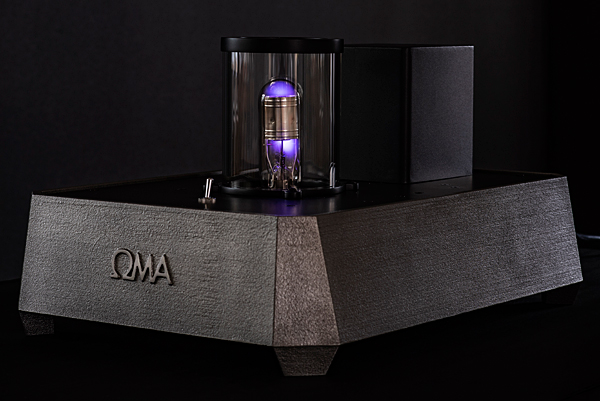
The K3 could easily run off of a "wall wart" cube, especially since the 24V DC supply does not directly drive the motor. The motor is driven by the digital motor controller—but a cheap supply for a costly turntable was never considered. Lab-grade "scientific quality" regulated power supplies were tested first, followed by custom supplies using batteries, and finally, a tube-regulated supply using a Xenon rectifier, which produced a surprising yet inexplicable sonic improvement, as judged by Weiss, Krebs, and OMA tech Douglas Eisemann, who conceived and implemented the idea. (Anyone who's compared Brinkmann's solid state and tubed motor power supplies would not be at all surprised.) Plus, housed in its own chassis, heavier than most turntables, and producing a dancing, Prince-like purple glow, it looks great.
This arm (which has no name, but needs one!), available only on the K3, is a typically elegant Frank Schröder design with an effective length of 282mm (11.1"). It is, according to Schröder, the first tonearm to be constructed with selective laser melting (SLM). The primary goal of the design, Schröder said, is to reduce energy storage to near zero, "which in part accounts for the lack of overhang throughout the sonic spectrum." As with his other creations, every parameter is adjustable, though the set points are mostly well-hidden to avoid "curious fingers" and dangling parts. This arm will surely be set up by a professional and not the end user, but setting it up is ridiculously easy. Antiskating compensation is based on magnetic attraction and repulsion and is adjustable via a magnet-tipped set screw.
A tiny, indexed wheel adjusts azimuth at the vertical bearing pivot by raising or lowering bearing pins set in a pair of inverted, self-centering cups.
A helicoid that forms the arm base and works like a high-friction version of a lens's focus or zoom ring neatly lowers and raises the arm for setting VTA/SRA once you've set the arm shaft height in the traditional manner. This is a very cool innovation and so easy to adjust! The arm alone probably deserves a column.
What the K3 does and does not feature
Antiskating compensation is based on magnetic attraction and repulsion and is adjustable via a magnet-tipped set screw.
A tiny, indexed wheel adjusts azimuth at the vertical bearing pivot by raising or lowering bearing pins set in a pair of inverted, self-centering cups.
A helicoid that forms the arm base and works like a high-friction version of a lens's focus or zoom ring neatly lowers and raises the arm for setting VTA/SRA once you've set the arm shaft height in the traditional manner. This is a very cool innovation and so easy to adjust! The arm alone probably deserves a column.
What the K3 does and does not feature
The K3 produced the best overall measurements I've encountered (figs.1 & 2), but not by large margins. Remember: The Platterspeed and shaknspin apps are not scientific devices; rather, they're intended to provide an informal baseline. I continue using them because the better turntables measure better, but neither does much more than take speed and wow and flutter averages over time.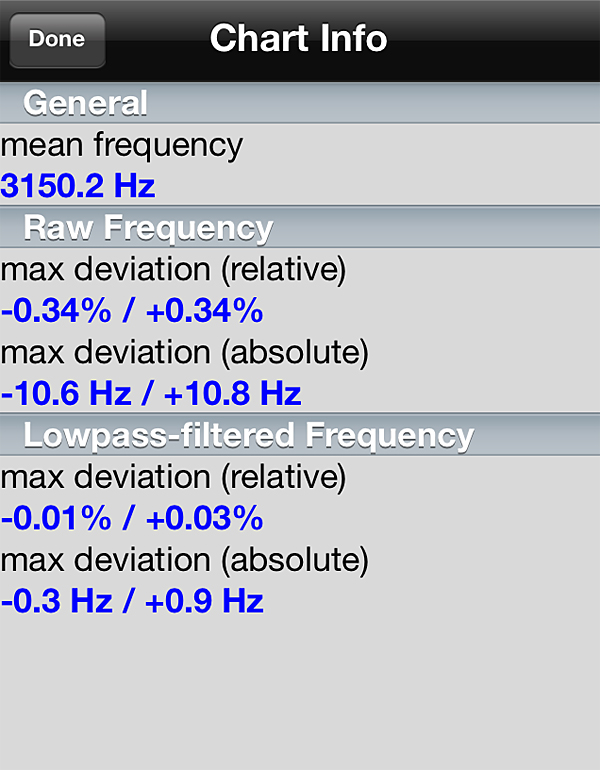
 While OMA justifiably likens its K3 design to a cutting lathe—it resembles one more than any other turntable I've encountered—it omits one feature common to all: vacuum hold down. OMA's tech sheet claims that its damped platter obviates the need for it. That proved more or less true in terms of normal record/platter coupling, as long as you achieved a tight platter–record bond with the screw-on clamp; not doing so was audible.
Warped records are another matter. I love Haim's double-45rpm set Women in Music Pt III (Columbia 19439748311) including the cover, shot at Canter's Deli on Fairfax Avenue in Los Angeles. More than two dozen salamis hang behind the three Haim sisters, and the "now serving" number is set to 69.
The first record has a warp the OMA can't handle. That's something to be considered when spending $360,000 for a turntable with tonearm, or $400,000 with dedicated stand, or $450,000 for all of that plus OMA's phono preamplifier, which is incorporated into the stand. However, the $1150 ORB DF-01iA disc flattener can solve the problem. Review to come.
Together, the two K3s have been here for 10-plus months. They performed flawlessly—as you'd expect from an "industrial grade" machine, and that includes the rectifier tube in the power supply. Trouble-free, fun to use, built like a critically damped tank, OMA's K3 appears to have the "last a lifetime" goods and sonics to keep you happy from now to the inevitable.
K3 sound
While OMA justifiably likens its K3 design to a cutting lathe—it resembles one more than any other turntable I've encountered—it omits one feature common to all: vacuum hold down. OMA's tech sheet claims that its damped platter obviates the need for it. That proved more or less true in terms of normal record/platter coupling, as long as you achieved a tight platter–record bond with the screw-on clamp; not doing so was audible.
Warped records are another matter. I love Haim's double-45rpm set Women in Music Pt III (Columbia 19439748311) including the cover, shot at Canter's Deli on Fairfax Avenue in Los Angeles. More than two dozen salamis hang behind the three Haim sisters, and the "now serving" number is set to 69.
The first record has a warp the OMA can't handle. That's something to be considered when spending $360,000 for a turntable with tonearm, or $400,000 with dedicated stand, or $450,000 for all of that plus OMA's phono preamplifier, which is incorporated into the stand. However, the $1150 ORB DF-01iA disc flattener can solve the problem. Review to come.
Together, the two K3s have been here for 10-plus months. They performed flawlessly—as you'd expect from an "industrial grade" machine, and that includes the rectifier tube in the power supply. Trouble-free, fun to use, built like a critically damped tank, OMA's K3 appears to have the "last a lifetime" goods and sonics to keep you happy from now to the inevitable.
K3 sound
The K3 was fast, clean, detailed, highly resolving, super-transparent, effortlessly dynamic, and capable of producing unparalleled transient precision and depth-charge-deep bass "wallop" that's fully extended yet totally free from overhang. The K3's "hit fast, hit hard, linger just long enough, and then get out of town" performance could not have been more different from the Air Force Zero's. That would come as neither a surprise nor a disappointment to either 'table's designers—although my time with Mr. Weiss leads me to believe he'll be disappointed that I didn't write that "the K3 blows the fat, sluggish, energy-retaining Air Force Zero out of the water." I've heard my share of fat, sluggish, bulbous-sounding turntables and thin, lean, edgy, bass-deficient ones too. The sonic performance of these two super-'tables—and that of the SAT XD1, which sonically sits somewhere in between—isn't accidental. All three are purposeful and intentional in design and sonic outcome.
The K3 is brash and bold (which doesn't mean bright or mechanical), while the Air Force Zero is velvety and reserved (which doesn't mean timid or sluggish). I'd give the silent-backgrounds nod to the Zero (over every turntable I've yet heard) and the pristine, explosive transients nod to the K3.
Repeating the "Time Out" and "Fever" tracks used in the Air Force Zero review in the September 2021 Stereophile made the sonic differences between the two 'tables clear. Which you would prefer depends on your sonic preferences, though I can't imagine anyone not being transfixed by both. Will you hear the K3's rendering of Joe Morello's kickdrum hits as truncated and stingy compared to the Air Force Zero's or as more precise, more nimble, more cleanly rendered yet no less powerful? Will you decode the Zero's sustain generosity as "time stoppingly unique and exciting," resulting in a bigger, more generous soundstage with more space around the instruments, or as perhaps a tiny bit too thick and too slow for your sonic sensibilities?
 The K3 was a cartridge differentiation champ. It clearly defined the timbral and textural differences between Lyra's Etna SL Lambda and Atlas SL Lambda. The Etna's midrange was fuller and fleshier than the Atlas's, which produced a somewhat leaner but more transparent picture. Ortofon's Anna D, which some critics find harmonically threadbare—I don't, at all—let fly with satisfying midband riches, bottom-end wallop, all of the detail the Replicant 100 stylus produces, and the startling 3D imaging and soundstaging for which it's known (when correctly set up!).
The "unobtainium" Craft "Small Batch" pressing of Yusef Lateef 's 1961 classic Eastern Sounds (Moodsville/Craft CR00229) opens with Lateef blowing into a Chinese globular flute. It has a particular whistling sound like (as the annotation says) blowing into a soda bottle. Lateef is on the left. Barry Harris's piano sits well back center stage. (Rudy gets it right this time.) Percussion is on the right—a rhythmic tapping of an unidentified something or other plus what sounds like a jangling tambourine—an utterly natural, transparent, and convincing presentation via the Anna D with airy flute roundness, sparkling, effervescent percussion, and zero overhang.
As with any truly great audio product, regardless of price, the OMA K3 turntable speaks with a singular voice.
Conclusion
The K3 was a cartridge differentiation champ. It clearly defined the timbral and textural differences between Lyra's Etna SL Lambda and Atlas SL Lambda. The Etna's midrange was fuller and fleshier than the Atlas's, which produced a somewhat leaner but more transparent picture. Ortofon's Anna D, which some critics find harmonically threadbare—I don't, at all—let fly with satisfying midband riches, bottom-end wallop, all of the detail the Replicant 100 stylus produces, and the startling 3D imaging and soundstaging for which it's known (when correctly set up!).
The "unobtainium" Craft "Small Batch" pressing of Yusef Lateef 's 1961 classic Eastern Sounds (Moodsville/Craft CR00229) opens with Lateef blowing into a Chinese globular flute. It has a particular whistling sound like (as the annotation says) blowing into a soda bottle. Lateef is on the left. Barry Harris's piano sits well back center stage. (Rudy gets it right this time.) Percussion is on the right—a rhythmic tapping of an unidentified something or other plus what sounds like a jangling tambourine—an utterly natural, transparent, and convincing presentation via the Anna D with airy flute roundness, sparkling, effervescent percussion, and zero overhang.
As with any truly great audio product, regardless of price, the OMA K3 turntable speaks with a singular voice.
Conclusion
I spent a great deal of column space describing the product and probably not enough describing the sonics, but hopefully you got the picture. There was so much honest, innovative technology to cover, all of it important to understand. The K3 is a from-the-ground-up, truly innovative design with a unique, flashy-and-functional faáade—whatever your reaction to its looks. In many ways, the K3 reminds me of the Continuum Caliburn, from the international design team to the effective mix of science, art, and reach-for-the-stars innovation. However, 16 years later, the K3's turbocharged, precision performance blows the chrome doors off of the Caliburn, although it is still a great turntable and a classic design. Time marches on. Records spin round and round.
The K3 could easily run off of a "wall wart" cube, especially since the 24V DC supply does not directly drive the motor. The motor is driven by the digital motor controller—but a cheap supply for a costly turntable was never considered. Lab-grade "scientific quality" regulated power supplies were tested first, followed by custom supplies using batteries, and finally, a tube-regulated supply using a Xenon rectifier, which produced a surprising yet inexplicable sonic improvement, as judged by Weiss, Krebs, and OMA tech Douglas Eisemann, who conceived and implemented the idea. (Anyone who's compared Brinkmann's solid state and tubed motor power supplies would not be at all surprised.) Plus, housed in its own chassis, heavier than most turntables, and producing a dancing, Prince-like purple glow, it looks great.
Photo: Cynthia van Elk/OMA
Frank Schröder's SLM "aluminum girder" tonearmThis arm (which has no name, but needs one!), available only on the K3, is a typically elegant Frank Schröder design with an effective length of 282mm (11.1"). It is, according to Schröder, the first tonearm to be constructed with selective laser melting (SLM). The primary goal of the design, Schröder said, is to reduce energy storage to near zero, "which in part accounts for the lack of overhang throughout the sonic spectrum." As with his other creations, every parameter is adjustable, though the set points are mostly well-hidden to avoid "curious fingers" and dangling parts. This arm will surely be set up by a professional and not the end user, but setting it up is ridiculously easy.
Photo: Cynthia van Elk/OMA
The cartridge is first affixed to a porous, "foamed" aluminum plate, which secures to the arm with a single bolt—an oft-copied Schröder innovation. The adjustable offset angle is set with a small rod inserted through a tiny hole in the arm and fitted into the "foamed" plate; once that's set, the single bolt is securely fixed.
The disc-shaped counterweight rides on an articulated flat stub that rises and lowers in opposition to the arm's vertical movement for greater vertical stability and tracking-force consistency. This levered system allows for a lighter counterweight than would normally be found in a medium-to-high–effective-mass tonearm. Loosening a large, knurled set screw allows the counterweight to slide on the flat stub for coarse vertical tracking force (VTF) adjustment, after which a fine adjustment weight, which is built into the counterweight and accessed through an opening at the counterweight's rear, dials in the final VTF. Very neat and easy to use.
The K3 produced the best overall measurements I've encountered (figs.1 & 2), but not by large margins. Remember: The Platterspeed and shaknspin apps are not scientific devices; rather, they're intended to provide an informal baseline. I continue using them because the better turntables measure better, but neither does much more than take speed and wow and flutter averages over time.
Fig.1 OMA K3, speed stability data.
Fig.2 OMA K3, speed stability (raw frequency yellow; low-pass filtered frequency green).
The shaknspin measurements were equally stellar. Everything promised in the K3's lengthy information sheet proved true.
The K3 is solid as a rock, the Schröder tonearm elegant in its simplicity. The tonearm performed flawlessly with a wide variety of cartridges, board to be rigidly bolted to the rear of the plinth, so two arms can be used.
The K3 was fast, clean, detailed, highly resolving, super-transparent, effortlessly dynamic, and capable of producing unparalleled transient precision and depth-charge-deep bass "wallop" that's fully extended yet totally free from overhang. The K3's "hit fast, hit hard, linger just long enough, and then get out of town" performance could not have been more different from the Air Force Zero's. That would come as neither a surprise nor a disappointment to either 'table's designers—although my time with Mr. Weiss leads me to believe he'll be disappointed that I didn't write that "the K3 blows the fat, sluggish, energy-retaining Air Force Zero out of the water." I've heard my share of fat, sluggish, bulbous-sounding turntables and thin, lean, edgy, bass-deficient ones too. The sonic performance of these two super-'tables—and that of the SAT XD1, which sonically sits somewhere in between—isn't accidental. All three are purposeful and intentional in design and sonic outcome.
Photo: Vincent Dixon
The finger snaps on Elvis's "Fever" were not as fleshy through the K3 as they were via the Air Force Zero, but the transient snap was faster and more clearly defined (with the same cartridge) yet it was certain you were hearing flesh, not corn popping. Preferences will differ, but any fair-minded listener hearing these two 'tables would be certain they were hearing two of the best turntables ever made. Both will stop you in your standing or sitting tracks!
I spent a great deal of column space describing the product and probably not enough describing the sonics, but hopefully you got the picture. There was so much honest, innovative technology to cover, all of it important to understand. The K3 is a from-the-ground-up, truly innovative design with a unique, flashy-and-functional faáade—whatever your reaction to its looks. In many ways, the K3 reminds me of the Continuum Caliburn, from the international design team to the effective mix of science, art, and reach-for-the-stars innovation. However, 16 years later, the K3's turbocharged, precision performance blows the chrome doors off of the Caliburn, although it is still a great turntable and a classic design. Time marches on. Records spin round and round.