Sidebar 3: Measurements
I measured the Aqua Formula xHD DAC with my Audio Precision SYS2722 system (see the January 2008 As We See It"), using both the Audio Precision's coaxial and AES/EBU digital outputs, and USB data sourced from my MacBook Pro running on battery power with Pure Music 3.0 playing WAV and AIFF test-tone files. Apple's USB Prober utility identified the Formula xHD as "aqua XHD" from "aqua," its serial number as "0 (none)," and confirmed that its USB port operated in the optimal isochronous asynchronous mode. Apple's AudioMIDI utility revealed that, via USB, the Formula xHD accepted 24-bit integer data sampled at all rates up to 768kHz. Its coaxial and AES/EBU inputs accepted PCM datastreams with sample rates up to 192kHz.
The Formula xHD's maximum output level at 1kHz in was 3.84V from its balanced outputs and 2.8V from its unbalanced outputs, the latter 2.9dB higher than the CD standard's 2V. The outputs preserved absolute polarity with the front-panel Phase LED dark. (The XLR jacks are wired with pin 2 hot.) The unbalanced output impedance was higher than the specified 19 ohms, at 100 ohms across the audioband. The balanced output impedance is specified as 600 ohms; I measured 24 ohms at low frequencies, and 68 ohms at the top of the audioband.
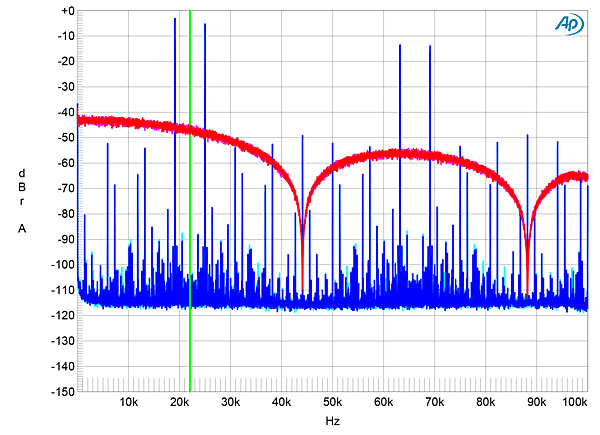
The reconstruction filter's impulse response was a perfect pulse (fig.1; ignore the tiny amounts of pre- and post-ringing, which are due to the SYS2722's anti-aliasing filter operating at a sample rate of 200kHz). There is no digital reconstruction filter, and with white noise sampled at 44.1kHz (fig.2, magenta and red traces, footnote 1) there was a slow rolloff above the audioband, disturbed by nulls at 44.1 and 88.2kHz. Consequently, the aliased image of a full-scale 19.1kHz tone (cyan and blue traces) was hardly suppressed at all.

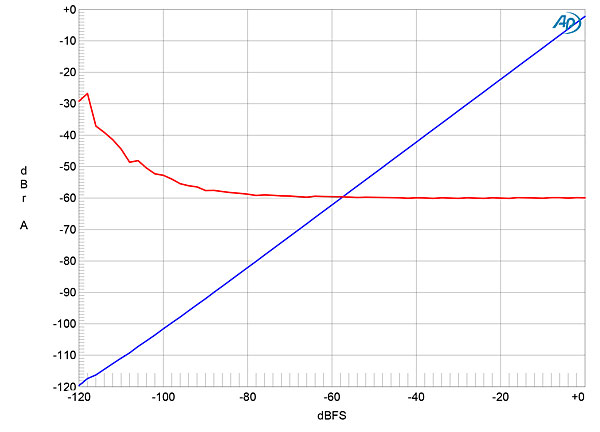
 The Formula xHD's channel separation was excellent, at >105dB from 100Hz to 10kHz, and the low-frequency noise floor was virtually free from any power-supply–related spuriae (fig.4). One thing I noted during this test was that the 1kHz waveform on my oscilloscope was stepped rather than smooth, which is typical of an NOS (Non-OverSampling) DAC. A relevant issue with resistor-ladder DACs is the linearity error: Will a digital signal at, say, –80dBFS be reproduced at the outputs by an analog signal the same 80dB down from full level? However, the Aqua performed well in this respect. When I examined its linearity (fig.5), the error was negligible down to –80dBFS, and remained below 1dB down to –104dBFS.

 Increasing the bit depth from 16 to 24 with a dithered 1kHz tone at –90dBFS (fig.6) dropped the noise floor by 25dB. However, the many distortion harmonics visible in the 24-bit signal suggest that something is not optimal in the Formula xHD's handling of low-level data with this bit depth. As with the HoloAudio Spring DAC reviewed in May, another resistor-ladder DAC, perhaps the LSBs are being truncated. With undithered data representing a tone at exactly –90.31dBFS (fig.7), the three DC voltage levels described by the data were well resolved. With undithered 24-bit data, the result was a clean sinewave (fig.8).




 Most of the questionable aspects of the Aqua Formula xHD's measured performance stem from its lack of a reconstruction filter. But its poor rejection of word-clock jitter, and that inadequate transformer used to implement the balanced outputs, are flaws that should have been avoided.—John Atkinson
Footnote 1: My thanks to Jürgen Reis of MBL for suggesting this test to me.
Fig.1 Aqua Formula xHD, impulse response (one sample at 0dBFS, 44.1kHz sampling, 4ms time window).
Fig.2 Aqua Formula xHD, wideband spectrum of white noise at –4dBFS (left channel red, right magenta) and 19.1kHz tone at 0dBFS (left blue, right cyan), with data sampled at 44.1kHz (20dB/vertical div.).
Looking in more detail at the frequency response from the balanced outputs (fig.3): Other than a rolloff below 25Hz, it is flat in the audioband at all sample rates, though there is a very slight rising trend toward 100kHz at the higher sample rates. Measured at the unbalanced outputs, the response was flat from 10Hz up (not shown). The channels were well matched from both sets of outputs.
Fig.3 Aqua Formula xHD, balanced frequency response at –12dBFS into 100k ohms with data sampled at: 44.1kHz (left channel green, right gray), 96kHz (left cyan, right magenta), 192kHz (left blue, right red) (1dB/vertical div.).
Fig.4 Aqua Formula xHD, spectrum, 0Hz–1kHz, of dithered 1kHz tone at 0dBFS (20dB/vertical div.).
Fig.5 Aqua Formula xHD, 1kHz output level vs data level in dBFS (blue, 10dB/vertical div.); linearity error (red, 1dB/vertical div.).
Fig.6 Aqua Formula xHD, spectrum with noise and spuriae of dithered 1kHz tone at –90dBFS with: 16-bit data (left channel cyan, right magenta), 24-bit data (left blue, right red) (20dB/vertical div.).
Fig.7 Aqua Formula xHD, waveform of undithered 1kHz sinewave at –90.31dBFS, 16-bit TosLink data (left channel blue, right red).
Fig.8 Aqua Formula xHD, waveform of undithered 1kHz sinewave at –90.31dBFS, 24-bit TosLink data (left channel blue, right red).
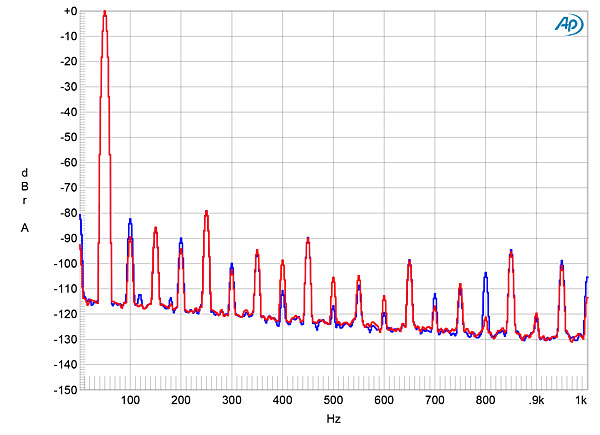
When I tested the Formula xHD's harmonic distortion from its balanced outputs, I got a surprise: With the 50Hz tone I usually use, the distortion was extremely high. Even at –3dBFS into 100k ohms (fig.9), the third harmonic lay at just –20dB (10%), which will be very audible. The unbalanced outputs offered very much lower distortion, even into 600 ohms (fig.10). Fig.11 plots the percentage of THD+noise against frequency with a full-scale signal into the high 100k ohms load from both balanced and unbalanced outputs. You can see that while both outputs offer similarly low distortion in the treble, the balanced THD+N percentage increases rapidly below 200Hz, with almost complete waveform clipping below 80Hz. As the distortion from the balanced output is almost completely odd-order harmonics, I suspect that what we are seeing in fig.10 is saturation of the output transformer's core. Fortunately, as Jason Victor Serinus used only the Aqua's unbalanced outputs, he dodged this bullet.
Fig.9 Aqua Formula xHD, balanced output, spectrum of 50Hz sinewave, DC–1kHz, at –3dBFS into 100k ohms (left channel blue, right red; linear frequency scale).
Fig.10 Aqua Formula xHD, unbalanced output, spectrum of 50Hz sinewave, DC–1kHz, at 0dBFS into 600 ohms (left channel blue, right red; linear frequency scale).
Fig.11 Aqua Formula xHD, THD+N (%) vs frequency at 0dBFS: balanced output (left channel blue, right red), unbalanced output (left cyan, right magenta).
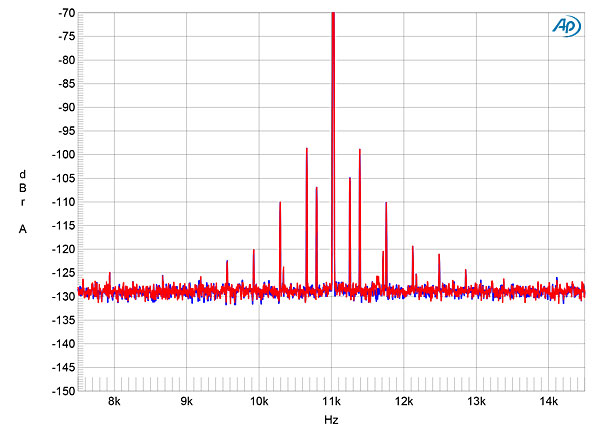
The poor ultrasonic rejection visible in fig.2 resulted in a multitude of aliased images with a full-scale mix of 19 and 20kHz tones (fig.12), and reducing the signal level by up to 10dB produced no change in the number of images. Fortunately, music rarely has significant energy toward the top of the audioband.
Fig.12 Aqua Formula xHD, balanced output, HF intermodulation spectrum, DC–30kHz, 19+20kHz at 0dBFS into 600 ohms, 44.1kHz data (left channel blue, right red; linear frequency scale).
When I tested the Formula xHD for its rejection of word-clock jitter, using undithered 16-bit J-Test data fed to its AES/EBU input, the odd-order harmonics of the low-frequency, LSB-level squarewave were much higher than they should have been (fig.13). (The correct levels are indicated by the sloping green line.) This behavior was identical when I repeated the test using the optical and coaxial inputs. However, the picture looked a little cleaner with 24-bit J-Test data sourced via USB (fig.14).
Fig.13 Aqua Formula xHD, high-resolution jitter spectrum of analog output signal, 11.025kHz at –6dBFS, sampled at 44.1kHz with LSB toggled at 229Hz: 16-bit AES/EBU data (left channel blue, right red). Center frequency of trace, 11.025kHz; frequency range, ±3.5kHz.
Fig.14 Aqua Formula xHD, high-resolution jitter spectrum of analog output signal, 11.025kHz at –6dBFS, sampled at 44.1kHz with LSB toggled at 229Hz: 24-bit USB data (left channel blue, right red). Center frequency of trace, 11.025kHz; frequency range, ±3.5kHz.
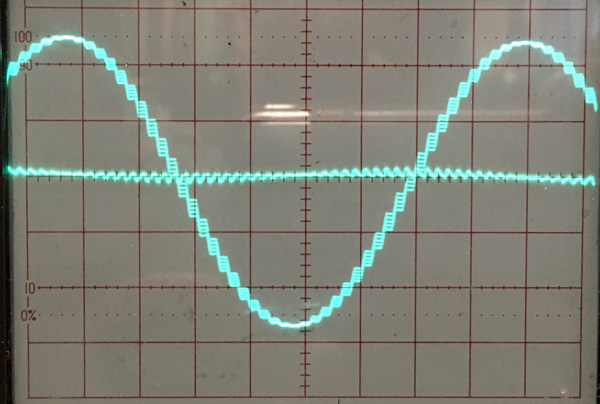
Fig.15 Aqua Formula xHD, waveform of analog output reproducing 1kHz waveform sampled at 44.1kHz. Note stepped appearance due to the absence of a reconstruction filter.
One of the earliest but incorrect criticisms of CD players was that they produced a "stepped" waveform. The criticism was incorrect because all players back then incorporated an analog or digital high-order, low-pass reconstruction filter that "smoothed" the waveform. Ironically, because D/A processors like the Aqua don't have a reconstruction filter, their output is indeed stepped, as you can see from fig.15.
Footnote 1: My thanks to Jürgen Reis of MBL for suggesting this test to me.