

 Though the original Artemis Systems Eos has been around for a few years, it doesn't seem to have made a big impression on audiophiles. Judging by a brief but exciting audition of the new Eos Signature and its accompanying Base Module at HI-FI '96, I found it hard to understand how it could remain such a well-kept secret. A few weeks later, to my surprise, Wes Phillips asked me if I wanted to review a pair and, throwing caution to the winds, I jumped at the opportunity. Rash move.
The movers delivered three large boxes and two absolutely huge crates. Inside the boxes were the two Eos Signatures and their external crossovers. Each crate contained a Base Module, and their appearance struck fear into my heart. I had gone too far—each one weighed 300 lbs, and together they were more commodious than some apartments in my Manhattan neighborhood. I signed for the delivery, then panicked when I realized there was no way to get these unpacked before my wife came home. Indeed, I didn't know how I was going to do it at all.
Enlisting a friend with a strong back and a sturdy dolly (the kind with wheels), we began by removing the multitude of screws that held the top and one side of each crate. We then gently walked each 225-lb Base Module onto the dolly for its trip to the other end of the listening room. While I can describe this task in two sentences, it was a long and serious undertaking. We had an easier task with the Eos Signatures (only 70 lbs each) and crossovers, and the precisely matched wood grain confirmed that each Signature was positioned correctly on its Base Module.
For wiring to their external crossovers, the Eos Signatures came with four stout lengths of Cardas Golden Hex 5C cable. But the Base Modules require separate wiring, so we quickly hooked up the Signatures without the Base Modules to see if our strenuous efforts had been in a good cause. Within seconds, we smiled at each other; these speakers were something special.
Though the original Artemis Systems Eos has been around for a few years, it doesn't seem to have made a big impression on audiophiles. Judging by a brief but exciting audition of the new Eos Signature and its accompanying Base Module at HI-FI '96, I found it hard to understand how it could remain such a well-kept secret. A few weeks later, to my surprise, Wes Phillips asked me if I wanted to review a pair and, throwing caution to the winds, I jumped at the opportunity. Rash move.
The movers delivered three large boxes and two absolutely huge crates. Inside the boxes were the two Eos Signatures and their external crossovers. Each crate contained a Base Module, and their appearance struck fear into my heart. I had gone too far—each one weighed 300 lbs, and together they were more commodious than some apartments in my Manhattan neighborhood. I signed for the delivery, then panicked when I realized there was no way to get these unpacked before my wife came home. Indeed, I didn't know how I was going to do it at all.
Enlisting a friend with a strong back and a sturdy dolly (the kind with wheels), we began by removing the multitude of screws that held the top and one side of each crate. We then gently walked each 225-lb Base Module onto the dolly for its trip to the other end of the listening room. While I can describe this task in two sentences, it was a long and serious undertaking. We had an easier task with the Eos Signatures (only 70 lbs each) and crossovers, and the precisely matched wood grain confirmed that each Signature was positioned correctly on its Base Module.
For wiring to their external crossovers, the Eos Signatures came with four stout lengths of Cardas Golden Hex 5C cable. But the Base Modules require separate wiring, so we quickly hooked up the Signatures without the Base Modules to see if our strenuous efforts had been in a good cause. Within seconds, we smiled at each other; these speakers were something special.
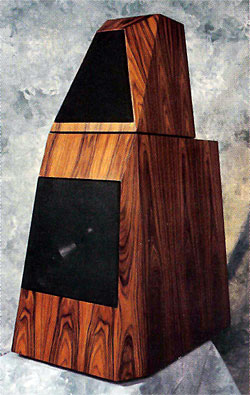
From the front, the Eos Signature looks like a truncated pyramid. The front panel tilts gently back, its sides and top strongly chamfered. Under the grille one finds a damping pad of thick felt with openings cut precisely to accommodate the 1" concave ceramic-dome HF driver and the 7" three-layer Kevlar/Nomex honeycomb woofer/midrange. The rear surface of the Eos bears a large flared port. While the standard Eos looks the same and has a first-order crossover network built-in, the Eos Signature has an external crossover box. Despite this, the Signature is no lighter than the standard Eos; a substantial internal damping system has been added to a cabinet that already had 1.25"-thick side walls and a 3"-thick front panel! The Signature's external crossover is first-order (6dB/octave), providing significant overlap in the output of the two drivers, and its larger-capacity components are isolated from the busy acoustic environment of the speaker enclosure. The width of the Base Module's upper surface fits the Eos Signature exactly, and its chamfered sides mirror those of its companion. The Base Module is heroically constructed of a five-layer composite with 2"-thick side walls and a 4"-thick front panel. It's simply oblivious to knuckle raps. Inside is an 11" Kevlar/Nomex driver similar to the 7" woofer/midrange, and the flared port on the rear is a bigger version of the one on the Eos. Although the Base Module contains a low-pass filter tailored to match the rolloff of the Eos, the two are wired in parallel, with no additional high-pass filtering on the Eos. The combined shape of the Eos/Base Module is graceful, the quality of the finish extraordinary, and, surprisingly, it does not dominate the room. In fact, this is the first loudspeaker in my living room to elicit favorable comments from my wife and from my interior-decorator neighbor, neither of whom cares a lot about sound. Let's hear it already!
We wired up the Eos Signatures, leaving the Base Modules to serve only as, well, bases, and positioned them in a seemingly reasonable location facing straight ahead. From the get-go, it was apparent that these speakers can make music come alive. Focused as we were on the hardware, it was especially stunning to hear them "disappear." Sounds seemed to emanate from the spaces between, above, behind, and even beside the Eoses, but only rarely from the cabinets themselves.















