

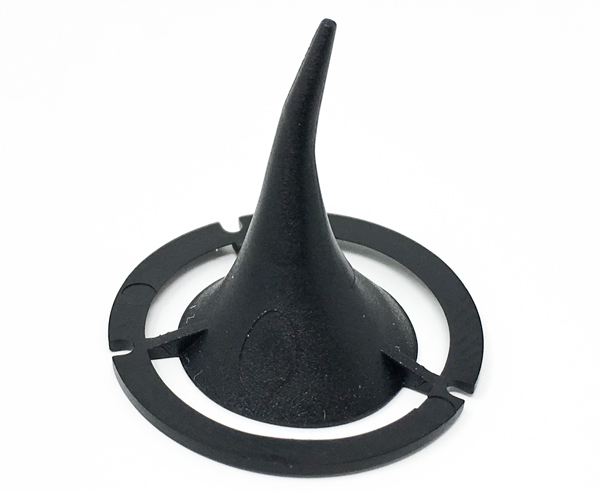
The Fazor within the eartube is crucial to the extreme linearity and low distortion performance of the iSine 20.
The trick, for any IEM, is to be a good acoustic impedance matching coupler. An IEM is a completely enclosed system with no normally propagated sound. An IEM is bascally a sonic waveguide from driver to eardrum. As sound moves from the driver through the various spaces to the ear drum, the acoustic impedance in each area can stimulate reflections and resonances if not carefully designed.
Two major competing goals in the IEM design process are linearity and frequency response. Linearity, in this case, means lack of distortion; the reduction of harmonic byproducts and resonances; and good time alignment. Good frequency response is producing something like the Harman response curve at the ear drum. The problem is if you optimize for lowest distortion, you don't necessarily, or even usually, get a good frequency response. If you tweak things to get a good frequency response, you usually do so at the expense of added distortion and phase error.
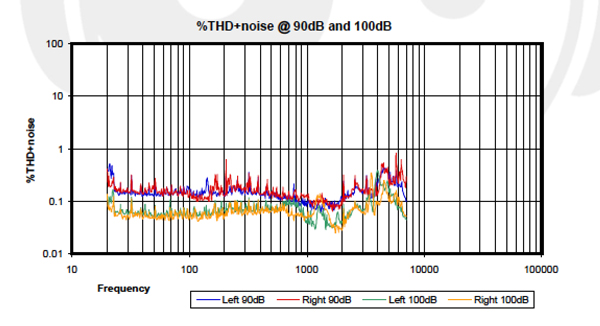 It appears to me that Audeze chose to optimize strongly for high linearity and low distortion. The above THD+noise measurement is one of, if not the lowest distortion measurements I've taken. It's absolutely superb. Much of this is due the the acoustic impedance matching of the Fazor plug in the eartube of the iSine.
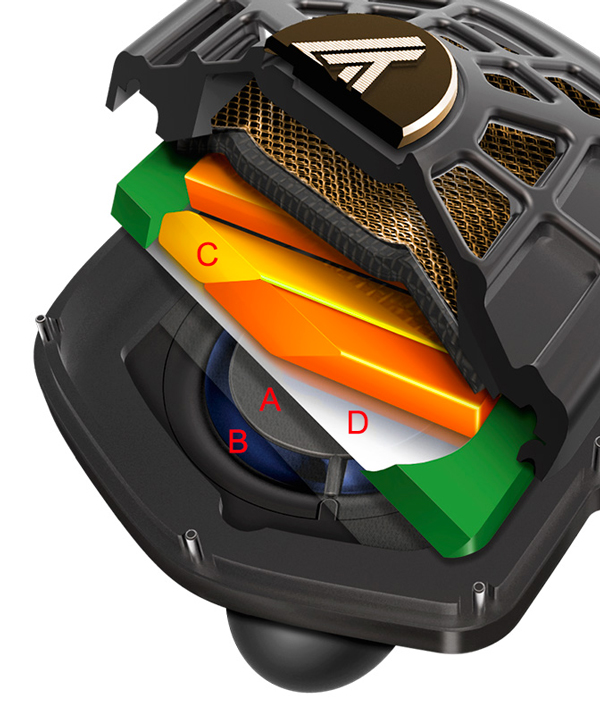
Exploded view of the iSine with parts labeled: A) The base of the Fazor plug; B) Openeing of the ear tube; C) Fluxor magnets; D) diaphragm.
In front of the iSine diaphragm is a circular opening for sound to enter the eartube (labeled B above). This opening is blocked in the center by the Fazor plug (A). This creates a ring shaped passage for sound that decreases in radius until it reaches the tip of the Fazor plug where the sound combines to exit the port into your ear canal.
I did get to talk with Sankar and Doc. C, their chief designer, during a factory visit about a year ago where we discussed the nature of this acoustic design. Suffice it to say it's an extremely complex gadget. In revisiting the Fazor plug this week I had a look at phase plugs and compression drivers as they appear similar in some ways. I asked Doc C. to explain the differences for me:
Let me start with compression drivers. Function is somewhat similar - transferring sound waves from large diaphragm to smaller area with minimum sound degradation. In compression drivers there is very small volume chamber where rigid diaphragm is installed. When diaphragm moves it creates high air pressure. Front side of the chamber (Phase Plug) has small openings or slots where air exits into a mouth of the horn. Openings are optimized to minimize phase anomalies and provide relatively smooth frequency response. Here we are dealing with high air pressure, very high air flow velocities and turbulent air flow behavior. Major benefits are very good acoustical impedance matching and very high efficiency. Downside - typically higher distortion and not very flat response. Compression drivers are limited bandwidth devices, mostly for high frequencies and sometimes for midrange. Near field listening is quite fatiguing with harsh sound.After seeing the measurements and noting the very low distortion but significant (in my view) deviation from an ideal target response, I asked if the direction of optimization was towards high linearity and then use of DSP to tweak the target response.Fazor - It is an acoustical structure placed within the sound port to properly manage sound waves propagation from large flexible diaphragm into small sound port exit. It works in conjunction with diaphragm, damping cloth (to manage the resonance of the diaphragm), ear canal and ear drum. Fazor has profound influence on the final frequency and phase response in the midrange and high frequencies creating spacious sound stage and great imaging. It is also responsible for acoustical impedance matching between diaphragm and air within sound port and ear canal resulting a very high efficiency (about 110dB/1mW).
iSine design was very complex. It took many months of acoustical simulations, prototyping and tweaking to get the best possible performance. This was ground breaking research of something that was not done previously. The main design goal was to make reliable, good sounding earphones with high power handling, very low distortion, great imaging, high sensitivity, and excellent sound quality. Due to the nature of the internal acoustics, like forcing large diaphragm to send sound through very small diameter hole we have ended up with not "perfect" response (still better than in most IEMs), but excellent behaving earphones. Along with our super-thin Uniforce Diaphragm, extremely strong magnetic induction created by our Fluxor magnets and open back design we have a unique product which is hard to beat.Here's the frequency response using the passive cable.Isine is primarily designed as a high-end portable solution for listening to the music. Since we have already developed Ligtning cable it was a natural solution for us to use its very powerful DSP to create even better sound signature. I am all along with your research on ideal target curve, as many others like Harman, ... Ligtning cable has given us a nice hardware solution to correct the earphones to sound as best as possible.
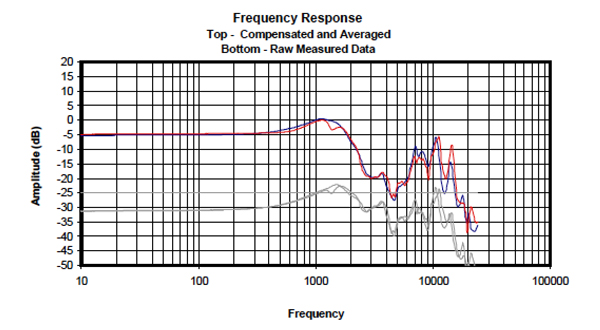 And here we see the corrected raw response with the Lightning cable.
 In passive mode you can see in the raw response plots (gray) that the major peak is at about 1.7kHz and does not resemble a good target response. In the Lightning cable measurement you can see that the response is quite close to the Harman target with a modest bass boost below 100Hz, a gentle and ever increasing run-up to the peak at 3kHz, and subsequent roll-off in the treble. This is a very nice response profile; the Cipher Cable DSP does a very good job of correcting the natural response of the iSine 20.
The down side, in my view, is that the iSine really needs to be driven through the Cipher cable from an Apple product. There are currently no easy tuning/EQ solutions for PC and Android users, but progress is being made, and some plug-ins are soon to be available. Audeze has shared their compensation curve as a set of parametric-EQ values, you can learn about it starting with this Head-Fi post by Karthick Manivannan, Audeze Research Director - Signal Processing. Until all that gets sorted, I consider the iSine 20 a product best viewed as Apple centric, and in that roll it excels.
In passive mode you can see in the raw response plots (gray) that the major peak is at about 1.7kHz and does not resemble a good target response. In the Lightning cable measurement you can see that the response is quite close to the Harman target with a modest bass boost below 100Hz, a gentle and ever increasing run-up to the peak at 3kHz, and subsequent roll-off in the treble. This is a very nice response profile; the Cipher Cable DSP does a very good job of correcting the natural response of the iSine 20.
The down side, in my view, is that the iSine really needs to be driven through the Cipher cable from an Apple product. There are currently no easy tuning/EQ solutions for PC and Android users, but progress is being made, and some plug-ins are soon to be available. Audeze has shared their compensation curve as a set of parametric-EQ values, you can learn about it starting with this Head-Fi post by Karthick Manivannan, Audeze Research Director - Signal Processing. Until all that gets sorted, I consider the iSine 20 a product best viewed as Apple centric, and in that roll it excels.















