

Sidebar 3: Measurements
I used DRA Labs' MLSSA system and a calibrated DPA 4006 microphone to measure the Audio Physic Step Plus's frequency response in the farfield, and an Earthworks QTC-40 for the nearfield responses. (I didn't use the grilles.) My estimate of the Audio Physic's voltage sensitivity was 84.2dB/2.83V/m, significantly lower than the specified 87dB/2.83V/m. While the specified nominal impedance is 8 ohms, the solid trace in fig.1 shows that the impedance magnitude drops slightly below 8 ohms in the midrange and to 6 ohms at 20kHz. The electrical phase angle (fig.1, dashed trace) never gets extreme, meaning that this speaker is easy for an amplifier to drive.

 The saddle centered on 50Hz in the impedance-magnitude trace in fig.1 suggests that this is the tuning frequency of the reflex port on the rear panel. However, as shown by the blue trace in fig.3, the woofer's minimum-motion notch, which is when the cone is held stationary by the back pressure from the port resonance, occurs a little lower in frequency, at 44Hz. The port's output (red trace) peaks a little more broadly than is usually the case, and its high-frequency rolloff is disturbed by low-level peaks at the same frequencies as the panel resonances noted earlier.
 Of greater concern in fig.3 is the major suckout in the crossover region in the farfield response on the tweeter axis (black trace). This suckout negatively affected my sensitivity estimate and will make the speaker sound lacking in life if the ear interprets the midrange level as being correct, or midrange-forward if the presence region is taken as the reference. This will depend on the music being played. This suckout does tend to fill in to the speaker's sides (fig.4)—I note that KM ended up with the Steps wide apart and with their sidewalls barely visible—but, more important, it disappears when a listener sits with his ears well above the tweeter, as can be seen both from the graph of the speaker's vertical dispersion (fig.5) and from the green trace in fig.3. If the Steps are placed on stands low enough that the tweeter is around 8" below the listener's ears, the treble balance will then be even and flat. But with the speakers on stands that place the tweeters higher than the listener's ears, the suckout will be even deeper.

 In the time domain, the Audio Physic's step response on the tweeter axis (fig.6) indicates the cause of this suckout: the drive-units are out of phase in the crossover region. While both drive-units are connected in positive acoustic polarity and, as usual, the tweeter's output arrives at the microphone before the woofer's, the decay of the tweeter's step overlaps the start of the woofer's step but is in opposite polarity. This could have been solved by inverting the polarity either of the tweeter or of the woofer, so that one unit's output smoothly blended with the other's. Alternatively, by moving the microphone significantly above the tweeter axis, the woofer's output is pushed back in time until its step smoothly blends with the decay of the tweeter's step. As a result, the outputs of the two drivers, instead of canceling, now correctly sum in the crossover region—again, compare the green with the black trace in fig.3. The cumulative spectral-decay plot on the tweeter axis (fig.7) is pretty clean, however.

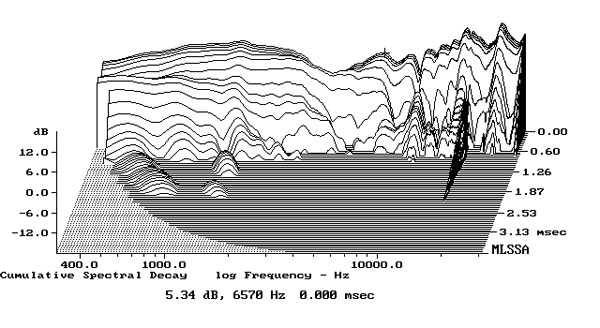
Fig.1 Audio Physic Step Plus, electrical impedance (solid) and phase (dashed) (2 ohms/vertical div.).
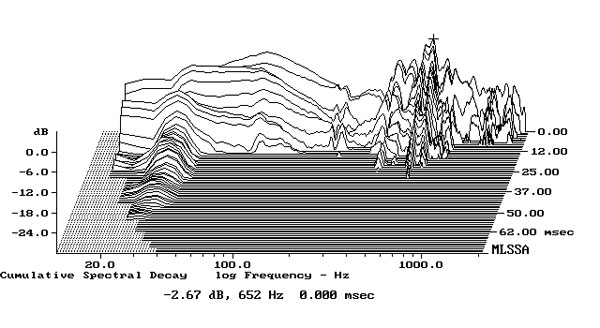
Discontinuities in the fig.1 traces at 420 and 650Hz imply the presence of cabinet-wall resonances at those frequencies. I did find a mode quite high in level at 650Hz on the sidewalls (fig.2), and another at 420Hz on the top panel. These modes are high enough in Q and frequency that they might not be excited by music.
Fig.2 Audio Physic Step Plus, cumulative spectral-decay plot calculated from output of accelerometer fastened to center of sidewall (MLS driving voltage to speaker, 7.55V; measurement bandwidth, 2kHz).
Fig.3 Audio Physic Step Plus, anechoic response averaged across 30° horizontal window on tweeter axis at 50" (black), averaged across 30° horizontal window centered 10° above tweeter axis (green), both corrected for microphone response, with nearfield responses of port (red), woofer (blue), and their complex sum, respectively plotted below 925, 310, 310Hz.
The complex sum of the nearfield woofer and port responses is shown as the black trace below 300Hz in fig.3. The usual nearfield bump in output in the upper bass is minimal, which, in conjunction with the depressed level of the farfield response (black trace above 300Hz), suggests that the Step Plus is intended to be used close to the wall behind it, in order for its balance to gain the benefit of some boundary reinforcement. However, as Ken Micallef noted, this will diminish the speakers' imaging performance. I must admit to some puzzlement at KM's finding that the Step Plus offered "first-rate bass-frequency reproduction," as the port tuning suggests that it won't be able to fully deliver the lowest note of the four-string double bass and bass guitar at the correct balance with the upper harmonics.
Fig.4 Audio Physic Step Plus, lateral response family at 50", normalized to response on tweeter axis, from back to front: differences in response 90–5° off axis, reference response, differences in response 5–90° off axis.
Fig.5 Audio Physic Step Plus, vertical response family at 50", normalized to response on tweeter axis, from back to front: differences in response 45–5° above axis, reference response, differences in response 5–45° below axis.
Fig.6 Audio Physic Step Plus, step response on tweeter axis at 50" (5ms time window, 30kHz bandwidth).
Fig.7 Audio Physic Step Plus, cumulative spectral-decay plot on tweeter axis at 50" (0.15ms risetime).
I note that KM enjoyed his time with the Audio Physic Step Plus. However, its measured performance suggests it must be used on a low stand. I will be investigating this aspect of the Step Plus's behavior in a future issue.—John Atkinson















