

Follow-Up: the Audioengine A2+ from April 2015 (Vol.38 No.4):
When Robert J. Reina reviewed the Audioengine A2 powered loudspeaker in the December 2007 issue, he concluded, "I have never been more impressed with or more stunned by a component I've reviewed for Stereophile than I was with the Audioengine 2. The level of sound quality produced by this uncolored, detailed, articulate, and dynamic speaker, in all situations, was beyond reproach, and its ratio of value to cost borders on the criminal."
I, too, was impressed. I bought a pair of the tiny A2s—each measures just 6" H by 4" W by 5.25" D—to use in our kitchen TV system, where they've done sterling service ever since, hooked up to the headphone output of a Samsung flat-panel TV. My only quibble was that the bass boost the A2 uses to squeeze enough low frequencies out of its woofer, which has a Kevlar cone just 2.75" in diameter and a rubber half-roll surround, makes the speaker intolerant of positioning close to room corners, where it sounds hooty.
At the end of 2013, Audioengine replaced the A2 with the A2+ (footnote 1). This appears to be identical to the A2, but adds to the left, master speaker a USB 1.1 input for digital audio and a pair of output jacks, used to feed an unfiltered, unequalized signal to a subwoofer(s). (The right speaker in each pair is a conventional passive type; the left contains the amplifiers for both channels, the volume control, left and right input RCA jacks, a 3.5mm stereo input jack, and a pair of output terminals to feed the other speaker.) The tweeter is still a ¾" (20mm) silk-dome unit, the internal amplifier still a 15Wpc monolithic analog type. The price has increased from $199 to $249/pair.
Stephen Mejias had originally intended to write about the A2+ in his column, "The Entry Level," but left the magazine before being able to do so. When I finally got around to trying them out, I couldn't get any sound, from either the USB port or the line inputs. I asked for replacement samples. (The original samples had the serial number 13052000078W, the replacements 14011509708B.)
Before I performed any measurements, I compared the A2+s with my pair of original A2s. The two pairs of Audioengines sounded identical, and when I listened critically to the new versions, driven by Pono's PonoPlayer (reviewed elsewhere in this issue) and with the A2+s set up on 24"-high stands, I was impressed by how well these tiny speakers managed to fill my listening room with sound. No, they didn't play at head-banging levels, but with both classical chamber music and well-recorded rock they sounded clear and clean. Low bass was missing in action, of course, but in free space, the upper bass was in good balance with the midrange. The bass in "There Ain't No Sweet Man That's Worth the Salt of My Tears," from Diana Krall's Glad Rag Doll (24-bit/96kHz ALAC file), lacked body but still sufficiently supported the music. Krall's husky voice had a slightly woody coloration, though this was relatively mild in degree. The top octave lacked some air.
Once I'd listened to the new speakers and confirmed that their sound quality lived up to Bob Reina's evaluation of the originals, I took them into the test lab. To examine their behavior via USB, I used my 2012-vintage MacBook Pro, running on battery power. The Mac USB Prober utility reported that the Audioengine A2+'s USB port operated in the usual isochronous adaptive mode, and that it would accept 16-bit data with sample rates of up to 48kHz. This is what I'd expected, given that the speaker uses the TI/Burr-Brown PCM2704C USB receiver/DAC chip. The Manufacturer string was reported as "Audioengine," the Product String as "Audioengine 2+," and the Device Vendor ID as "Texas Instruments Japan."




 My experience of the + version of the Audioengine A2 was pleasant indeed—sufficiently so that I will reinstate it in "Recommended Components," which appears elsewhere in this issue. A heck of a speaker at a heck of a price!—John Atkinson
Footnote 1: The A2+ costs $249/pair in black or white.
Fig.1 Audioengine A2+, spectrum with noise and spuriae of dithered 1kHz tone at –90dBFS with 16-bit data (20dB/vertical div.).
With the volume control at its maximum, a full-scale digital signal via USB gave a level at the right-speaker output terminals of 9.823V, equivalent to 12W into 8 ohms. The only digital-domain test I performed was to examine the DAC's resolution. Fig.1 is a spectral analysis taken at the speaker terminals while the speaker decoded 16-bit data representing a dithered 1kHz tone at –90dBFS. The tone is reproduced 5dB too high in level, and some low-level, low-order harmonics can be seen. The noise floor lies between the 14- and 15-bit level, which again is what I would expect from the PCM2704C DAC chip.
In the analog-domain tests, the A2+'s line input impedance of 4.5k ohms was lower than that of both the original speaker and the specified 10k ohms. The line input preserved absolute polarity (ie, was non-inverting), and the maximum gain was 27.6dB, which is on the high side.
Fig.2 Audioengine A2+, passive sample, electrical impedance (solid) and phase (dashed) (2 ohms/vertical div.).
The passive, right speaker had an estimated sensitivity of 83dB(B)/V/m, and its impedance remained between 4 and 10 ohms through most of the audioband (fig.2). The magnitude saddle centered on 65Hz in fig.2 suggests only modest low-end extension, though the low height of the lower-frequency peak suggests that the alignment is more overdamped than in the A2.
Fig.3 Audioengine A2+, built-in amplifier frequency response at 1V into 8 ohms, measured at: right-channel speaker output jacks (red), subwoofer output jacks (blue) (2dB/vertical div.).
The red trace in fig.3 shows the internal amplifier's frequency response, taken at the speaker output terminals. As in the A2, a modest, 4.7dB boost centered on 80–100Hz is used to extend the acoustic output in the midbass, though this will reduce the dynamic range at low frequencies. This boost was independent of the volume-control setting. The blue trace in this graph is the response at the output RCA jacks. No equalization is applied.
Fig.4 Audioengine A2+, anechoic response on tweeter axis at 50", averaged across 30° horizontal window and corrected for microphone response, with nearfield responses of woofer (blue), port (red), and complex sum of nearfield responses (black), all plotted below 300Hz.
For the acoustic measurements, I used DRA Labs' MLSSA system and a calibrated DPA 4006 microphone to measure the Audioengine A2+'s frequency response in the farfield, and an Earthworks QTC-40 for the nearfield responses. The A2+'s farfield response on the tweeter axis (fig.4 above 300Hz) is identical to the A2's: impressively flat and extended in the treble, though with the upper midrange shelved down by up to 5dB. The rise in measured output below 400Hz will be partly due to the nearfield measurement technique, but mainly reflects the equalization shown in fig.3. The individual responses of the woofer (blue trace) and port (red) are shown, scaled in the ratio of the square roots of the radiating areas. I have shown the port's output only up to 300Hz; above that frequency, the measurement was affected by leakage from the woofer. The black trace in the bass is the sum of the port and woofer outputs, taking into account acoustic phase; even with the equalization, the A2+ rolls off below 120Hz or so.
Fig.5 Audioengine A2+, lateral response family at 50", normalized to response on tweeter axis, from back to front: differences in response 90–5° off axis, reference response, differences in response 5–90° off axis.
Fig.6 Audioengine A2+, vertical response family at 50", normalized to response on tweeter axis, from back to front: differences in response 45–5° above axis, reference response, differences in response 5–45° below axis.
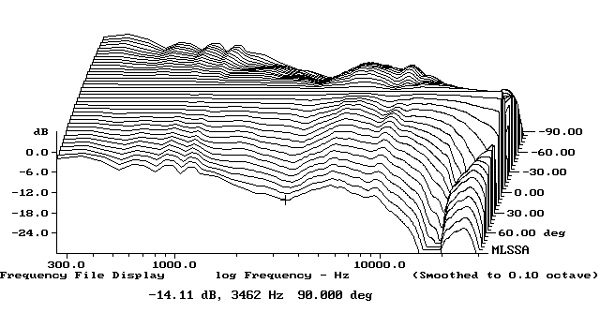
Fig.5 shows the A2+'s lateral dispersion, normalized to the tweeter-axis response. As with the A2, there is a slight flare at the bottom of the tweeter's passband, due to the on-axis depression filling in to the speaker's sides. The tweeter's dispersion in the top octave is restricted, which explains why I found the sound lacking a touch of top-octave air. In the vertical plane (fig.6), a suckout develops in the crossover region more than 5° above the tweeter axis. To get the most neutral tonal balance from this speaker, be sure to listen on or below the tweeter axis.
Fig.7 Audioengine A2+, step response on tweeter axis at 50" (5ms time window, 30kHz bandwidth).
Fig.8 Audioengine A2+, cumulative spectral-decay plot on tweeter axis at 50" (0.15ms risetime).
The A2+'s step response on the tweeter axis (fig.7) indicates that both drivers are connected in positive acoustic polarity. While the cumulative spectral-decay plot (fig.8) is clean in the treble, there is some delayed energy associated with the upper-midrange step in the frequency response.
Footnote 1: The A2+ costs $249/pair in black or white.















