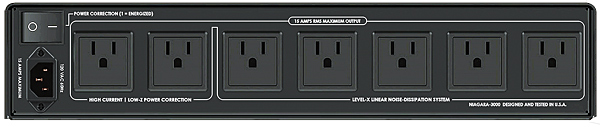
The unit has seven rear-panel AC receptacles. Receptacles 1 and 2 are the High Current/Low-Z receptacles intended for power amplifiers; they employ AQ's Transient Power Correction. The remaining five receptacles, for sources, employ AQ's Level-X Linear Noise-Dissipation System; all five source receptacles are isolated from the two high-current receptacles and are broken into two banks, 3–5 and 6–7, which are also isolated from each other. These receptacles are principally intended for connection of source equipment; the manual offers some connection guidelines, but also recommends experimentation to determine which connection scheme yields the best-sounding results. All Niagara units are shipped without power cords.
Early in the review process, I had questions with respect to not only the Niagara 3000 but also AQ's AC power design philosophy and implementation, in general. Garth Powell, AQ's senior director of engineering and designer of power products, answered my questions.
"The NEMA Edison duplex receptacle is a 'grandfathered' design that's nearly a century old. It was meant for 110VAC at 10 amps. [The standard is] now 120VAC at 20A, and all that's changed is mostly cosmetic. The brass material is soft and thin; it was made for marginal safety concerns and to be inexpensive. In an audiophile system, we have special tools to tighten our speaker cables to the binding posts, and RCA or balanced XLR connectors feature a vice-like grip. Yet the poorest connector in the system is the one that carries the most RMS (average) current, transient current, and AC voltage?
 "At AudioQuest, we reverse-engineered every premium-audiophile power receptacle we could find. Some were substantially better than average (a few [were] actually worse), but what I saw too often was cryogenic freezing, or rhodium plating over a mostly stock design that simply wasn't up to par. I decided to not only use beryllium copper base metal for its high spring strength, but all metal parts are up to 40% thicker than a typical NEMA or hospital grade AC receptacle. The only plating is thick, direct silver using what's called the 'hanging' plating process. This assures that induced radio-frequency noise has a low-impedance path back to the electrical panel and Earth ground. Further, it's low-impedance at radio frequencies. The plating covers all modes: Line, Neutral, and Ground. Many premium power receptacles do not. For audio-video performance, details count. Noise-dissipation is a drainage system, and we do not want a power receptacle to interfere with the drain path back to earth. Additionally, a typical power amplifier can require instantaneous transient current as high as 70 amps peak. The lower the impedance of the wall connection, the better the delivery of the transient current. [There's] less current compression."
Listening with the Bel Canto e1X
"At AudioQuest, we reverse-engineered every premium-audiophile power receptacle we could find. Some were substantially better than average (a few [were] actually worse), but what I saw too often was cryogenic freezing, or rhodium plating over a mostly stock design that simply wasn't up to par. I decided to not only use beryllium copper base metal for its high spring strength, but all metal parts are up to 40% thicker than a typical NEMA or hospital grade AC receptacle. The only plating is thick, direct silver using what's called the 'hanging' plating process. This assures that induced radio-frequency noise has a low-impedance path back to the electrical panel and Earth ground. Further, it's low-impedance at radio frequencies. The plating covers all modes: Line, Neutral, and Ground. Many premium power receptacles do not. For audio-video performance, details count. Noise-dissipation is a drainage system, and we do not want a power receptacle to interfere with the drain path back to earth. Additionally, a typical power amplifier can require instantaneous transient current as high as 70 amps peak. The lower the impedance of the wall connection, the better the delivery of the transient current. [There's] less current compression."
Listening with the Bel Canto e1X
The Bel Canto e1X was reinserted into my system and connected to the Niagara 3000 with an AudioQuest Blizzard AC cable. "Song of the Stars," from the Dead Can Dance album Spiritchaser (16/44.1 FLAC, 4AD 46230), was playing; something very quickly got my attention: The dual subs seemed to be playing at a lower-than-usual volume. After adjusting the volume of the subs upward to match the rest of the system, I noticed that the bass content was all there, just none of the distortion that often accompanies it. With the dual subs connected to the Niagara 3000, it was obvious that there was less distortion in the signal, and the bass was deeper, more dynamic, and more musical than before. The e1X is a superb class-D amplifier; I've never found its performance lacking. Designer John Stronczer says his power supply design allows the e1X to avoid the sort of midrange distortions that seem to plague many class A/B amps with large toroidal transformers. The e1X—even when connected directly to my existing AC line—presented music that was almost Technicolor in comparison to my Emotiva XPA-1Ls. During the Dead Can Dance session, it became apparent that the bass content wasn't the only story; Brendan Perry's deep baritone never sounded so resounding, and his guitar tone was articulate and rounded. Later in the song, when Lisa Gerrard's otherworldly voice joined in a call and response with Perry, the effect was mesmerizing.
The new playback chain that now included the Niagara 3000 and the NRG Edison receptacles allowed my system to extract a previously unheard level of tangibility from the streamed recording. I also listened to the tune "Don't Let It Bring You Down" from Neil Young's Live at Massey Hall (16/44.1 FLAC, Reprise 9362-43328-2); I was taken aback by the vividness of Neil Young alone with his guitar. The real eye-opener, however, was when the music stopped: The absolute quiet in my room was almost ghostly compared to the state I was accustomed to.
Additional listening
The Emotiva XPA-1L monoblocks have been part of my system for some time now; their sound has always impressed me as being both neutral and dynamic. After the appearance of the Bel Canto e1X, however, I was almost ready to consign them to the scrap heap. Their presentation seemed "colorless" in comparison with the e1X, which was confirmed by repeat listens in the aftermath of the e1X review.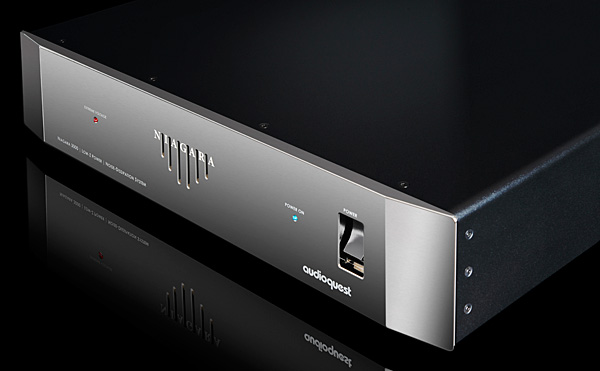 Upon connecting the XPA-1L's to the Niagara 3000, I was struck by an improved level of clarity and authority and perhaps a touch of previously unheard sweetness; listening through them suddenly became a more engaging musical experience. I'd been using recent SACD acquisition, the Shostakovich Symphonies Nos. 1 and 15 (SACD, BIS 7318599916439) with Mark Wigglesworth and the Netherlands RPO, as a demo disc for friends with the Bel Canto e1X and the Maggie LRS loudspeakers. With the Niagara 3000 in place, it was now possible to experience the delicacies and dynamics of this music to a degree previously unheard.
I played a few LPs with the PrimaLuna EVO 300 integrated amp connected to the Zu Omens, among them, the new Craft Recordings vinyl reissue of Collective Soul's eponymous second album (Craft Recordings CR00290). The opening track, "Simple," is powerful and dynamic, easily the best song on the album. With the Niagara 3000 in the loop, analog playback was the best I'd ever heard here. Even though the Musical Surroundings Phonomena II+ phono pre has a dedicated linear power supply, plugging it into one of the 3000's source receptacles vanquished the touch of electronic haze that normally appeared in my system around the midpoint of the volume dial. That haze is now gone, at all volume levels.
Conclusion
Upon connecting the XPA-1L's to the Niagara 3000, I was struck by an improved level of clarity and authority and perhaps a touch of previously unheard sweetness; listening through them suddenly became a more engaging musical experience. I'd been using recent SACD acquisition, the Shostakovich Symphonies Nos. 1 and 15 (SACD, BIS 7318599916439) with Mark Wigglesworth and the Netherlands RPO, as a demo disc for friends with the Bel Canto e1X and the Maggie LRS loudspeakers. With the Niagara 3000 in place, it was now possible to experience the delicacies and dynamics of this music to a degree previously unheard.
I played a few LPs with the PrimaLuna EVO 300 integrated amp connected to the Zu Omens, among them, the new Craft Recordings vinyl reissue of Collective Soul's eponymous second album (Craft Recordings CR00290). The opening track, "Simple," is powerful and dynamic, easily the best song on the album. With the Niagara 3000 in the loop, analog playback was the best I'd ever heard here. Even though the Musical Surroundings Phonomena II+ phono pre has a dedicated linear power supply, plugging it into one of the 3000's source receptacles vanquished the touch of electronic haze that normally appeared in my system around the midpoint of the volume dial. That haze is now gone, at all volume levels.
Conclusion
It's obvious to me now that clean AC power is necessary to allow audiophile-grade equipment to perform as designed; otherwise, even the best products will fail to fulfill their potential. In combination with the Niagara 3000, the Edison receptacles and upgraded AC power cables enhanced the performance of all my system components. AudioQuest and Garth Powell had already managed that with the more advanced and expensive components in the Niagara Series; now the reasonably priced Niagara 3000 places that goodness within reach of more people.
"At AudioQuest, we reverse-engineered every premium-audiophile power receptacle we could find. Some were substantially better than average (a few [were] actually worse), but what I saw too often was cryogenic freezing, or rhodium plating over a mostly stock design that simply wasn't up to par. I decided to not only use beryllium copper base metal for its high spring strength, but all metal parts are up to 40% thicker than a typical NEMA or hospital grade AC receptacle. The only plating is thick, direct silver using what's called the 'hanging' plating process. This assures that induced radio-frequency noise has a low-impedance path back to the electrical panel and Earth ground. Further, it's low-impedance at radio frequencies. The plating covers all modes: Line, Neutral, and Ground. Many premium power receptacles do not. For audio-video performance, details count. Noise-dissipation is a drainage system, and we do not want a power receptacle to interfere with the drain path back to earth. Additionally, a typical power amplifier can require instantaneous transient current as high as 70 amps peak. The lower the impedance of the wall connection, the better the delivery of the transient current. [There's] less current compression."
Listening with the Bel Canto e1XThe Bel Canto e1X was reinserted into my system and connected to the Niagara 3000 with an AudioQuest Blizzard AC cable. "Song of the Stars," from the Dead Can Dance album Spiritchaser (16/44.1 FLAC, 4AD 46230), was playing; something very quickly got my attention: The dual subs seemed to be playing at a lower-than-usual volume. After adjusting the volume of the subs upward to match the rest of the system, I noticed that the bass content was all there, just none of the distortion that often accompanies it. With the dual subs connected to the Niagara 3000, it was obvious that there was less distortion in the signal, and the bass was deeper, more dynamic, and more musical than before. The e1X is a superb class-D amplifier; I've never found its performance lacking. Designer John Stronczer says his power supply design allows the e1X to avoid the sort of midrange distortions that seem to plague many class A/B amps with large toroidal transformers. The e1X—even when connected directly to my existing AC line—presented music that was almost Technicolor in comparison to my Emotiva XPA-1Ls. During the Dead Can Dance session, it became apparent that the bass content wasn't the only story; Brendan Perry's deep baritone never sounded so resounding, and his guitar tone was articulate and rounded. Later in the song, when Lisa Gerrard's otherworldly voice joined in a call and response with Perry, the effect was mesmerizing.
The Emotiva XPA-1L monoblocks have been part of my system for some time now; their sound has always impressed me as being both neutral and dynamic. After the appearance of the Bel Canto e1X, however, I was almost ready to consign them to the scrap heap. Their presentation seemed "colorless" in comparison with the e1X, which was confirmed by repeat listens in the aftermath of the e1X review.
Upon connecting the XPA-1L's to the Niagara 3000, I was struck by an improved level of clarity and authority and perhaps a touch of previously unheard sweetness; listening through them suddenly became a more engaging musical experience. I'd been using recent SACD acquisition, the Shostakovich Symphonies Nos. 1 and 15 (SACD, BIS 7318599916439) with Mark Wigglesworth and the Netherlands RPO, as a demo disc for friends with the Bel Canto e1X and the Maggie LRS loudspeakers. With the Niagara 3000 in place, it was now possible to experience the delicacies and dynamics of this music to a degree previously unheard.
It's obvious to me now that clean AC power is necessary to allow audiophile-grade equipment to perform as designed; otherwise, even the best products will fail to fulfill their potential. In combination with the Niagara 3000, the Edison receptacles and upgraded AC power cables enhanced the performance of all my system components. AudioQuest and Garth Powell had already managed that with the more advanced and expensive components in the Niagara Series; now the reasonably priced Niagara 3000 places that goodness within reach of more people.