

The result? "If we connect the two baskets directly to earth while playing music, the dynamics of the music gets severely restricted," Ole told me. Not a good outcome, but it meant they had discovered a way to influence the sound. They experimented and eventually came up with an approach in which those potential differences are controlled, not eliminated: They grounded the baskets "not directly to earth, but through a dedicated filter," Ole wrote in an email—like a crossover but for baskets. "If we connect through our dedicated Freedom circuit"—that's the grounding network—"we do not lose any dynamics, and we can create a more quiet background and a deeper 3D perspective."
Listening
I found the Audiovector R 8 Arreté to be mostly neutral in its sonic presentation—maybe slightly on the sweet side; I'll be interested to see what JA's measurements show. The bass is full and full-range but in my room not overly assertive. At first I wondered if the sweetness I heard was due to the fact that the tweeters were high and my chair low: The centers of the R 8's AMT tweeters are about 52.5" off the floor, while, as I sit in my listening chair, my ears are about 34" off the ground. (It's an IKEA POÄNG chair, which is low to start with, and when I sit in it, the bentwood frame bends several more inches under my circa 200lb weight.)
I asked Ole Klifoth: What is the preferred listening axis for the R 8? "The preferred listening height for us is 100–110cm at a distance of 3m, but this is not overly critical," he replied—that's 39"–43" at a distance of about 10' in countries that never embraced the metric system. Seated comfortably in my listening chair, my ears were several inches below the preferred vertical listening range.
 So I tilted the Arretés forward as much as I could with the provided spikes and listened. I moved the listening chair out and moved an adjustable-height office chair in, and listened again. In its lowest position, the office chair placed my ears about 39" from the floor; its hydraulic lift took me through and beyond the preferred range. Listening to music, I heard a slight reduction in the highest frequencies, let us say 8kHz or so and up, at my normal listening height relative to the preferred zone. I heard no difference, or even a slight increase in level, in the presence region and upper treble. So, my listening height was softening the presentation a little, but the effect was small. With apologies to Ralph the Christmas Dog (who is featured on the first Stereophile Test CD), now for some pink noise (16/44.1 FLAC, rip from Stereophile STPH002-2, footnote 3).
Pink noise through the R 8 Arreté was unremarkable, in the best way. Nothing stood out. What I heard from the pink noise was consistent with an overall balance in which the bass is slightly elevated relative to the treble but without any prominent peaks.
Next up, the warble tones from the Stereophile Editor's Choice CD (16/44.1 FLAC rip from Stereophile STPH0016-2). In the bass, listening at a level of about 80dB, (C-weighted, measured with pink noise), I heard strong, even output (with some fluctuations due to room interactions, not too severe) down to 31.5Hz; the two lowest tones, at 25kHz and 20kHz, were easily audible but significantly lower in subjective level.
Listening to the midrange warble tones, I noted a slight reduction in level—just audible—in the lower midrange. That's consistent with what I heard with music, although I didn't notice it listening to music.
The first real music track I listened to with the R 8 Arreté was "Visions," the Stevie Wonder song, performed by Cécile McLorin Salvant on her album The Window (24/96 FLAC, Mac Avenue/Qobuz, and LP, Mac Avenue MAC 1132LP). The most striking aspect of this recording is the immediacy and physicality of the vocal: I have heard her live several times, and on this recording Salvant herself is in the room. Would that immediacy and physicality be retained through the R 8, which fires some of its midrange energy to the rear for added ambience?
So I tilted the Arretés forward as much as I could with the provided spikes and listened. I moved the listening chair out and moved an adjustable-height office chair in, and listened again. In its lowest position, the office chair placed my ears about 39" from the floor; its hydraulic lift took me through and beyond the preferred range. Listening to music, I heard a slight reduction in the highest frequencies, let us say 8kHz or so and up, at my normal listening height relative to the preferred zone. I heard no difference, or even a slight increase in level, in the presence region and upper treble. So, my listening height was softening the presentation a little, but the effect was small. With apologies to Ralph the Christmas Dog (who is featured on the first Stereophile Test CD), now for some pink noise (16/44.1 FLAC, rip from Stereophile STPH002-2, footnote 3).
Pink noise through the R 8 Arreté was unremarkable, in the best way. Nothing stood out. What I heard from the pink noise was consistent with an overall balance in which the bass is slightly elevated relative to the treble but without any prominent peaks.
Next up, the warble tones from the Stereophile Editor's Choice CD (16/44.1 FLAC rip from Stereophile STPH0016-2). In the bass, listening at a level of about 80dB, (C-weighted, measured with pink noise), I heard strong, even output (with some fluctuations due to room interactions, not too severe) down to 31.5Hz; the two lowest tones, at 25kHz and 20kHz, were easily audible but significantly lower in subjective level.
Listening to the midrange warble tones, I noted a slight reduction in level—just audible—in the lower midrange. That's consistent with what I heard with music, although I didn't notice it listening to music.
The first real music track I listened to with the R 8 Arreté was "Visions," the Stevie Wonder song, performed by Cécile McLorin Salvant on her album The Window (24/96 FLAC, Mac Avenue/Qobuz, and LP, Mac Avenue MAC 1132LP). The most striking aspect of this recording is the immediacy and physicality of the vocal: I have heard her live several times, and on this recording Salvant herself is in the room. Would that immediacy and physicality be retained through the R 8, which fires some of its midrange energy to the rear for added ambience?
 But first things first: The piano comes before the vocal. Sullivan Fortner's piano was more spacious-sounding than I'm used to—quite a different presentation but no less natural. Salvant's voice, when it entered, was significantly farther back on the stage than it was with the Magico A5s, for example. The Audiovectors have a meaningfully different spatial presentation than that of the speakers that preceded them in my listening room.
Did Salvant's voice lose any presence, vividness, or corporeality? Not meaningfully, which surprised me. The vocal was no less intimate than it usually is. It didn't seem affected by the added ambience. The piano now occupied a different, more resonant acoustic than the voice.
This was a subtle thing, and it's not unnatural. Setting aside the fact that the vocal was probably recorded in an isolation room, and that studio effects could be added, the degree of resonance or room sound is determined by where the mikes are placed. Salvant is close-miked while the piano is miked—well, I'm not sure how or where, but well outside the piano case, so there's more room sound on the piano.
Still, I wondered: What would happen if the piano and the voice were in the same acoustic? This album is a mix of live (recorded at NYC's Village Vanguard) and studio tracks (Sear Sound Studios), so I didn't have to go far for a live comparison. I put on Salvant and Fortner's account of Bernstein and Sondheim's "Somewhere," from West Side Story, another track I turn to often in reviews.
This live track didn't sound that much different than "Visions," which is an impressive engineering feat. The piano was still more resonant than the vocal, somewhat more distantly miked; the voice was still intimate and direct and a bit farther back on the stage than I'm used to. Which presentation—this one or the one I'm more used to—is truer to the source? I can't say. As I've written before, data in a FLAC file don't really make sound, do they?
At the climax of this song—"Somewhere"—Salvant sings loud, and, at natural listening levels, it sounds loud: almost piercing but also natural and real. This was true also with the Magico A5 and the Magico M2. Good speakers give you all the dynamics the music has to offer.
But first things first: The piano comes before the vocal. Sullivan Fortner's piano was more spacious-sounding than I'm used to—quite a different presentation but no less natural. Salvant's voice, when it entered, was significantly farther back on the stage than it was with the Magico A5s, for example. The Audiovectors have a meaningfully different spatial presentation than that of the speakers that preceded them in my listening room.
Did Salvant's voice lose any presence, vividness, or corporeality? Not meaningfully, which surprised me. The vocal was no less intimate than it usually is. It didn't seem affected by the added ambience. The piano now occupied a different, more resonant acoustic than the voice.
This was a subtle thing, and it's not unnatural. Setting aside the fact that the vocal was probably recorded in an isolation room, and that studio effects could be added, the degree of resonance or room sound is determined by where the mikes are placed. Salvant is close-miked while the piano is miked—well, I'm not sure how or where, but well outside the piano case, so there's more room sound on the piano.
Still, I wondered: What would happen if the piano and the voice were in the same acoustic? This album is a mix of live (recorded at NYC's Village Vanguard) and studio tracks (Sear Sound Studios), so I didn't have to go far for a live comparison. I put on Salvant and Fortner's account of Bernstein and Sondheim's "Somewhere," from West Side Story, another track I turn to often in reviews.
This live track didn't sound that much different than "Visions," which is an impressive engineering feat. The piano was still more resonant than the vocal, somewhat more distantly miked; the voice was still intimate and direct and a bit farther back on the stage than I'm used to. Which presentation—this one or the one I'm more used to—is truer to the source? I can't say. As I've written before, data in a FLAC file don't really make sound, do they?
At the climax of this song—"Somewhere"—Salvant sings loud, and, at natural listening levels, it sounds loud: almost piercing but also natural and real. This was true also with the Magico A5 and the Magico M2. Good speakers give you all the dynamics the music has to offer.
 Similarly, on "I've Got Your Number," pianist Fortner hits a few notes hard. Once, with the volume front-row Village Vanguard loud (although this track was recorded in-studio), I jumped. Again, good. I don't want speakers to protect me from scary things.
As I listened more, I adapted to the R 8's distinctive presentation, as one does. I stopped hearing it as different from what was here before and instead heard it for what it is, on its own merits, the new default. I put on another familiar recording—my reissue of The Paul Desmond Quartet featuring Don Elliott (LP, OJC-119, originally Fantasy 3235). Very clean, explicit, with good transients, good rhythm. Slightly more spacious-sounding than I'm used to hearing. (It's a mono recording, so I'm hearing more reverb.)
On John Atkinson's recording of Robert Silverman playing the Liszt B minor sonata (16/44.1 rip from Stereophile STPH008-2), at about 11:20 of the first movement, Lento Assai, those big chords were very big indeed, noisy in a good way, every tone so distinct I could count 'em. The metal in those strings was easy to hear, especially in the long reverberation tails as the notes faded out one by one.
The R 8's imaging was impressive, and not just from the sweet spot. I put on some Charles Mingus, Mingus Ah Um (24/192 FLAC Columbia/Qobuz). I moved my listening chair several feet to the right so that it was lined up with the inside edge of the right speaker, to see whether the soundstage would survive there. It did, and very well. The piano, which normally comes almost entirely from the left speaker, continued to come almost entirely from the left speaker. When the whole band entered, it filled the space between the two speakers. This is another speaker that, like the Magico A5 that preceded it in this room, projects a complete stage even when you're far off the center line. Audiovector attributes this good off-axis behavior to the SEC concept—which, the website says, "means the soundstage stays intact, wherever you are positioned." I attribute it to good horizontal dispersion.
However, the SEC—all those drivers firing in different directions in measured amounts—is surely responsible for what I found to be the speakers' most distinctive and appealing feature: their presentation of soundstage depth.
In several recent reviews, I've mentioned the third movement of Mahler's Symphony No.2 with Benjamin Zander and the Philharmonia Orchestra (24/192 ALAC file, Linn Records). I've emphasized the challenge that recording poses to the reproduction of bass instruments—specifically the massed double basses at a particular moment in the third movement, as first noted by John Atkinson in his review of the Pass Laboratories XA60.5 monoblock amplifier.
But this recording isn't good only for a single moment. It's a great orchestral recording, a profound pleasure, and it presents many opportunities to take the measure of an audio component. Whenever I listen, I start at the beginning.
I put on the third movement. Immediately I heard something unfamiliar in this very familiar recording, something happening in the percussion section way at the back of the soundstage.
At the very beginning of the movement, there's timpani, and then, about 10 seconds in, different timpani, even farther back. But it's the quiet bass drum at 14 seconds that most drew my attention—that I found especially moving.
These percussion instruments are oh so far away, way back on a vast stage carved out from space in my room by the orchestra's own sound, extending well beyond my back wall. I've listened to this many times and know it well, but here, familiar music was subtly transformed—or maybe not subtly at all. The illusion of depth was much stronger with the R 8s than I'm accustomed to, and it made a strong emotional impression.
It's fascinating to me how a rag wrapped on a stick gently bumping a stretched membrane and recorded in London can be so moving here in my NYC living room. Put this same music, the same notes, in a plane between the loudspeakers, without the depth, and it would be ignorable. We like to say it's about the music, but for me it is about the sound, too, equally. Music, after all, is made up of sound. It is a distinction without a difference.
Something similar happened at the 3-minute mark when a snare (or is it that pile of sticks, called ruthe in Mahler scores) plays along with the timpani. Once again, these instruments, together, mapped out a space far back behind the plane of the speakers. Again, it touched something inside.
Summing up
Similarly, on "I've Got Your Number," pianist Fortner hits a few notes hard. Once, with the volume front-row Village Vanguard loud (although this track was recorded in-studio), I jumped. Again, good. I don't want speakers to protect me from scary things.
As I listened more, I adapted to the R 8's distinctive presentation, as one does. I stopped hearing it as different from what was here before and instead heard it for what it is, on its own merits, the new default. I put on another familiar recording—my reissue of The Paul Desmond Quartet featuring Don Elliott (LP, OJC-119, originally Fantasy 3235). Very clean, explicit, with good transients, good rhythm. Slightly more spacious-sounding than I'm used to hearing. (It's a mono recording, so I'm hearing more reverb.)
On John Atkinson's recording of Robert Silverman playing the Liszt B minor sonata (16/44.1 rip from Stereophile STPH008-2), at about 11:20 of the first movement, Lento Assai, those big chords were very big indeed, noisy in a good way, every tone so distinct I could count 'em. The metal in those strings was easy to hear, especially in the long reverberation tails as the notes faded out one by one.
The R 8's imaging was impressive, and not just from the sweet spot. I put on some Charles Mingus, Mingus Ah Um (24/192 FLAC Columbia/Qobuz). I moved my listening chair several feet to the right so that it was lined up with the inside edge of the right speaker, to see whether the soundstage would survive there. It did, and very well. The piano, which normally comes almost entirely from the left speaker, continued to come almost entirely from the left speaker. When the whole band entered, it filled the space between the two speakers. This is another speaker that, like the Magico A5 that preceded it in this room, projects a complete stage even when you're far off the center line. Audiovector attributes this good off-axis behavior to the SEC concept—which, the website says, "means the soundstage stays intact, wherever you are positioned." I attribute it to good horizontal dispersion.
However, the SEC—all those drivers firing in different directions in measured amounts—is surely responsible for what I found to be the speakers' most distinctive and appealing feature: their presentation of soundstage depth.
In several recent reviews, I've mentioned the third movement of Mahler's Symphony No.2 with Benjamin Zander and the Philharmonia Orchestra (24/192 ALAC file, Linn Records). I've emphasized the challenge that recording poses to the reproduction of bass instruments—specifically the massed double basses at a particular moment in the third movement, as first noted by John Atkinson in his review of the Pass Laboratories XA60.5 monoblock amplifier.
But this recording isn't good only for a single moment. It's a great orchestral recording, a profound pleasure, and it presents many opportunities to take the measure of an audio component. Whenever I listen, I start at the beginning.
I put on the third movement. Immediately I heard something unfamiliar in this very familiar recording, something happening in the percussion section way at the back of the soundstage.
At the very beginning of the movement, there's timpani, and then, about 10 seconds in, different timpani, even farther back. But it's the quiet bass drum at 14 seconds that most drew my attention—that I found especially moving.
These percussion instruments are oh so far away, way back on a vast stage carved out from space in my room by the orchestra's own sound, extending well beyond my back wall. I've listened to this many times and know it well, but here, familiar music was subtly transformed—or maybe not subtly at all. The illusion of depth was much stronger with the R 8s than I'm accustomed to, and it made a strong emotional impression.
It's fascinating to me how a rag wrapped on a stick gently bumping a stretched membrane and recorded in London can be so moving here in my NYC living room. Put this same music, the same notes, in a plane between the loudspeakers, without the depth, and it would be ignorable. We like to say it's about the music, but for me it is about the sound, too, equally. Music, after all, is made up of sound. It is a distinction without a difference.
Something similar happened at the 3-minute mark when a snare (or is it that pile of sticks, called ruthe in Mahler scores) plays along with the timpani. Once again, these instruments, together, mapped out a space far back behind the plane of the speakers. Again, it touched something inside.
Summing up
Some speakers I've heard that radiate energy in many directions gain an enhanced sense of space but only at the expense of articulation, image corporeality and specificity, and other virtues. The R 8s managed to avoid that tradeoff: They achieve an enhanced sense of space while retaining exemplary articulation and precise, fleshy images. They manage this, I'm thinking, via careful balancing: Not counting the bass, the amount of energy being launched in directions other than forward is modest. "Rear radiation is about 20% of front radiation," Ole told me. As I wrote at the beginning of this review, the Audiovector R 8 Arreté is more complicated than your typical loudspeaker. But what I heard from the R 8s was anything but complicated: It was pure and coherent and easily grasped. It was commendably neutral but also slightly sweet and a touch warm, with bass that, while extended, was not over-prominent in this room. The spatial presentation was quite special, especially the perception of depth. The R 8 Arreté managed this while remaining articulate and rendering concrete, precise images.
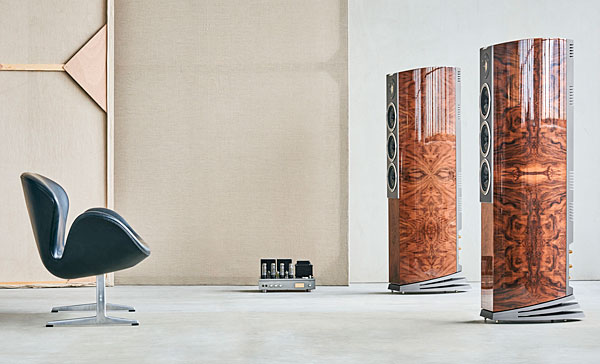
Let's not forget about the appearance. Tastes vary, but my tastes are mine and I'm the one writing this: This is one of the most attractive loudspeakers I've encountered. It's classical but also edgy—just a little bit.
I'm tempted to call the R 8's presentation relaxed. Instead, I'll choose a different word: free, which I admit I picked up from the Audiovector literature, where freedom is a prominent concept. It's not empty marketing: It's easy to see how the concept informs the R 8's design, and you can hear it in the R 8's sound. There's never a sensation of pent-up energy with these speakers. The R 8 Arretés release their music into the air in a way that seems effortless—and free.
Footnote 3: Test CD 1 is out of print but the pink noise track is included on Editor's Choice, which is still available.—Ed.
I found the Audiovector R 8 Arreté to be mostly neutral in its sonic presentation—maybe slightly on the sweet side; I'll be interested to see what JA's measurements show. The bass is full and full-range but in my room not overly assertive. At first I wondered if the sweetness I heard was due to the fact that the tweeters were high and my chair low: The centers of the R 8's AMT tweeters are about 52.5" off the floor, while, as I sit in my listening chair, my ears are about 34" off the ground. (It's an IKEA POÄNG chair, which is low to start with, and when I sit in it, the bentwood frame bends several more inches under my circa 200lb weight.)
So I tilted the Arretés forward as much as I could with the provided spikes and listened. I moved the listening chair out and moved an adjustable-height office chair in, and listened again. In its lowest position, the office chair placed my ears about 39" from the floor; its hydraulic lift took me through and beyond the preferred range. Listening to music, I heard a slight reduction in the highest frequencies, let us say 8kHz or so and up, at my normal listening height relative to the preferred zone. I heard no difference, or even a slight increase in level, in the presence region and upper treble. So, my listening height was softening the presentation a little, but the effect was small. With apologies to Ralph the Christmas Dog (who is featured on the first Stereophile Test CD), now for some pink noise (16/44.1 FLAC, rip from Stereophile STPH002-2, footnote 3).
Pink noise through the R 8 Arreté was unremarkable, in the best way. Nothing stood out. What I heard from the pink noise was consistent with an overall balance in which the bass is slightly elevated relative to the treble but without any prominent peaks.
But first things first: The piano comes before the vocal. Sullivan Fortner's piano was more spacious-sounding than I'm used to—quite a different presentation but no less natural. Salvant's voice, when it entered, was significantly farther back on the stage than it was with the Magico A5s, for example. The Audiovectors have a meaningfully different spatial presentation than that of the speakers that preceded them in my listening room.
Did Salvant's voice lose any presence, vividness, or corporeality? Not meaningfully, which surprised me. The vocal was no less intimate than it usually is. It didn't seem affected by the added ambience. The piano now occupied a different, more resonant acoustic than the voice.
This was a subtle thing, and it's not unnatural. Setting aside the fact that the vocal was probably recorded in an isolation room, and that studio effects could be added, the degree of resonance or room sound is determined by where the mikes are placed. Salvant is close-miked while the piano is miked—well, I'm not sure how or where, but well outside the piano case, so there's more room sound on the piano.
Similarly, on "I've Got Your Number," pianist Fortner hits a few notes hard. Once, with the volume front-row Village Vanguard loud (although this track was recorded in-studio), I jumped. Again, good. I don't want speakers to protect me from scary things.
As I listened more, I adapted to the R 8's distinctive presentation, as one does. I stopped hearing it as different from what was here before and instead heard it for what it is, on its own merits, the new default. I put on another familiar recording—my reissue of The Paul Desmond Quartet featuring Don Elliott (LP, OJC-119, originally Fantasy 3235). Very clean, explicit, with good transients, good rhythm. Slightly more spacious-sounding than I'm used to hearing. (It's a mono recording, so I'm hearing more reverb.)
On John Atkinson's recording of Robert Silverman playing the Liszt B minor sonata (16/44.1 rip from Stereophile STPH008-2), at about 11:20 of the first movement, Lento Assai, those big chords were very big indeed, noisy in a good way, every tone so distinct I could count 'em. The metal in those strings was easy to hear, especially in the long reverberation tails as the notes faded out one by one.
Some speakers I've heard that radiate energy in many directions gain an enhanced sense of space but only at the expense of articulation, image corporeality and specificity, and other virtues. The R 8s managed to avoid that tradeoff: They achieve an enhanced sense of space while retaining exemplary articulation and precise, fleshy images. They manage this, I'm thinking, via careful balancing: Not counting the bass, the amount of energy being launched in directions other than forward is modest. "Rear radiation is about 20% of front radiation," Ole told me. As I wrote at the beginning of this review, the Audiovector R 8 Arreté is more complicated than your typical loudspeaker. But what I heard from the R 8s was anything but complicated: It was pure and coherent and easily grasped. It was commendably neutral but also slightly sweet and a touch warm, with bass that, while extended, was not over-prominent in this room. The spatial presentation was quite special, especially the perception of depth. The R 8 Arreté managed this while remaining articulate and rendering concrete, precise images.
Footnote 3: Test CD 1 is out of print but the pink noise track is included on Editor's Choice, which is still available.—Ed.















