

Another thing to watch out for is when you switch from the Stream input to a hardwired input such as Coax: The streaming function then stops, and it takes a few seconds to boot up again when you switch back to Stream. Here's the tricky part: the Stream input can be chosen only from the Altair's front panel or remote control, not from the app, which now has lost connection and, again, works only when Stream is engaged. Until I figured this out, the first few times I went to Stream after using the USB drive, the Lightning DS or Roon app would lose the Altair, and I'd restart the Altair to get going again. Eventually, I realized that this wasn't necessary, got used to the timing when switching from Stream to Coax or USB HS and back again, and ignored the warnings of "CAN'T FIND DEVICE."
But after successfully running everything wired, I really did want to try streaming over WiFi, and again tried to set up the Altair as a wireless device. I used Google to find, in an online forum, another user who was having the same problem, but no luck. I started up the app anyway, selected Lightning Device, and switched the connection from Wired to Wireless. And it worked! I have no idea why it found my network this time and not before, but once I'd fired up Roon on my computer and selected the Altair, music was streaming again.
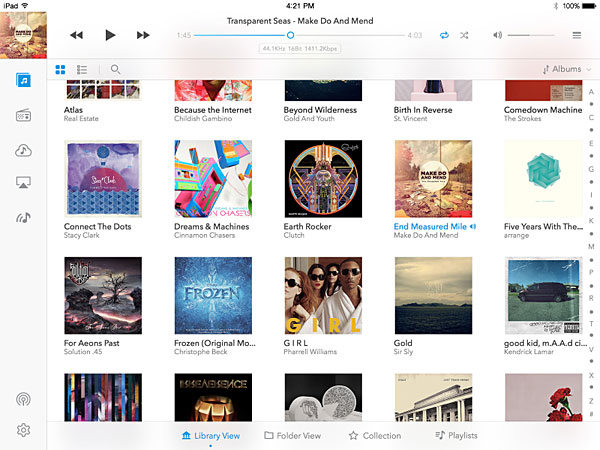 And, as with the wired connection, wireless playback of all streaming sources worked without a hitch at all resolutions (PCM up to 24-bit/192kHz and various rates of DSD) with no drop in sound quality, so I put away the Ethernet cable for good. At this point I also set up my Tidal account, streamed from my iPhone via AirPlay (although at a maximum sampling rate of only 44.1kHz), tried some Internet Radio, and generally ran as many sources as possible. This included a couple of MQA tracks, which streamed at 24/48—not MQA decoded, of course, but they worked.
Though at first I found Auralic's iPad app a tad nonintuitive and limited (I'm spoiled by the Roon and Sooloos apps), everything was eventually sorted out, and it was fairly easy to switch back and forth between various playback menus and views. The playback resolution and streaming rate of the track playing are shown near the top of the app's display, and everything looked correct. However, I encourage Auralic to make a simpler setup app that can control everything, even when not in Stream mode, for those of us who would go straight to another library app, such as Roon.
The Sound of Music
And, as with the wired connection, wireless playback of all streaming sources worked without a hitch at all resolutions (PCM up to 24-bit/192kHz and various rates of DSD) with no drop in sound quality, so I put away the Ethernet cable for good. At this point I also set up my Tidal account, streamed from my iPhone via AirPlay (although at a maximum sampling rate of only 44.1kHz), tried some Internet Radio, and generally ran as many sources as possible. This included a couple of MQA tracks, which streamed at 24/48—not MQA decoded, of course, but they worked.
Though at first I found Auralic's iPad app a tad nonintuitive and limited (I'm spoiled by the Roon and Sooloos apps), everything was eventually sorted out, and it was fairly easy to switch back and forth between various playback menus and views. The playback resolution and streaming rate of the track playing are shown near the top of the app's display, and everything looked correct. However, I encourage Auralic to make a simpler setup app that can control everything, even when not in Stream mode, for those of us who would go straight to another library app, such as Roon.
The Sound of Music
Setup issues and user quirks can be sorted and adjusted, but how a digital product sounds is how it sounds—unless you have some choices of digital filter to play with, which, as regular readers know, I love to do. The Auralic Altair offers four digital filters: Precise, Dynamic, Balance, and Smooth. Auralic says that the Precise filter is tuned for perfect in-band ripple and out-band attenuation. Dynamic slightly rolls off the high frequencies, but otherwise has technical characteristics similar to Precise; Balance has more high-frequency rolloff, but with less pre- and post-ringing; and Smooth is a minimum-phase design with no pre-ringing.
For whatever reason—John Atkinson might be able to reveal them in his measurements—these filters sounded more alike than have the filters of other, similarly endowed DACs I've heard, and I couldn't easily pick a clear overall winner. Still, I found myself using Smooth for most of my listening, because it sounded closest to what I hear from Ayre Acoustics' Codex and the Bézier Interpolator plus IIR filter in T+A Elektroakustik's DAC8, which have been my favorite DACs for the last few months. Though it opened up the top end, Precise seemed a tad more hashy with cymbals, and Balance a bit too polite. But I didn't hear images move around as much as when switching among the filters of other DACs, and overall, tonality was very consistent.
I began my serious listening with Jake Shimabukuro's excellent new album, Nashville Sessions (JS 5852), played via Roon. Luckily, I have a 24/88.2 PCM version that the mastering engineer Dropboxed to me, and I picked a couple of the fusion tracks featuring acoustic ukulele, electric bass, and acoustic drums. I listened with my computer wired to the Altair's USB HS input, and wirelessly via the Stream input. "Celtic Tune" begins with solo ukulele, then a slow roll on the snare builds until the full drum kit and bass guitar kick in. Switching back and forth between the Altair's wired and wireless playback, I heard no differences. Details and textures were just as I'm used to hearing from this track, though when I compared the Auralic's playback directly with the T+A and then the Benchmark DAC2 HGC, both via USB, I noted a slight leanness in the Altair's sound.
The snap of the ukulele strings was excellent through the Altair, especially in the next track I tried, "Blue Haiku"—but there was greater dynamic impact with the other DACs, especially when the drums and bass kick in. The Altair's sound felt slightly more polite and laid-back. I tried the other filters, but the Altair's mellow character was consistent, especially in comparison with the other DACs.
The Benchmark DAC2 is similar in price to the Altair, and the T+A costs twice as much—and neither functions as a streamer. But this comparison does offer some useful information about the Altair's DAC section. By this time I'd already sent the Ayre Codex to JA, but I would think it would be similar to the T+A in this comparison. The Benchmark has always emphasized the top end a bit more than all other DACs I've heard, but its bottom is clean and dynamic; the Altair was a bit shy.
 Next I pulled up musician-producer Steven Wilson's 2016 remix of Stand Up, Jethro Tull's brilliant second album, from 1969 (Rhino 9029593286), to listen through various headphones. Both the flat transfers of the original mix tapes and Wilson's new mixes are offered in 24/96 PCM, and what a contrast! In Wilson's hands, gone are all the buzzes, grime, and random studio noises, and each instrument feels much more real and immediate. Various instruments and voices are also positioned and layered as in a more contemporary-sounding stereo mix, while keeping the overall balance familiar.
The subtle differences between DACs noted above were still present, but the Altair's headphone section performed well, offering plenty of headroom, and was easily the equal of the Benchmark's or T+A's headphone amp overall. However, my memory of the Ayre Codex's headphone sound put the Altair at a slight disadvantage. The Auralic's slightly softer sound made me end up preferring the Audeze LCD-X headphones over more rounded-sounding models such as AudioQuest's NightHawks, though the NightHawks did restore some overall warmth.
For something completely different, I finished my listening back in my main system, with Meredith Monk's On Behalf of Nature (ECM New Series 2473), which features a small, eclectic ensemble of acoustic instruments and a cast of human voices (Burmese piccolo and Macauan birdcalls, anyone?). Again, there was a subtle softening of the overall impact of percussion instruments, but in this case I felt the Altair better suited the nature of these organic textures. As sounds emerged in the large acoustic space, often appearing to float in mid-air before evaporating, the word that came to mind was silky. Magnificent.
Conclusions
Next I pulled up musician-producer Steven Wilson's 2016 remix of Stand Up, Jethro Tull's brilliant second album, from 1969 (Rhino 9029593286), to listen through various headphones. Both the flat transfers of the original mix tapes and Wilson's new mixes are offered in 24/96 PCM, and what a contrast! In Wilson's hands, gone are all the buzzes, grime, and random studio noises, and each instrument feels much more real and immediate. Various instruments and voices are also positioned and layered as in a more contemporary-sounding stereo mix, while keeping the overall balance familiar.
The subtle differences between DACs noted above were still present, but the Altair's headphone section performed well, offering plenty of headroom, and was easily the equal of the Benchmark's or T+A's headphone amp overall. However, my memory of the Ayre Codex's headphone sound put the Altair at a slight disadvantage. The Auralic's slightly softer sound made me end up preferring the Audeze LCD-X headphones over more rounded-sounding models such as AudioQuest's NightHawks, though the NightHawks did restore some overall warmth.
For something completely different, I finished my listening back in my main system, with Meredith Monk's On Behalf of Nature (ECM New Series 2473), which features a small, eclectic ensemble of acoustic instruments and a cast of human voices (Burmese piccolo and Macauan birdcalls, anyone?). Again, there was a subtle softening of the overall impact of percussion instruments, but in this case I felt the Altair better suited the nature of these organic textures. As sounds emerged in the large acoustic space, often appearing to float in mid-air before evaporating, the word that came to mind was silky. Magnificent.
Conclusions
Setup problems aside—problems that could have been caused by my network—once everything was running, the versatility of the Auralic Altair as a streaming or wired hub and DAC was obvious. To get started, all you need is the Altair and a USB drive stuffed with music. The Altair's sound quality was good, and about what I'd expect from so many features packed together and costing under two grand. I conjecture that this is where Auralic's more expensive, and more tricked-out Vega DAC might even the score with the other DACs I had on hand. And remember, the USB output jack on the Altair's rear panel provides an upgrade path to a better DAC. Caveats: Auralic's Lightning DS app is quite usable as a basic tool for sorting and playing a music library's tracks, but it could use a final polish. And I didn't like the fact that of the three different ways of controlling the Altair—remote control, front panel, and iPad app—none could do everything, forcing the user to juggle controllers, depending on the result desired.
All of these issues are easily solved. For example: Run the Altair as a Roon endpoint, add Roon's metadata-rich app and its associated library running on a networked computer or NAS somewhere, and you've hit the sweet spot of streaming, state-of-the-art control, and decent sound—all for a reasonable price.
And, as with the wired connection, wireless playback of all streaming sources worked without a hitch at all resolutions (PCM up to 24-bit/192kHz and various rates of DSD) with no drop in sound quality, so I put away the Ethernet cable for good. At this point I also set up my Tidal account, streamed from my iPhone via AirPlay (although at a maximum sampling rate of only 44.1kHz), tried some Internet Radio, and generally ran as many sources as possible. This included a couple of MQA tracks, which streamed at 24/48—not MQA decoded, of course, but they worked.
Setup issues and user quirks can be sorted and adjusted, but how a digital product sounds is how it sounds—unless you have some choices of digital filter to play with, which, as regular readers know, I love to do. The Auralic Altair offers four digital filters: Precise, Dynamic, Balance, and Smooth. Auralic says that the Precise filter is tuned for perfect in-band ripple and out-band attenuation. Dynamic slightly rolls off the high frequencies, but otherwise has technical characteristics similar to Precise; Balance has more high-frequency rolloff, but with less pre- and post-ringing; and Smooth is a minimum-phase design with no pre-ringing.
Next I pulled up musician-producer Steven Wilson's 2016 remix of Stand Up, Jethro Tull's brilliant second album, from 1969 (Rhino 9029593286), to listen through various headphones. Both the flat transfers of the original mix tapes and Wilson's new mixes are offered in 24/96 PCM, and what a contrast! In Wilson's hands, gone are all the buzzes, grime, and random studio noises, and each instrument feels much more real and immediate. Various instruments and voices are also positioned and layered as in a more contemporary-sounding stereo mix, while keeping the overall balance familiar.
The subtle differences between DACs noted above were still present, but the Altair's headphone section performed well, offering plenty of headroom, and was easily the equal of the Benchmark's or T+A's headphone amp overall. However, my memory of the Ayre Codex's headphone sound put the Altair at a slight disadvantage. The Auralic's slightly softer sound made me end up preferring the Audeze LCD-X headphones over more rounded-sounding models such as AudioQuest's NightHawks, though the NightHawks did restore some overall warmth.
Setup problems aside—problems that could have been caused by my network—once everything was running, the versatility of the Auralic Altair as a streaming or wired hub and DAC was obvious. To get started, all you need is the Altair and a USB drive stuffed with music. The Altair's sound quality was good, and about what I'd expect from so many features packed together and costing under two grand. I conjecture that this is where Auralic's more expensive, and more tricked-out Vega DAC might even the score with the other DACs I had on hand. And remember, the USB output jack on the Altair's rear panel provides an upgrade path to a better DAC. Caveats: Auralic's Lightning DS app is quite usable as a basic tool for sorting and playing a music library's tracks, but it could use a final polish. And I didn't like the fact that of the three different ways of controlling the Altair—remote control, front panel, and iPad app—none could do everything, forcing the user to juggle controllers, depending on the result desired.















