

Sidebar 3: Measurements
The importance of the Avantgarde Acoustic Duo's sensitivity result puts this parameter at the top of the list of lab tests—I measured 103dB/2.83V/m, possibly the highest yet for a Stereophile review. Moreover, the impedance rating is a genuine 8 ohms, which doesn't compromise the sensitivity value.
The implications are substantial, and in no small way help define this design's engineering value. 103dB means that a loud program level of 96dBA is attainable at the listening position with input of just 0.5W. The Duo is wholly compatible with 3W-and-up SE amplifiers, while an average 10W peak of SE power will produce a genuinely high 108dBA in a typical room.
Suppose a 250Wpc Conrad-Johnson Premier Eight A had been on your amplifier wish list; with the Duo, the Premier Eleven A's 60Wpc would be more than ample, the combination capable achieving a stunning 115dBA maximum sound level. If a Cary CAD-805C is your dream partner for a conventional speaker of healthy sensitivity, Cary's 10W 300SE will be ample, saving thousands of dollars and perhaps providing an even better match.
On the other hand, the Duo's wide dynamic range means that it can drive larger rooms with aplomb, approaching the peak sound level of the Wilson X-1/Grand SLAMM. I found that the Duo will accept the equivalent of 100W unclipped music program of normal spectral content, which, in a good-sized listening room, will result in levels of 118dBA. It will possibly reach 110dBA in larger spaces, such as a small ballroom.
As well as being sensitive, Avantgarde's horn technology delivers genuinely high efficiency at turning electrical power into acoustic power: 20dB (100 times) greater than such low-efficiency classics as the LS3/5a or some of the older big, full-range Apogee planars. The Duo is approximately 10% efficient from 150Hz to 20kHz, compared with the diminutive LS3/5a at just 0.1%.
Fig.1 shows the impedance magnitude and phase plotted for the horns. A smoother characteristic would ideally be preferred, given the higher source impedances of single-ended tube power amplifiers. Note the relatively high minimum value of 5.8 ohms at 9kHz, the moderate variation from 8 ohms nominal of +6, –2 ohms from 100Hz to 20kHz. The magnitude peak (31 ohms) of the midrange driver is not important, merely indicating that its fundamental resonance lies at 58Hz. Peaks of high impedance are relatively harmless if the overall impedance remains fairly high, as it does in this case. At near-infrasonic frequencies the impedance finally falls to an inconsequential 9.5 ohms. There's no cheating with the Duo on impedance in order to give a falsely high sensitivity reading.


 I noted that while the mid tonality generally tended to moderate lightness, this character became still more noticeable at greater listening distances. It sounded as if the frequency response of the mid horn varied a little with distance. To investigate this proximity effect, I charted the output of the midrange horn at distances of 1', 2', 3', 4', and 8' (fig.4). Comparison of the curves indicated that there was indeed a proximity effect, and that the response did "thin" slightly at farther distances. Some compensation could be obtained with the woofer controls.
 In the lateral plane (fig.5), very little change occurred up to and including 30° off-axis—just some smooth attenuation of the upper-treble range, which remained uniformly extended nonetheless. By 45° off-axis the result was still extraordinarily good except for a moderate bump at 1.7kHz, which also appears in the in-room response. What a surprise to find a horn speaker with such a wide and well-controlled directivity.

 Theory tells us that a high-sensitivity speaker should have low distortion and greater freedom from dynamic compression. With the aid of ear defenders (!), I was able to explore the Duo's distortion performance at genuinely high sound-pressure levels (shown in Table 1). Only the second and third harmonics are shown; the rest were below measurement limits and were inconsequential.
In the bass, a single speaker channel overloads above 105dB at 1m for frequencies below 50Hz in equivalent anechoic conditions. This is, in fact, a good result for a direct-radiating woofer system. In practice, with room-boundary reinforcement and on typical program, the woofer section is capable of keeping up with the main horn system up to the 110–115dB limit.
Taking the bass-distortion results first, these were quite reasonable: for example, at 100dB at 35Hz and 50Hz, the distortion will be barely audible in practice. At normal 90dB levels, the results were fine for both 35 and 50Hz.
Handsomely delivering the promised high linearity, the midrange horn distortion was astonishingly low, even at a measured 110dB test level. Even at 100 and 90dB SPLs, the third harmonic was unmeasurable, and the second was well below 0.1%—this rivals a good push-pull electrostatic speaker and even some amplifiers! Even at 100dB, the third harmonic remained negligible, while the second was still excellent at just 0.12%. Very fine results were also obtained for the tweeter, if not in the same class as the mid system. At 90dB, the second harmonic was 0.13%, with third at a negligible 0.03%. By 100dB, the second had risen to a tolerable 1%. By 110dB it hadn't broken loose, still holding to a satisfactory 2% of second harmonic. At this sound level, natural distortion in the ear at the equivalent room SPL is likely to exceed this figure! With that low third harmonic content, what a match this Duo speaker would make with similarly gifted triode amplifiers!
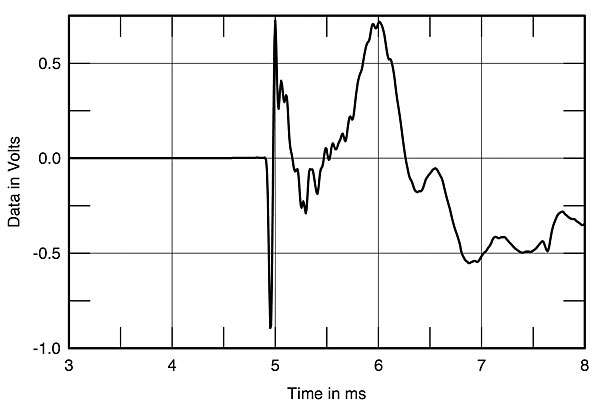
I noted some differences in arrival time from each part of the system; for example, the treble was early, arriving 0.6ms ahead of the mid (see the step response, shown in fig.7). Nevertheless, this is a good signature, especially for a horn, and there was no evidence of significant infrasonic ringing from the metal tweeter diaphragm. Looking at the broad Energy-Time Curve (fig.8), it looks good enough down to –25dB and 1ms elapsed. Some artifacts then hang on for a while.
Theory tells us that a high-sensitivity speaker should have low distortion and greater freedom from dynamic compression. With the aid of ear defenders (!), I was able to explore the Duo's distortion performance at genuinely high sound-pressure levels (shown in Table 1). Only the second and third harmonics are shown; the rest were below measurement limits and were inconsequential.
In the bass, a single speaker channel overloads above 105dB at 1m for frequencies below 50Hz in equivalent anechoic conditions. This is, in fact, a good result for a direct-radiating woofer system. In practice, with room-boundary reinforcement and on typical program, the woofer section is capable of keeping up with the main horn system up to the 110–115dB limit.
Taking the bass-distortion results first, these were quite reasonable: for example, at 100dB at 35Hz and 50Hz, the distortion will be barely audible in practice. At normal 90dB levels, the results were fine for both 35 and 50Hz.
Handsomely delivering the promised high linearity, the midrange horn distortion was astonishingly low, even at a measured 110dB test level. Even at 100 and 90dB SPLs, the third harmonic was unmeasurable, and the second was well below 0.1%—this rivals a good push-pull electrostatic speaker and even some amplifiers! Even at 100dB, the third harmonic remained negligible, while the second was still excellent at just 0.12%. Very fine results were also obtained for the tweeter, if not in the same class as the mid system. At 90dB, the second harmonic was 0.13%, with third at a negligible 0.03%. By 100dB, the second had risen to a tolerable 1%. By 110dB it hadn't broken loose, still holding to a satisfactory 2% of second harmonic. At this sound level, natural distortion in the ear at the equivalent room SPL is likely to exceed this figure! With that low third harmonic content, what a match this Duo speaker would make with similarly gifted triode amplifiers!
I noted some differences in arrival time from each part of the system; for example, the treble was early, arriving 0.6ms ahead of the mid (see the step response, shown in fig.7). Nevertheless, this is a good signature, especially for a horn, and there was no evidence of significant infrasonic ringing from the metal tweeter diaphragm. Looking at the broad Energy-Time Curve (fig.8), it looks good enough down to –25dB and 1ms elapsed. Some artifacts then hang on for a while.


* Full overload/clipping in woofer system
Fig.1 Avantgarde Duo horn section only, electrical impedance (solid) and phase (dashed) (2 ohms/vertical div.).
Fig.2 shows the individual responses of the two horns, the moving-coil woofers, and the port (the frequency control was set to its maximum position for the latter two traces). A low-rate crossover is placed at approximately 200Hz, typically 6dB/octave, and the out-of-phase setting on the woofer panel correctly imparted a phase notch of some 23dB at around 170Hz. The implied transition frequency between the midrange and treble horns was a little lower than specified, at 1.7kHz. The exact frequency was obscured by the lift in the midrange response at this point.
Fig.2 Avantgarde Duo acoustic crossover on tweeter axis at 5', with the nearfield midrange, woofer, and port responses plotted below 500Hz, 300Hz, and 1kHz, respectively, with "Frequency" set to maximum.
My presentation of the axial frequency response (fig.3) is based on a greater-than-usual 5' microphone distance to help improve the driver balancing. This is because it's hard to determine know the rate of intensity decay with distance for multiple sources, each a different distance to the measuring microphone. With a fairly tall speaker like the Duo, it's also true that a median measuring position will give an artificial prominence to the central tweeter horn. So in practice, some of the elevated treble level (+3dB up to 8kHz) seen in this graph will actually be more in balance at a 3–4m listening distance.
Fig.3 Avantgarde Duo, anechoic response on tweeter axis at 5', with complex sum of the nearfield midrange, woofer, and port responses, "Frequency" set to maximum, plotted below 300Hz (top trace) and of the woofer and port responses, "Frequency" set to minimum (bottom trace).
Above 8kHz, it can be seen from fig.3 that the treble stepped up by an average of 4dB, reaching a commendably (for a horn) extended upper limit of 19kHz. The main range was remarkably smooth, as was the midrange; even in this narrow-band, high-resolution analysis, the output was marred only by the minor "glitch" in the crossover range at 1.7kHz. This aside, the speaker met ±3dB limits from 60Hz to 8kHz—a good tolerance, if still leaving room for a bit of "character" arising from the practical perceived tonal balance.
In the base, the nearfield measurement indicated the typical –6dB bass cutoff point at normal woofer settings to be 36Hz; a respectable value, if not low enough for a true subwoofer. The top trace to the left of fig.3 is the complex sum of the woofers and port nearfield outputs with the frequency control set to its maximum position; the narrow bandpass trace is the summed nearfield responses with the woofer system set to the same level but the frequency control set to its minimum position.
Fig.4 Avantgarde Duo, response of midrange horn with the microphone at (from top to bottom): 1', 2', 3', 4', and 8'.
I was agreeably surprised by the uniformity and integration demonstrated by the off-axis response plotted in the vertical plane (not shown). Absolute and relative levels varied little over a 30° vertical window, the only point of interest being between 1kHz and 2.5kHz at the interchange between the mid and treble horns. On the optimum listening axis, the crossover and drive-unit phasing has been skillfully adjusted for the flattest response, while modest cancellations above and below axis reveal a true power maximum at around 1.7kHz, this associated with the mid horn.
Fig.5 Avantgarde Duo, horizontal response family, from back to front: differences in response 45°–15° off-axis; reference response; differences in response 15°–45° off-axis.
The Duo's response in the listening room was fascinating, and I had looked forward with interest to seeing the effects of these directional horns on the overall energy response (fig.6). Remarkably, the Duo offered a substantially uniform energy output, the in-room response meeting ±3dB limits from 36Hz to 17kHz (including the woofer). There are some expected minor lumps and bumps, but the interface to the room can be seen to be very well controlled by these carefully designed acoustic devices.
Fig.6 Avantgarde Duo, spatially averaged, 1/3-octave in-room response.
Two critical points can be made here. The 4.5dB bump at 1.7kHz was indeed pervasive. A function of the low-pass cutoff of the mid horn, it did occasionally pop up in the Duo's sound depending on music program. Second, the power response in the treble above 8kHz was a little too good for comfort; a gentle tapering-off might well be preferred. This feature could well explain why the upper treble sometimes sounded more forward and "ahead" of the mid region, although the subjective magnitude of this effect also depends on the matching electronics. Some SE designs have a degree of softness in their high range that is in fact complemented by this horn's characteristic power response.
Good output in-room was seen to below 40Hz, though it is fair to say that, by audiophile standards, the Duo's woofer is not a true subwoofer, for which extension to 25Hz or 20Hz would be expected. In practice, some scope is available for adjusting the low-pass crossover frequency and the woofer level to provide greater effective and subjective extension. Though enthusiasts could easily add more extended active subwoofers as required, when I tried the big REL Stentor it had insufficient voltage sensitivity for a good match.
Summing up, the in-room response was wide and remarkably uniform in balance, a testament to the Duo's good off-axis energy response.
Fig.7 Avantgarde Duo, step response on tweeter axis at 5' (5ms time window, 30kHz bandwidth).
Fig.8 Avantgarde Duo, Energy-Time Curve on tweeter axis at 5' (unfiltered, unwindowed).
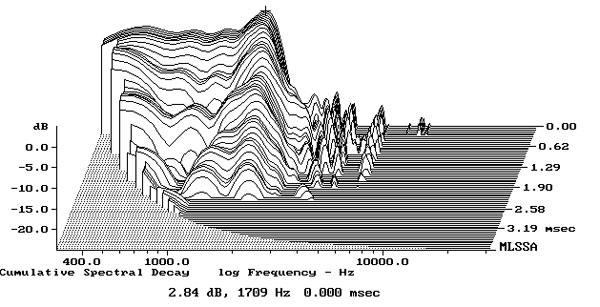
Turning to the "waterfall" cumulative spectral-decay presentation, my usual 10dB/division graph (not shown) emphasized longer-term, frequency-resolved decay and showed a complex field. Overlapping resonances could be seen in the 1.7kHz crossover range, plus some "clutter" at high frequencies that might well impair upper-range transparency. A horn throat-resonance "ridge" could be seen around 17kHz, but otherwise the treble decay was pretty good. In fig.9, a graph weighted to resolve resonance-decay speed by using 5dB/division resolution in conjunction with a 0.1ms filter setting, the Duo's early treble decay is especially good, while the upper-midrange problem can be clearly seen. To investigate this further, I ran a waterfall plot for the midrange horn system alone (fig.10) and got a clear presentation of the long-lived 1.7kHz phenomenon.
Fig.9 Avantgarde Duo, cumulative spectral-decay plot (0.1ms risetime).
Fig.10 Avantgarde Duo, midrange horn, cumulative spectral-decay plot (0.1ms risetime).
The bass box was well constructed, with no significant resonances in its working range save from the slotted port. As for the horns, those curved ABS sections seemed rigid and well damped, with no consequential structural resonance modes.—Martin Colloms
Table 1 Avantgarde Duo: Harmonic Distortion| SPL(1m) | Low Bass 35Hz | Bass 50Hz | Midrange 1kHz | Treble 5kHz | ||||
| 2nd | 3rd | 2nd | 3rd | 2nd | 3rd | 2nd | 3rd | |
| 90dB | 0.33% | 1.00% | 0.31% | 0.42% | 0.08% | 0v.low | 0.13% | 0.03% |
| 100dB | 3.40% | .30% | 0.60% | 1.50% | 0.06% | 0v.low | 1.05% | 00.08% |
| 110dB | -* | -* | 1.20% | 15.00%* | 0.18% | 0.01% | 2.20% | 0.08% |















