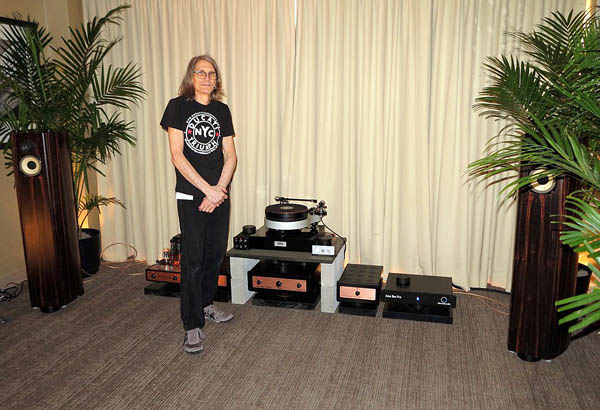
I scored big this year, because my floors included High Water Sound's room. As usual, Jeffrey Catalano was a breath of fresh air, playing LPs of music not encountered in other rooms. First came a movement from Shostakovich's String Quartet 9 (performed by the Fitzwilliam Quartet, dressed in echt '70s slim-cut suits), which sounded gorgeous. Next, Lou Reed and John Cale's Songs for Drella, which showcased the system's strong but balanced midrange. Finally, The Cairo Gang's "At the Show," recorded in 2007 in Chicago, on which the guitar's sound was to die for.
It's not just Jeffrey's unending curiosity and willingness to play great music that would otherwise remain unheard at a U.S. audio show: it's also the interaction of his choice selections with his equally choice taste for excellent equipment. The latter in this case included the TW-Acustic GT SE turntable ($12,500) with two TW 10.5 tonearms ($5500 each); Miyajima Labs Madake/Stereo cartridge ($6000) and Zero/Mono cartridge ($2000), along with their ETR MC step-up transformer ($1995); New Audio Frontiers Stradivari line stage ($10,000), Stradivari phono stage ($11,500), and Stereo 845 SE Special Edition amplifier ($12,500); Horning Hybrid Systems Eufrodite Mark IV Ellipse speakers ($32,000/pair), Silver Circle Audio Juice Box Pro SE ($3690), ZenSati cabling, and Silent Running Audio racks and bases. Bravo!
 Knut Skogrand was justifiably proud of the newest addition to his cable line, the Skogrand SCD Beethoven USB. Taking its place in a system that mated a complete complement of Skogrand Beethoven cabling with the EgglestonWorks Andra III SE loudspeakers ($28,635/pair); ModWright Instruments' LS 36.5 'DM' tube preamp ($9995), KWA 150 Signature Edition monoblocks ($8995/each), Elyse Reference tube DAC ($6900), PH 150 Reference tube phono stage ($7900), and ModWright-modified Oppo 105D ($3995); TriangleArt Signature turntable ($15,995), Osiris 12" tonearm ($5800), Apollo MC cartridge ($8000), Titan SUT ($3500), and RA-8 power distribution ($3500); and Massif Audio Design component rack ($3000/each), amp and turntable platforms ($700/each), and cable risers ($50/each), the sound initially sounded a bit metallic and edgy, with a high noise floor and a lack of warmth.
When Knut said, in response to my request from some non-soppy, complex classical music, "You've probably heard this 1000 times, but how about The Dance of the Tumblers," I resisted an urge to somersault out of the room and instead opted for Shostakovich's Fugue 4 in E Minor for piano. This was a far more satisfactory listening experience, with the piano sounding great. Ditto for my CD of pianist Murray Perahia playing Handel. Again, the sound was nowhere near as transparent as in some systems I heard at the show, but it was quite lovely.
Knut Skogrand was justifiably proud of the newest addition to his cable line, the Skogrand SCD Beethoven USB. Taking its place in a system that mated a complete complement of Skogrand Beethoven cabling with the EgglestonWorks Andra III SE loudspeakers ($28,635/pair); ModWright Instruments' LS 36.5 'DM' tube preamp ($9995), KWA 150 Signature Edition monoblocks ($8995/each), Elyse Reference tube DAC ($6900), PH 150 Reference tube phono stage ($7900), and ModWright-modified Oppo 105D ($3995); TriangleArt Signature turntable ($15,995), Osiris 12" tonearm ($5800), Apollo MC cartridge ($8000), Titan SUT ($3500), and RA-8 power distribution ($3500); and Massif Audio Design component rack ($3000/each), amp and turntable platforms ($700/each), and cable risers ($50/each), the sound initially sounded a bit metallic and edgy, with a high noise floor and a lack of warmth.
When Knut said, in response to my request from some non-soppy, complex classical music, "You've probably heard this 1000 times, but how about The Dance of the Tumblers," I resisted an urge to somersault out of the room and instead opted for Shostakovich's Fugue 4 in E Minor for piano. This was a far more satisfactory listening experience, with the piano sounding great. Ditto for my CD of pianist Murray Perahia playing Handel. Again, the sound was nowhere near as transparent as in some systems I heard at the show, but it was quite lovely.
 Madisound had really put some thought into its speaker parts layout. If only our three canine terrorers—I call them, in pig Spanish, "los tres poocheros superbos" in honor of their first home in the barrio of East Oakland—would take the lead from Madisound, and lay their bones out even half as neatly on the floor. As in: there goes Daddy slipping on another bone that we concealed from view. See Daddy fly
!
Madisound had really put some thought into its speaker parts layout. If only our three canine terrorers—I call them, in pig Spanish, "los tres poocheros superbos" in honor of their first home in the barrio of East Oakland—would take the lead from Madisound, and lay their bones out even half as neatly on the floor. As in: there goes Daddy slipping on another bone that we concealed from view. See Daddy fly
!
 Designed by the original designer of Emerald Physics, Spatial M3 dipole loudspeakers ($2595/pair) remain among the great Plain-Jane surprises of any show. Mated with a Red Dragon S500 stereo amplifier ($1995), a full array of AntiCables Turbo 5 ($1250), MacBook Air, and Lampizator Lite 7 music server, this was one of my two Best Lower-Priced Systems of the 3rd floor. (You'll have to read more posts to learn the other.) Listening to a file of Hilary Hahn playing Bach's Violin Concerto 1, I greatly admired the lovely timbres, spaciousness, and air transmitted by this truly musical system.
 Channel D's clean, neutral, and eminently quiet presentation made great use of Rob Robinson's two-decades-old reference pair of Wisdom Audio D75 Planar Magnetic loudspeakers, which were upgraded with 21st Century technology. Robinson replaced the Wisdom analog electronic crossover with the digital electronic crossover feature found in Pure Vinyl, and used six output channels of the Lynx Hilo ADC/ DAC ($2500) and three stereo power amplifiers in a Hegel H20 tri-amped configuration ($6000 each).
Robinson played a super 24/192 transfer of Alexander Gibson's Witches' Brew LP, which was digitized using Channel D Pure Vinyl software ($299). It sounded wonderful. Also in the system: Channel D Seta Model L phono preamp ($4998), Music Hall MMF 9.3 turntable ($2300), and Apple Mac mini ($800). Thanks to Robinson for explaining to me that Pure Music file-playback software converts Apple Lossless and FLAC to AIFF or WAV before playback rather than on the fly during playback, which means that the computer power required for the conversion process does not negatively impact the power the computer needs to deliver its best sound.
Channel D's clean, neutral, and eminently quiet presentation made great use of Rob Robinson's two-decades-old reference pair of Wisdom Audio D75 Planar Magnetic loudspeakers, which were upgraded with 21st Century technology. Robinson replaced the Wisdom analog electronic crossover with the digital electronic crossover feature found in Pure Vinyl, and used six output channels of the Lynx Hilo ADC/ DAC ($2500) and three stereo power amplifiers in a Hegel H20 tri-amped configuration ($6000 each).
Robinson played a super 24/192 transfer of Alexander Gibson's Witches' Brew LP, which was digitized using Channel D Pure Vinyl software ($299). It sounded wonderful. Also in the system: Channel D Seta Model L phono preamp ($4998), Music Hall MMF 9.3 turntable ($2300), and Apple Mac mini ($800). Thanks to Robinson for explaining to me that Pure Music file-playback software converts Apple Lossless and FLAC to AIFF or WAV before playback rather than on the fly during playback, which means that the computer power required for the conversion process does not negatively impact the power the computer needs to deliver its best sound.
 Channel D was also showing, on passive display in the Manufacturer's Showcase, their new Seta Supreme Phono preamp ($8998). It's the first galvanically isolated preamp/ADC/DAC system that features a preamp working in conjunction with the Lynx Hilo battery powered ADC/DAC, which is also galvanically isolated from the computer.
 Technics has just introduced their SL-1200GAE 50th Anniversary direct-drive turntable system ($4000). Framed as an attempt "to redefine the direct-drive turntable reference," the table boasts an all-new design, three turntable speeds, and an extremely wide variable-range pitch control. Paired with Technics' Grand Class SU-G30 Network Audio amplifier ($4000), not-yet-released ST-G30 music server (due in May or June), and SB-C700 loudspeakers ($1699/pair), the system sounded very midrange-ish and smooth on Frank Sinatra's "I'm a Fool to Love You." (But I don't think anyone running the room was aware of the music's subliminal message.)
 A winning system came in the form of hand-built-in-Maine Volti Audio Alura 99dB-sensitive loudspeakers ($15,900/pair), Vinnie Rossi LIO ultracapacitor-powered integrated amplifier with phono stage and DAC ($10,470 as configured), Acoustic Signature Challenger MKIII turntable ($4995) with TA-1000 arm ($1500), and the world-premiere appearance of Triode Wire Labs' Gold Statement power cord ($999), along with other Triode Wire Labs power cords and cables. Ella sounded gorgeous on her "April in Paris" duet with Louis Armstrong, with fabulous soundstaging but exaggerated sibilants on consonants. I could really hear how Satchmo's trumpet and vocals seemed all of one piece (as in: the product of the same musical intelligence and inspiration), and marvel at the natural timbral contrast between trumpet and piano.
 My lucky streak of great-sounding rooms continued with Hanson AV, where I encountered Magico S3 loudspeakers ($22,600/pair) connected to a Devialet D900 Limited Edition integrated amplifier ($36,900) and Aurender N10 server ($8000), with Iconoclast cabling. Also in the system were a Clearaudio Innovation Wood turntable with Goldfinger cartridge and Stillpoints supports.
My equipment list may be a bit sketchy due to the exhibitor's handwritten scribble, but the sound was anything but. Everyone in the room was totally hushed as Mazzy Star performed "Into Dust" with gorgeous, mesmerizing tone. Gorgeous also seems the adjective of choice when describing the sound on Tracy Chapman's "I Am Yours." And while David Maslanka's Garden of Dreams, performed by Jerry Junkin's Dallas Wind Band, may be too derivative a composition for my taste, the timbres of acoustic instruments seemed spot-on. Not only that, but those instruments were also correctly balanced throughout the range, with none unnaturally spotlighted due to frequency imbalances. A winning system playing, for the most part, great music.
My lucky streak of great-sounding rooms continued with Hanson AV, where I encountered Magico S3 loudspeakers ($22,600/pair) connected to a Devialet D900 Limited Edition integrated amplifier ($36,900) and Aurender N10 server ($8000), with Iconoclast cabling. Also in the system were a Clearaudio Innovation Wood turntable with Goldfinger cartridge and Stillpoints supports.
My equipment list may be a bit sketchy due to the exhibitor's handwritten scribble, but the sound was anything but. Everyone in the room was totally hushed as Mazzy Star performed "Into Dust" with gorgeous, mesmerizing tone. Gorgeous also seems the adjective of choice when describing the sound on Tracy Chapman's "I Am Yours." And while David Maslanka's Garden of Dreams, performed by Jerry Junkin's Dallas Wind Band, may be too derivative a composition for my taste, the timbres of acoustic instruments seemed spot-on. Not only that, but those instruments were also correctly balanced throughout the range, with none unnaturally spotlighted due to frequency imbalances. A winning system playing, for the most part, great music.
 It took two trips to the Auralic room until the people running it finally ceased their non-stop sales pitches long enough to enable a serious listen. The company's new Altair wireless streaming DAC ($1899) was touted as "a perfect single-box music source" with 15 input sources, the ability to play in quad-rate DSD/DXD, and Tidal/Qobuz/AirPlay/Bluetooth/Roon readiness. But heard via Ryan 630 loudspeakers and AudioQuest cabling, the presentation seemed surprisingly flat on more than one selection. I missed the name of the first one, but a track from Queen's A Night at the Opera mixed welcome liveliness on top with a flat and color-deficient midrange.
Knut Skogrand was justifiably proud of the newest addition to his cable line, the Skogrand SCD Beethoven USB. Taking its place in a system that mated a complete complement of Skogrand Beethoven cabling with the EgglestonWorks Andra III SE loudspeakers ($28,635/pair); ModWright Instruments' LS 36.5 'DM' tube preamp ($9995), KWA 150 Signature Edition monoblocks ($8995/each), Elyse Reference tube DAC ($6900), PH 150 Reference tube phono stage ($7900), and ModWright-modified Oppo 105D ($3995); TriangleArt Signature turntable ($15,995), Osiris 12" tonearm ($5800), Apollo MC cartridge ($8000), Titan SUT ($3500), and RA-8 power distribution ($3500); and Massif Audio Design component rack ($3000/each), amp and turntable platforms ($700/each), and cable risers ($50/each), the sound initially sounded a bit metallic and edgy, with a high noise floor and a lack of warmth.
Madisound had really put some thought into its speaker parts layout. If only our three canine terrorers—I call them, in pig Spanish, "los tres poocheros superbos" in honor of their first home in the barrio of East Oakland—would take the lead from Madisound, and lay their bones out even half as neatly on the floor. As in: there goes Daddy slipping on another bone that we concealed from view. See Daddy fly
!
Designed by the original designer of Emerald Physics, Spatial M3 dipole loudspeakers ($2595/pair) remain among the great Plain-Jane surprises of any show. Mated with a Red Dragon S500 stereo amplifier ($1995), a full array of AntiCables Turbo 5 ($1250), MacBook Air, and Lampizator Lite 7 music server, this was one of my two Best Lower-Priced Systems of the 3rd floor. (You'll have to read more posts to learn the other.) Listening to a file of Hilary Hahn playing Bach's Violin Concerto 1, I greatly admired the lovely timbres, spaciousness, and air transmitted by this truly musical system.
Channel D's clean, neutral, and eminently quiet presentation made great use of Rob Robinson's two-decades-old reference pair of Wisdom Audio D75 Planar Magnetic loudspeakers, which were upgraded with 21st Century technology. Robinson replaced the Wisdom analog electronic crossover with the digital electronic crossover feature found in Pure Vinyl, and used six output channels of the Lynx Hilo ADC/ DAC ($2500) and three stereo power amplifiers in a Hegel H20 tri-amped configuration ($6000 each).
Robinson played a super 24/192 transfer of Alexander Gibson's Witches' Brew LP, which was digitized using Channel D Pure Vinyl software ($299). It sounded wonderful. Also in the system: Channel D Seta Model L phono preamp ($4998), Music Hall MMF 9.3 turntable ($2300), and Apple Mac mini ($800). Thanks to Robinson for explaining to me that Pure Music file-playback software converts Apple Lossless and FLAC to AIFF or WAV before playback rather than on the fly during playback, which means that the computer power required for the conversion process does not negatively impact the power the computer needs to deliver its best sound.
Channel D was also showing, on passive display in the Manufacturer's Showcase, their new Seta Supreme Phono preamp ($8998). It's the first galvanically isolated preamp/ADC/DAC system that features a preamp working in conjunction with the Lynx Hilo battery powered ADC/DAC, which is also galvanically isolated from the computer.
Technics has just introduced their SL-1200GAE 50th Anniversary direct-drive turntable system ($4000). Framed as an attempt "to redefine the direct-drive turntable reference," the table boasts an all-new design, three turntable speeds, and an extremely wide variable-range pitch control. Paired with Technics' Grand Class SU-G30 Network Audio amplifier ($4000), not-yet-released ST-G30 music server (due in May or June), and SB-C700 loudspeakers ($1699/pair), the system sounded very midrange-ish and smooth on Frank Sinatra's "I'm a Fool to Love You." (But I don't think anyone running the room was aware of the music's subliminal message.)
A winning system came in the form of hand-built-in-Maine Volti Audio Alura 99dB-sensitive loudspeakers ($15,900/pair), Vinnie Rossi LIO ultracapacitor-powered integrated amplifier with phono stage and DAC ($10,470 as configured), Acoustic Signature Challenger MKIII turntable ($4995) with TA-1000 arm ($1500), and the world-premiere appearance of Triode Wire Labs' Gold Statement power cord ($999), along with other Triode Wire Labs power cords and cables. Ella sounded gorgeous on her "April in Paris" duet with Louis Armstrong, with fabulous soundstaging but exaggerated sibilants on consonants. I could really hear how Satchmo's trumpet and vocals seemed all of one piece (as in: the product of the same musical intelligence and inspiration), and marvel at the natural timbral contrast between trumpet and piano.
My lucky streak of great-sounding rooms continued with Hanson AV, where I encountered Magico S3 loudspeakers ($22,600/pair) connected to a Devialet D900 Limited Edition integrated amplifier ($36,900) and Aurender N10 server ($8000), with Iconoclast cabling. Also in the system were a Clearaudio Innovation Wood turntable with Goldfinger cartridge and Stillpoints supports.
It took two trips to the Auralic room until the people running it finally ceased their non-stop sales pitches long enough to enable a serious listen. The company's new Altair wireless streaming DAC ($1899) was touted as "a perfect single-box music source" with 15 input sources, the ability to play in quad-rate DSD/DXD, and Tidal/Qobuz/AirPlay/Bluetooth/Roon readiness. But heard via Ryan 630 loudspeakers and AudioQuest cabling, the presentation seemed surprisingly flat on more than one selection. I missed the name of the first one, but a track from Queen's A Night at the Opera mixed welcome liveliness on top with a flat and color-deficient midrange.