When auditioning a new audio component, I invariably start with some ideas about what I should listen for, based on my preconceptions about the pitfalls and propensities of products in its category. For example, with single-ended triode amplifiers, I listen first for punch and transient definition in the lower octaves. With solid state amplifiers, I check for realistic tone and air in the upper octaves. With digital, I'm listening for sound that's awake and unprocessed. With every component, I start by hoping I can spot their colorations and assess their level of importance.
I could not tell you how many CD players I have used during my earth years, but I know that each one imposed an identifiable sonic thumbprint on the sound of every CD it played. Therefore, my goal as an audio reporter is to describe the nature of those digital thumbprints. But first I have to find them. That's the hard part.
Description
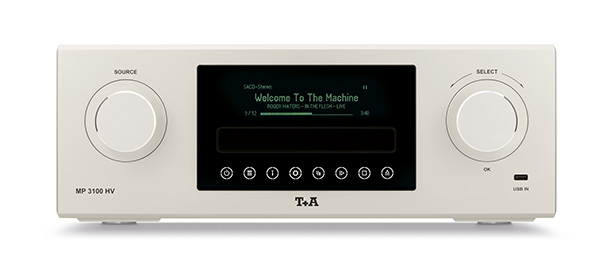
The User's Manual for T+A's MP 3100 HV G3 (footnote 1) is 71 pages long. It should be called an "Operator's Manual," because every page explains in small print how to make the big thing work. This T+A CD Player weighs 56.3lb. On my bathroom scale, its remote control weighs 0.9lb. The $25,490 MP 3100 HV G3 was delivered unboxed and hand-carried from the boot of a Porsche Panamera 4, by Dave Nauber, CEO of the wholly-owned distribution company T+A North America.
When I accept a product for review—especially one as heavy and technically complex as the MP 3100—I sometimes ask for help setting it in place and getting it programmed to do what it is supposed to do. Dave Nauber helped me with those chores.
With high-tech, feature-rich components, I usually ask a manufacturer's representative what I should be sure to notice, so that I don't embarrass myself by missing something obvious. When I put this question to Jim Shannon, T+A's public relations executive, this was his answer. "Most high-end and mid-priced audio manufacturers are using OEM disc mechanisms to play back SACD and CD content, which usually means that DSD is converted to PCM prior to decoding and delivery to the analog output stages. After T+A developed our own, completely separate, fully optimized, separate signal paths for DSD and PCM conversion, our engineers felt that the only genuinely high-end approach to DSD playback would be a properly designed transport that was optimized only for SACD/CD playback rather than modifying a Blu-ray transport for this purpose as most others have done. This meant that the servo board had to be designed from the ground up to ensure native delivery of both DSD and PCM to our separate processing architectures. Again, most competitors are using OEM servo boards that in most cases convert DSD to PCM before decoding in a PCM processor."
 T+A calls the MP 3100 HV G3 a "multi source player." It can serve as a disc transport, outputting digital data read from CDs and SACDs (stereo only—no multichannel) via S/PDIF. You might not want to do that, however, because the MP 3100 HV G3 sports not one but two perfectionist D/A converters, one for PCM data, the other for DSD. The PCM DAC is a "Double-Differential-Quadruple-Converter" with four 32-bit sigma-delta D/A converters per channel; it can handle sampling rates up to 384kHz. DSD is handled separately with the T+A True 1-bit DSD D/A Converter, with four selectable oversampling algorithms and several other options including the choice of analog filter and cutoff frequency.
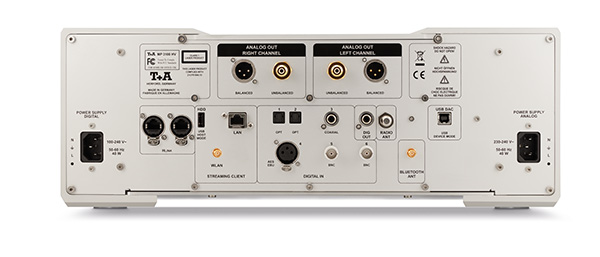
Those DACs can receive data not only from disc but also via USB, S/PDIF, AES3, TosLink (×2), Ethernet, Bluetooth, and AirPlay 2—all with app support and a IR remote control. The Ethernet/streaming input works with Tidal, Qobuz, Deezer, Amazon Music HD, highresaudio.com, and the Connect features of Tidal, Spotify, and Qobuz. The MP 3100 HV G3 is Roon Ready, works with Audirvana, and receives Airable internet radio and podcasts.
I was surprised to find, on the back panel of the G3, a 75-ohm input suitable for a "normal domestic aerial"—because there's an FM tuner built in. (For those in Europe, it also does DAB+.) Other back-panel connectors let you screw in Bluetooth and Wi-Fi antennas and connect USB flash drives or SSDs. (There is also one such USB connector on the front panel.)
Also on the back panel are two HLink connections, one in and one out. HLink is a proprietary protocol utilizing standard Ethernet cabling and allows connected T+A components to work together as one, with automatic source switching, universal power on, volume sync, and so on. HLink is not a path for music data.
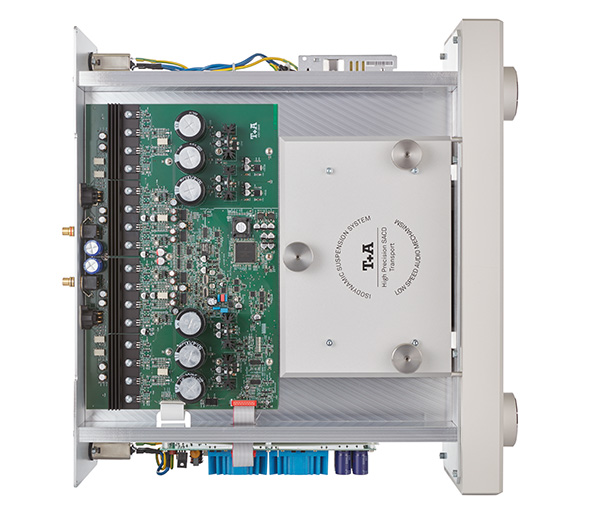
More unusually, the MP 3100 HV has two IEC power cord connectors feeding two separate power supplies: one for digital, the other for the analog circuitry. A nice touch. The MP 3100 HV G3 is a pure source component: There is no volume control.
T+A calls the MP 3100 HV G3 a "multi source player." It can serve as a disc transport, outputting digital data read from CDs and SACDs (stereo only—no multichannel) via S/PDIF. You might not want to do that, however, because the MP 3100 HV G3 sports not one but two perfectionist D/A converters, one for PCM data, the other for DSD. The PCM DAC is a "Double-Differential-Quadruple-Converter" with four 32-bit sigma-delta D/A converters per channel; it can handle sampling rates up to 384kHz. DSD is handled separately with the T+A True 1-bit DSD D/A Converter, with four selectable oversampling algorithms and several other options including the choice of analog filter and cutoff frequency.
Those DACs can receive data not only from disc but also via USB, S/PDIF, AES3, TosLink (×2), Ethernet, Bluetooth, and AirPlay 2—all with app support and a IR remote control. The Ethernet/streaming input works with Tidal, Qobuz, Deezer, Amazon Music HD, highresaudio.com, and the Connect features of Tidal, Spotify, and Qobuz. The MP 3100 HV G3 is Roon Ready, works with Audirvana, and receives Airable internet radio and podcasts.
I was surprised to find, on the back panel of the G3, a 75-ohm input suitable for a "normal domestic aerial"—because there's an FM tuner built in. (For those in Europe, it also does DAB+.) Other back-panel connectors let you screw in Bluetooth and Wi-Fi antennas and connect USB flash drives or SSDs. (There is also one such USB connector on the front panel.)
Also on the back panel are two HLink connections, one in and one out. HLink is a proprietary protocol utilizing standard Ethernet cabling and allows connected T+A components to work together as one, with automatic source switching, universal power on, volume sync, and so on. HLink is not a path for music data.
More unusually, the MP 3100 HV has two IEC power cord connectors feeding two separate power supplies: one for digital, the other for the analog circuitry. A nice touch. The MP 3100 HV G3 is a pure source component: There is no volume control.
 The build
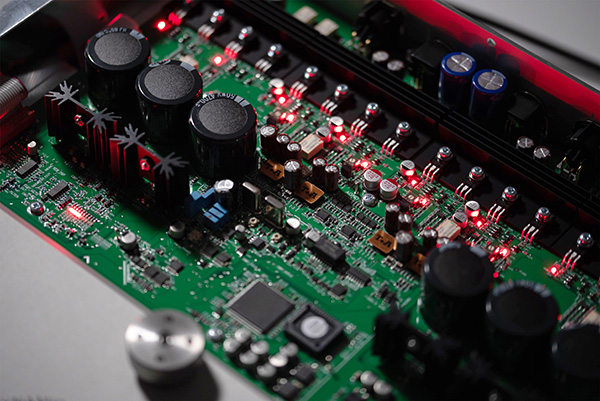
Today's luxury-level audio will be remembered for the architectural styles of its faceplates; think vintage McIntosh and Marantz tube gear, Wadia, dCS, Esoteric. T+A is a proponent of this aesthetic. Each of these brands present unique signature looks with high brand recognition, but one design element they all have in common is a sense of being anchored to their support by their own sheer mass. T+A's HV series presents its own version of that aesthetic. "Monumental" was my first impression of the MP 3100's chassis. It occupies its 18.1" × 6.7" × 18.1" space with a monolithic, 56.3lb presence. That mass provides a rocklike foundation for the CD player's machine shop–quality disc drawer. The MP 3100 looked best meeting my eye below eye level. That way, I could see the top plate, with its power supply vents and round glass plate that looks inside at the mechanism and circuitry.
The first time I opened the CD drawer, I could not believe what I saw. The tray came riding out on twin stainless steel rails ¼" in diameter, emerging from what appeared to be some type of long linear-bearing housings. I thought to myself, if this drawer is as full-on heavy duty as it looks, it won't start closing before I get the disc in straight. To check for that, I tapped on the drawer with my finger. Nothing happened. Then I tried, with some force, to push the drawer downward—to see if it would deflect. It did not move at all.
This heavy-duty drawer was (to me) a big-deal feature that no one told me about. I wrote Jim Shannon, asking, "What's up with those steel-tray rails that disappear into fancy bearings?" He forwarded my question to the engineering department. Here is the reply I received:
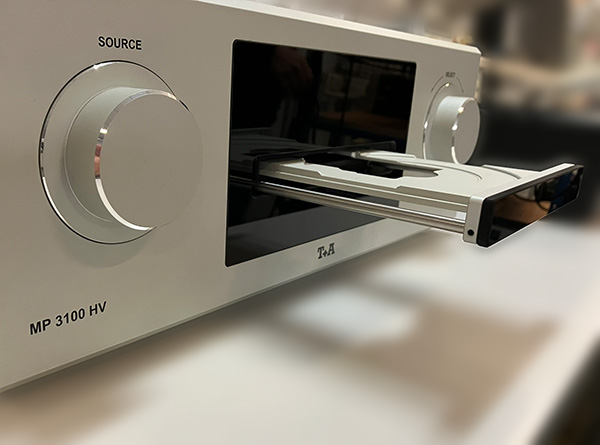 "The steel rails stabilize the drawer and prevent it from mechanical vibration during playback. Such vibration could mechanically couple into the laser pick-up system and deteriorate its tracking and read-out precision. So, in addition to the fact that the rails look good—that they make the drawer less wobbly and give the user a better experience and feeling—they also offer a very positive acoustic effect. This positive effect comes not only from a higher read-out precision and better data quality but also from the fact that the smoother (vibrationally) we can make the environment of the pick-up system, the less action of the tracking servos is needed. This in turn lowers the required servo currents, lowering the electromagnetic noise within the transport—and last but not least, lowering the stress on the power supply.
"Technically, the rail system consists of precisely machined stainless steel rails sliding in precision PTFE/phosphor-bronze bearings. These bearings are held in place by solid aluminum blocks suspended and isolated within the larger solid-aluminum chassis, to prevent external vibrations and noise from affecting the transport assembly itself. The whole arrangement has to be precisely fine-adjusted (manually) to give a smooth and constant travel and to prevent the drawer from any variances.
"If we were not T+A, we would perhaps make a bigger story about the acoustic uniqueness and superiority of the phosphor-bronze bearings. See this article from Wikipedia (footnote 2), especially the chapter about the use of p.b. in musical instruments..."
Since the first appearance of CD players, the primary cause of player demise has been disc drawers that fail to operate. The one in the MP 3100 looks like it's built to work for 100 years. The thing to remember about the "law of diminishing returns" is, it works in both directions.
"The steel rails stabilize the drawer and prevent it from mechanical vibration during playback. Such vibration could mechanically couple into the laser pick-up system and deteriorate its tracking and read-out precision. So, in addition to the fact that the rails look good—that they make the drawer less wobbly and give the user a better experience and feeling—they also offer a very positive acoustic effect. This positive effect comes not only from a higher read-out precision and better data quality but also from the fact that the smoother (vibrationally) we can make the environment of the pick-up system, the less action of the tracking servos is needed. This in turn lowers the required servo currents, lowering the electromagnetic noise within the transport—and last but not least, lowering the stress on the power supply.
"Technically, the rail system consists of precisely machined stainless steel rails sliding in precision PTFE/phosphor-bronze bearings. These bearings are held in place by solid aluminum blocks suspended and isolated within the larger solid-aluminum chassis, to prevent external vibrations and noise from affecting the transport assembly itself. The whole arrangement has to be precisely fine-adjusted (manually) to give a smooth and constant travel and to prevent the drawer from any variances.
"If we were not T+A, we would perhaps make a bigger story about the acoustic uniqueness and superiority of the phosphor-bronze bearings. See this article from Wikipedia (footnote 2), especially the chapter about the use of p.b. in musical instruments..."
Since the first appearance of CD players, the primary cause of player demise has been disc drawers that fail to operate. The one in the MP 3100 looks like it's built to work for 100 years. The thing to remember about the "law of diminishing returns" is, it works in both directions.
 Over time, I developed an affection for the machine's two large front-panel knobs and its cute, dimly lit On/Standby "button," which is flanked at the bottom of the display by a row of optical touch circles that cover the same functions as the 0.9lb remote.
The left knob is labeled Source, and it goes through a lot of sources—Qobuz, Deezer, Spotify, Roon, Apple Music, etc., and the whole list of back-panel inputs—though that long list can be limited to only the sources in use via the menu system, specifically via the "source settings" menu item. The right knob is labeled Select. It lets you choose tracks and is a keyhole to a whole menu of subtler programming options. Just below the Select knob is a USB socket for memory sticks or USB SSD. I needed the manual to do just about everything including Pause and Fast-Forward CDs. There is a learning curve. This machine is not plug-n-play.
If you need control beyond the front-panel buttons and the 1lb remote control, there's an app called T+A MusicNavigator G3, which I downloaded to play Qobuz and Spotify in hi-rez via LAN. The app added a nice touch to my daily encounters.
Over time, I developed an affection for the machine's two large front-panel knobs and its cute, dimly lit On/Standby "button," which is flanked at the bottom of the display by a row of optical touch circles that cover the same functions as the 0.9lb remote.
The left knob is labeled Source, and it goes through a lot of sources—Qobuz, Deezer, Spotify, Roon, Apple Music, etc., and the whole list of back-panel inputs—though that long list can be limited to only the sources in use via the menu system, specifically via the "source settings" menu item. The right knob is labeled Select. It lets you choose tracks and is a keyhole to a whole menu of subtler programming options. Just below the Select knob is a USB socket for memory sticks or USB SSD. I needed the manual to do just about everything including Pause and Fast-Forward CDs. There is a learning curve. This machine is not plug-n-play.
If you need control beyond the front-panel buttons and the 1lb remote control, there's an app called T+A MusicNavigator G3, which I downloaded to play Qobuz and Spotify in hi-rez via LAN. The app added a nice touch to my daily encounters.
 Listening to CDs
I played a dozen CDs and then, without planning to, I found myself listening extra closely to Bartók's String Quartets 1–6 played by the Alban Berg Quartett (EMI Classics 0946 3 60947 2 4). This two-CD set, issued in 2006, showed me a large portion of what I wanted to know about the T+A's knack for reconstructing recorded musical forms. The color and intensity of vocal and instrumental tones felt correct—exceptionally well-measured and sorted. These CDs are tastefully remastered reissues of recordings EMI made in 1987. To the MP 3100's credit, I could identify many of the most appealing aspects of EMI's traditional house sound—a sound rooted in what I affectionately call "the tones of His Master's Voice." The MP 3100 let me enjoy the fine balance EMI's 2006 remastering accomplished. I never would have predicted it, but this digital-on-top-of-digital (DDD) disc showed a little analog lurking in its shadows. Nowhere was it hard or annoyingly gray. Reverb reproduction was all there but restrained; I blame that on the disc, not the player. In every CD-spinner review, I must play a disc from field recordist Alan Lomax's Southern Journey. I play these discs because I love the music and because these two-track recordings are so pure, simple, and raw that they expose the slightest hint of any thumbprint imposed on their absolute clarity. When I played the disc entitled Bad Man Ballads—Songs of Outlaws and Desperadoes (Rounder CD 1705) on the T+A MP 3100 HV G3, I was caught up in comparing all the Po' Lazarus and John Henry tracks when all of a sudden Hobart Smith's "Railroad Bill" came along and blew the roof of my cranium clear off. I can say without exaggeration or hyperbole that this disc and that song never showed this much raw, clear energy before. Some of that energy probably came from the Cossor 2A3 tubes driving the Voxativ Hagen2s, but such vivid and solid CD playback was applause worthy. I wrote it just last month, and I'll write it again: Everything I've mocked, I become.
A CD player with a sigma-delta DAC is not something I've been inclined to mess with. But now, this supercharged DAC from Germany was making me forget my wife's name. Alan Lomax's Bad Man Ballads is one of my forever favorite discs. I've heard these recordings countless times over the years, most often recently with the TEAC VRDS-701T transport into my Lina and Spring 3 DACs. It never presented with the kind of raw energy it displayed with the T+A player. It never sounded this sharply focused or totally sorted. The MP 3100 HV G3 played this CD the same way it sits on a bureau: with massive stability. This was CD playback at its highest imaginable level.
I wrote it just last month, and I'll write it again: Everything I've mocked, I become.
A CD player with a sigma-delta DAC is not something I've been inclined to mess with. But now, this supercharged DAC from Germany was making me forget my wife's name. Alan Lomax's Bad Man Ballads is one of my forever favorite discs. I've heard these recordings countless times over the years, most often recently with the TEAC VRDS-701T transport into my Lina and Spring 3 DACs. It never presented with the kind of raw energy it displayed with the T+A player. It never sounded this sharply focused or totally sorted. The MP 3100 HV G3 played this CD the same way it sits on a bureau: with massive stability. This was CD playback at its highest imaginable level.
 Listening to SACDs
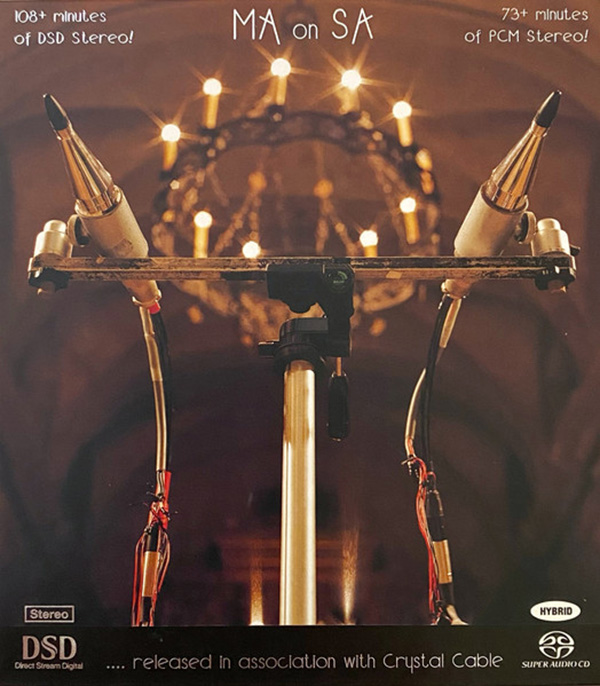
By now I had preconceptions about what to expect playing SACDs through the MP 3100 HV G3. I assumed this would be big-time prime time Digital Showtime. According to their website, T+A's monster machine was optimized for DSD and SACD playback; all I had to do was put on M•A Recordings's M•A on SA (no catalog number—released in association with and available from Crystal Cable) to experience the top level of SACD playback. This disc has 108 minutes of DSD Stereo on one layer and 73 minutes of PCM Stereo on another. These recordings are as-real-as-it-gets digital. M•A on SA is basically an M•A Recordings sampler with highlights from Todd Garfinkle's DSD and PCM recordings. If your friends all have turntables and you don't, you can smirk and shame them by playing this demonstration-quality digital. The sound I heard from Spanish singer Silvia Pérez Cruz and Israeli percussionist Ravid Goldschmidt performing "Gitano" off their debut album Llama (M070A) struck me as pure, luxury-class sigma-delta, which means it was sharply focused, high-contrast, overtly organized, but also smooth, supple, and easy-flowing, with delectable tone.
I played another SACD, Opening (MA081A), also from M•A Recordings, with Mathias Landæus playing a Hamburg Steinway concert grand piano, Palle Danielsson on bass, and Jon Fält on drums. This recording is a textbook example of naturally balanced microphone placement. Landæus's piano was neither too close nor too far from the microphones. It was positioned just right for getting bass and drums in their exact stereophonic places. This simple setup allowed for a relaxed spatiality and a plethora of natural detail that was a joy to hear but did not upstage the artistic content.
The SACD era passed me by because I had no desire to buy an SACD player. The music I listened to was not recorded in DSD. I also had no interest in going multichannel.
Even today, I always buy mono if the record was originally issued that way because it feels more whole and coherent—easier for my brain to decode. In mono, the performers are not sharing the stage with the chicanery of concocted illusions. Todd Garfinkle's Opening is a stereo-miked performance, the musicians lined up in real space performing in real time—no edits—at the Swedish Radio Broadcasting Studios in Stockholm. With the T+A MP 3100 playing this stereo SACD, it read like a flower in bloom. Opening's charm is rooted in its unforced dimensionality and the delicacy of its tone. The 3100 had no trouble conveying these phenomena.
What about the Lina?
I imagine that people like T+A's Dave Nauber, who drive Porsche Panamera 4s, are looking for the potential thrills and the seat-of-the-pants feel of a high-performance motorcar coupled to the convenience and comfort of a leather-seat sedan. My auditions suggest that many audiophiles would choose T+A's MP 3100 HV G3 for a similar set of reasons. It feels serious and heavy-duty and it delivers high-performance sound, but it looks smart and urbane. The dCS Lina DAC is in this same component category, and it too strives to look serious and high-performance without looking out of place on a Park Avenue bureau. To accomplish this tricky task, the dCS DAC leans into a serious Greek architectural style with no glitzy finishes. Its carefully curated sound is engineered to reflect that aesthetic: not flashy, just beautifully formed. Both the T+A and the dCS deliver a high-performance sound that would serve equally well in a recording studio or a living room. Both machines make sounds that would impress both audiophile friends and high-toned party guests. Nevertheless, I would advise potential customers to listen for each brand's family aesthetic. The T+A's smooth, nuanced sigma-delta feels considerably different than dCS's liquidy FPGA-controlled Ring DAC. The T+A's personality leans a little left brain, while the dCS leans a little right brain.
 Baby boum boum
In the 1980s, in New York's downtown art scene, whenever friends came over and I wanted to present myself as hip and worldly, I played French singer and avant-gardist Brigitte Fontaine's 1969 album, Comme à la radio (Saravah LP SH 10006). It was a conversation starter that hip downtowners hooked right onto. B. Fontaine made this album with Areski Belkacem and the Art Ensemble of Chicago, and I was sure Patti Smith and Jim Jarmusch were also listening to it. Now, more than 50 years later, when two of my friends came for tea, I reupped my artist-hipster status by playing Brigitte Fontaine's 2025 release, Baraka 1980, which also features composer and multi-instrumentalist Areski Belkacem (24/96 FLAC, Kuroneko Records/Qobuz). Baraka 1980 consists of raw demo tapes recorded in Fontaine's and Areski's home studio (footnote 3). Right now, I think Brigitte Fontaine is trending in Bed-Stuy. I've seen people in Von King Park sporting Fontaine's signature hairstyle: little pixie bangs. To impress my guests, Baraka 1980 had to come through my speakers with enough vibey presence at low background-listening volumes for people to notice and admire who was performing. Brigitte and Areski had to make my guests ask, "What is that record?" Which, thanks to the 3100, they did. It did. Brigitte's voice rasped with ear-catching impishness.
I was beyond impressed. The T+A MP 3100 HV G3 presented this track, and this album, and all the other recordings I tried with perfect clarity and compelling immediacy—right there, raw, bedrock solid and so, so, French.
Baby boum boum
Baby boum boum
Footnote 1: See Jim Austin's review of the original MP 3100 HV here. You can view the User's Manual for the G3 at ta-hifi.de/wp-content/uploads/UM_MP_3100HV_G3_EN.pdf. Footnote 2: See en.wikipedia.org/wiki/Phosphor_bronze. Footnote 3: The streaming version of Baraka 1980 Herb cites is a June 2025 release. It aims to correct a historical error by releasing "raw" tapes—just the kind of thing Herb favors—facilitated by the rediscovery of master tapes in the Saravah vaults, in place of a heavily produced version Fontaine herself repudiated. I just ordered Baraka 1980 on vinyl at barnesandnoble.com. Very quiet, good quality.—Jim Austin
The User's Manual for T+A's MP 3100 HV G3 (footnote 1) is 71 pages long. It should be called an "Operator's Manual," because every page explains in small print how to make the big thing work. This T+A CD Player weighs 56.3lb. On my bathroom scale, its remote control weighs 0.9lb. The $25,490 MP 3100 HV G3 was delivered unboxed and hand-carried from the boot of a Porsche Panamera 4, by Dave Nauber, CEO of the wholly-owned distribution company T+A North America.
T+A calls the MP 3100 HV G3 a "multi source player." It can serve as a disc transport, outputting digital data read from CDs and SACDs (stereo only—no multichannel) via S/PDIF. You might not want to do that, however, because the MP 3100 HV G3 sports not one but two perfectionist D/A converters, one for PCM data, the other for DSD. The PCM DAC is a "Double-Differential-Quadruple-Converter" with four 32-bit sigma-delta D/A converters per channel; it can handle sampling rates up to 384kHz. DSD is handled separately with the T+A True 1-bit DSD D/A Converter, with four selectable oversampling algorithms and several other options including the choice of analog filter and cutoff frequency.
The buildToday's luxury-level audio will be remembered for the architectural styles of its faceplates; think vintage McIntosh and Marantz tube gear, Wadia, dCS, Esoteric. T+A is a proponent of this aesthetic. Each of these brands present unique signature looks with high brand recognition, but one design element they all have in common is a sense of being anchored to their support by their own sheer mass. T+A's HV series presents its own version of that aesthetic. "Monumental" was my first impression of the MP 3100's chassis. It occupies its 18.1" × 6.7" × 18.1" space with a monolithic, 56.3lb presence. That mass provides a rocklike foundation for the CD player's machine shop–quality disc drawer. The MP 3100 looked best meeting my eye below eye level. That way, I could see the top plate, with its power supply vents and round glass plate that looks inside at the mechanism and circuitry.
"The steel rails stabilize the drawer and prevent it from mechanical vibration during playback. Such vibration could mechanically couple into the laser pick-up system and deteriorate its tracking and read-out precision. So, in addition to the fact that the rails look good—that they make the drawer less wobbly and give the user a better experience and feeling—they also offer a very positive acoustic effect. This positive effect comes not only from a higher read-out precision and better data quality but also from the fact that the smoother (vibrationally) we can make the environment of the pick-up system, the less action of the tracking servos is needed. This in turn lowers the required servo currents, lowering the electromagnetic noise within the transport—and last but not least, lowering the stress on the power supply.
Over time, I developed an affection for the machine's two large front-panel knobs and its cute, dimly lit On/Standby "button," which is flanked at the bottom of the display by a row of optical touch circles that cover the same functions as the 0.9lb remote.
The left knob is labeled Source, and it goes through a lot of sources—Qobuz, Deezer, Spotify, Roon, Apple Music, etc., and the whole list of back-panel inputs—though that long list can be limited to only the sources in use via the menu system, specifically via the "source settings" menu item. The right knob is labeled Select. It lets you choose tracks and is a keyhole to a whole menu of subtler programming options. Just below the Select knob is a USB socket for memory sticks or USB SSD. I needed the manual to do just about everything including Pause and Fast-Forward CDs. There is a learning curve. This machine is not plug-n-play.
If you need control beyond the front-panel buttons and the 1lb remote control, there's an app called T+A MusicNavigator G3, which I downloaded to play Qobuz and Spotify in hi-rez via LAN. The app added a nice touch to my daily encounters.
Listening to CDsI played a dozen CDs and then, without planning to, I found myself listening extra closely to Bartók's String Quartets 1–6 played by the Alban Berg Quartett (EMI Classics 0946 3 60947 2 4). This two-CD set, issued in 2006, showed me a large portion of what I wanted to know about the T+A's knack for reconstructing recorded musical forms. The color and intensity of vocal and instrumental tones felt correct—exceptionally well-measured and sorted. These CDs are tastefully remastered reissues of recordings EMI made in 1987. To the MP 3100's credit, I could identify many of the most appealing aspects of EMI's traditional house sound—a sound rooted in what I affectionately call "the tones of His Master's Voice." The MP 3100 let me enjoy the fine balance EMI's 2006 remastering accomplished. I never would have predicted it, but this digital-on-top-of-digital (DDD) disc showed a little analog lurking in its shadows. Nowhere was it hard or annoyingly gray. Reverb reproduction was all there but restrained; I blame that on the disc, not the player. In every CD-spinner review, I must play a disc from field recordist Alan Lomax's Southern Journey. I play these discs because I love the music and because these two-track recordings are so pure, simple, and raw that they expose the slightest hint of any thumbprint imposed on their absolute clarity. When I played the disc entitled Bad Man Ballads—Songs of Outlaws and Desperadoes (Rounder CD 1705) on the T+A MP 3100 HV G3, I was caught up in comparing all the Po' Lazarus and John Henry tracks when all of a sudden Hobart Smith's "Railroad Bill" came along and blew the roof of my cranium clear off. I can say without exaggeration or hyperbole that this disc and that song never showed this much raw, clear energy before. Some of that energy probably came from the Cossor 2A3 tubes driving the Voxativ Hagen2s, but such vivid and solid CD playback was applause worthy.
I wrote it just last month, and I'll write it again: Everything I've mocked, I become.
Listening to SACDsBy now I had preconceptions about what to expect playing SACDs through the MP 3100 HV G3. I assumed this would be big-time prime time Digital Showtime. According to their website, T+A's monster machine was optimized for DSD and SACD playback; all I had to do was put on M•A Recordings's M•A on SA (no catalog number—released in association with and available from Crystal Cable) to experience the top level of SACD playback. This disc has 108 minutes of DSD Stereo on one layer and 73 minutes of PCM Stereo on another. These recordings are as-real-as-it-gets digital. M•A on SA is basically an M•A Recordings sampler with highlights from Todd Garfinkle's DSD and PCM recordings. If your friends all have turntables and you don't, you can smirk and shame them by playing this demonstration-quality digital. The sound I heard from Spanish singer Silvia Pérez Cruz and Israeli percussionist Ravid Goldschmidt performing "Gitano" off their debut album Llama (M070A) struck me as pure, luxury-class sigma-delta, which means it was sharply focused, high-contrast, overtly organized, but also smooth, supple, and easy-flowing, with delectable tone.
I imagine that people like T+A's Dave Nauber, who drive Porsche Panamera 4s, are looking for the potential thrills and the seat-of-the-pants feel of a high-performance motorcar coupled to the convenience and comfort of a leather-seat sedan. My auditions suggest that many audiophiles would choose T+A's MP 3100 HV G3 for a similar set of reasons. It feels serious and heavy-duty and it delivers high-performance sound, but it looks smart and urbane. The dCS Lina DAC is in this same component category, and it too strives to look serious and high-performance without looking out of place on a Park Avenue bureau. To accomplish this tricky task, the dCS DAC leans into a serious Greek architectural style with no glitzy finishes. Its carefully curated sound is engineered to reflect that aesthetic: not flashy, just beautifully formed. Both the T+A and the dCS deliver a high-performance sound that would serve equally well in a recording studio or a living room. Both machines make sounds that would impress both audiophile friends and high-toned party guests. Nevertheless, I would advise potential customers to listen for each brand's family aesthetic. The T+A's smooth, nuanced sigma-delta feels considerably different than dCS's liquidy FPGA-controlled Ring DAC. The T+A's personality leans a little left brain, while the dCS leans a little right brain.
Baby boum boumIn the 1980s, in New York's downtown art scene, whenever friends came over and I wanted to present myself as hip and worldly, I played French singer and avant-gardist Brigitte Fontaine's 1969 album, Comme à la radio (Saravah LP SH 10006). It was a conversation starter that hip downtowners hooked right onto. B. Fontaine made this album with Areski Belkacem and the Art Ensemble of Chicago, and I was sure Patti Smith and Jim Jarmusch were also listening to it. Now, more than 50 years later, when two of my friends came for tea, I reupped my artist-hipster status by playing Brigitte Fontaine's 2025 release, Baraka 1980, which also features composer and multi-instrumentalist Areski Belkacem (24/96 FLAC, Kuroneko Records/Qobuz). Baraka 1980 consists of raw demo tapes recorded in Fontaine's and Areski's home studio (footnote 3). Right now, I think Brigitte Fontaine is trending in Bed-Stuy. I've seen people in Von King Park sporting Fontaine's signature hairstyle: little pixie bangs. To impress my guests, Baraka 1980 had to come through my speakers with enough vibey presence at low background-listening volumes for people to notice and admire who was performing. Brigitte and Areski had to make my guests ask, "What is that record?" Which, thanks to the 3100, they did. It did. Brigitte's voice rasped with ear-catching impishness.
Baby boum boum
Footnote 1: See Jim Austin's review of the original MP 3100 HV here. You can view the User's Manual for the G3 at ta-hifi.de/wp-content/uploads/UM_MP_3100HV_G3_EN.pdf. Footnote 2: See en.wikipedia.org/wiki/Phosphor_bronze. Footnote 3: The streaming version of Baraka 1980 Herb cites is a June 2025 release. It aims to correct a historical error by releasing "raw" tapes—just the kind of thing Herb favors—facilitated by the rediscovery of master tapes in the Saravah vaults, in place of a heavily produced version Fontaine herself repudiated. I just ordered Baraka 1980 on vinyl at barnesandnoble.com. Very quiet, good quality.—Jim Austin