

Sidebar 3: Measurements
The BeoLab 90 is so massive that, rather than having it shipped to my home, I traveled to Kal Rubinson's place to take some measurements. I used SMUGSoftware's Fuzzmeasure 3 app running on my MacBook Pro, along with an Earthworks QTC-40 microphone and a FireWire-connected Metric Halo ULN-2, which combines a low-noise microphone preamplifier with A/D and D/A converters. (These were set to a sample rate of 96kHz for the measurements and I fed Fuzzmeasure's analog signal to the Master loudspeaker where it was converted at 192kHz.)
First of all, as KR described in his review, the BeoLab 90 system uses digital signal processing (DSP) to correct the room's acoustic. However, it differs from conventional correction solutions in applying not just individual filters for the Left and Right speakers, but also filters to correct the speakers' summed (Mono) output and the difference between their outputs (Side). The responses of these filters, as set up by B&O's Geoff Martin, are shown in fig.1 (Mono and Side) and fig.2 (Left and Right). Both sets of filters are applied simultaneously; you can see that the amount of correction is relatively small, covering a range of +5 to –6dB.



 To say I was impressed with how the BeoLab 90 measured in its Narrow mode would be an understatement. This loudspeaker demonstrates just how much can be achieved with intelligent use of DSP to optimize its acoustic performance. As Kal Rubinson summed up, it is a tour de force. Wow!—John Atkinson
Footnote 1: See the review of MartinLogan's Renaissance ESL 15A loudspeaker elsewhere in this issue for a similar in-room response. Footnote 2: See fig.2 here.
Fig.1 Bang & Olufsen BeoLab 90, Mono (blue) and Side (red) correction filters for KR's listening room.
Fig.2 Bang & Olufsen BeoLab 90, Left (blue) and Right (red) correction filters for KR's listening room.
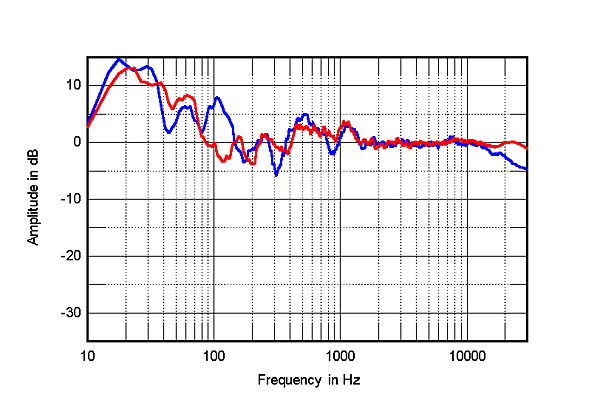
Also, as KR noted, no correction is applied above 1kHz. Yet, as seen in fig.3, which shows the corrected responses at the listening position of the two speakers in Narrow mode, their outputs above 400Hz are even, and above 1.5kHz are extraordinarily flat. While this might be thought to be a good thing, with an in-room measurement, the target response should gently slope down in the top octaves. Depending on the room's size and furnishings, a speaker that measures flat at the listening position will sound a little bright, as KR found in his auditioning, though I note that he did describe the sound as having a "mere suggestion of brightness in the very high treble."
Fig.3 Bang & Olufsen BeoLab 90, Narrow mode, 1/6-octave responses of left (blue) and right (red) speakers with DSP correction at listening position.
There are still some room effects visible—the lack of lower-midrange energy and the peak at 105Hz in the left channel—but these are mild, especially when you consider that there was no spatial averaging in this graph. I suspect that the increase in level in the low bass arises from the usual boundary reinforcement in this region—KR had each speaker situated just 18" from its respective sidewall. Though this rise looks alarming (footnote 1), it was not as audible as you might think—other than in the magnificence it added to the organ recording of mine mentioned by KR, which has significant energy below 32Hz. The sensitivity of human hearing decreases rapidly at low frequencies, and low-frequency sounds must be played at a much higher sound-pressure level to be perceived as being as loud as mid-frequency sounds (footnote 2).
For fig.4, I measured the BeoLab 90's spatially averaged response in each of its three modes of operation. (I average 20 1/6-octave–smoothed spectra, individually taken for the left and right speakers in a rectangular grid 36" wide by 18" high and centered on the positions of the listener's ears. This mostly eliminates the room acoustic's effects.) The red trace was taken in Narrow mode; despite the additional measurements that contribute to the averaging, it is very similar to the responses shown in fig.3. The blue trace, taken in Wide mode, is very similar to the Narrow-mode response in the middle and low frequencies, but there is less treble energy at the listening position, presumably because more energy is being directed to the speakers' sides and being absorbed by the room's furnishings. Finally, the green trace was taken in Omni mode—the spatially averaged response centered at the listening position is tilted up below 400Hz and down above 5kHz because the speaker is now radiating equally in all directions.
Fig.4 Bang & Olufsen BeoLab 90, spatially averaged, 1/6-octave response in KR's listening room in: Narrow mode (red), Wide mode (blue), Omni mode (green).
Finally, fig.5 shows the BeoLab 90's step response in Narrow mode. This was taken at the listening position, and so is disturbed by the presence of early boundary reflections—which also meant that I wasn't able to calculate the usual cumulative spectral-decay plot from the impulse-response data. However, you can see that all of the speaker's drive-units are connected in positive acoustic polarity, and that each unit's step blends smoothly with that of the next lower in frequency, suggesting an optimal crossover topology. Note, too, that the 0 milliseconds mark in this graph's time scale is arbitrary, dictated by the limitations of the program I wrote to translate Fuzzmeasure's time-domain data into data compatible with DRA Labs' MLSSA, which I used to calculate the step response. The BeoLab 90's DSP actually takes around 30ms to apply its corrections to the digital signals, meaning that the sound from the speaker reached the microphone 33ms after the stimulus signal was sent to the loudspeaker. When I discussed this latency with Geoff Martin during his visit to KR's room to set the speakers up, he explained that the goal was to keep this time equal to or less than one video frame— ie, 1/30 second.
Fig.5 Bang & Olufsen BeoLab 90, Narrow mode, step response at listening position (5ms time window, 48kHz bandwidth).
Footnote 1: See the review of MartinLogan's Renaissance ESL 15A loudspeaker elsewhere in this issue for a similar in-room response. Footnote 2: See fig.2 here.















