Scosche RH1060 ($199)
If the Koss BT540i is a Plain Jane, then the Scosche RH1060 is a big, fat drag queen. A bulbous and cumbersome agglomeration of curvaceous gloss black plastic with shiny bits as accents. Fortunately, other than their garish looks, they're a pretty nice BT headphone at this price.
Earpieces fold up and inward for storage and transport in the included hard-side clam-shell case. Ear pads are real leather covered with memory foam underneath, and are fairly spacious providing a comfortable, though a bit warm, fit. Headband pad touches only at the top of the head, but it's width and ample cushion spread the load nicely.
Battery life is 8 hours for continuous wireless use, and they will run passively on a wire. BT does not have aptX, but does use AAC and BT2.1 with A2DP, AVRCP, and HFP profiles.
Overall sound is perceived as a bit "V" shaped with an emphasized bass and remarkably clear treble. Bass emphasis is about 3-5dB excessive and bleeds into the mids, but I was surprised to find myself more pleased with the result than I first expected. Still, it's kind of a basshead can. From the mid-range to the mid-treble, frequency balance is near perfect to my ears. Upper-treble is slightly emphasized, but very clean and articulate. Sound quality wired and wireless were near identical.
While I found these to be somewhat overwhelming in bass and treble at high volume levels (not that the quality was poor, just that the bass, and treble to a lesser extent, was too intense). On the other hand, I found them
really enjoyable at my normal lower listening levels.
Isolation is quite good. These will make an excellent mobile listening headphone.
Measurements
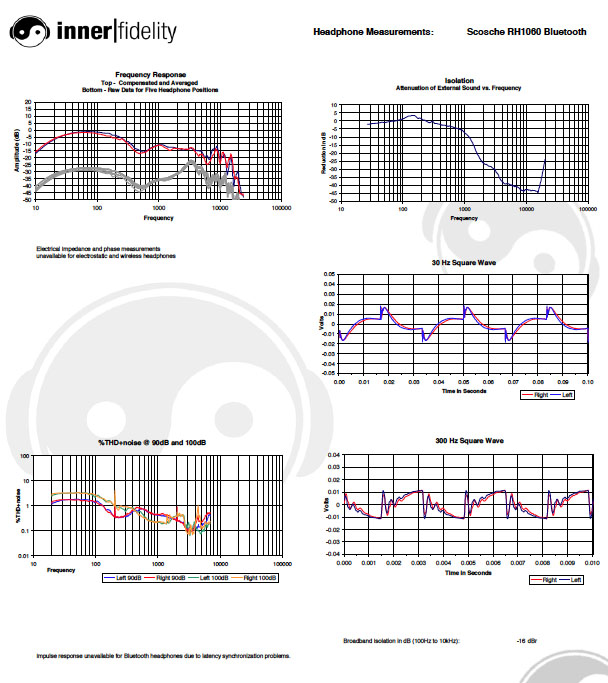
Click on graphs image to download .pdf for closer inspection.
Raw frequency response plots show a headphone that is quite insensitive to changing placement on the ear. Compare these compensated FR plots with the Koss BT540i and you'll see both having fairly flat response from 600Hz to 3.5kHz, but the Scosche RH1060 remains fairly flat from 3.5kHz to 10kHz and then begins to roll off. It may be a few dB hot between 8kHz and 15kHz, but it's pretty darn close to what I would conside ideal treble response.
The hump in the bass is about 5-8dB too excessive, and it extends too far into the mid-range. Definitely a headphone for those who like that bass.
30Hz square wave is significantly sway back in keeping with the FR bass hump, and THD+noise plot shows significant bass distortion. While bass response on the Scosche RH1060 is clearly over emphasized, these measurement would have me expecting a looser sounding bass than I actually heard in listening.
300Hz square wave shows a very fast initial transient with the following wave shape slowly rising to it's top level. Again, I would have guessed these cans would show better shape than this given the excellent treble FR.
THD+noise plots show moderate distortion (and remember, I think the BT transmitter might have something to do with the somewhat odd THD measurements of all the BT headphones) but remains below 1% until you start getting into the bass. Bass distortion does rise broadly, but in the context of the BT headsets in this article, bass distortion is lower than most. It's possible this may be indicative of my observation in listening that the bass, while a bit overbearing, was pretty good quality.
Isolation at -16dB broadband is among the best of the passively isolating headphones in this group. This will make an excellent mobile headphone.