

 Acoustics and DSP
Time to put on your thinking caps, this gadget is pretty weird. I'll forgo my normal measurement section as I'm not well set up for measuring this device, but I did do some measurements to confirm some interesting aspects of the SoundWear Companion that I'll talk about here. The left speaker plays directly into the left ear, but the rear of the left speaker is ported into a waveguide—a tube running through the neckband—and comes out the port on the right hand side next to the right speaker. And vice versa with the right speaker. The purpose of these waveguides is to provide stronger bass response than a small driver would deliver unaided. First, you must remember the acoustic signal from behind the speaker is out of polarity (180 degrees out of phase) from the signal coming out in front of the speaker. Second, it travels through the waveguide about one foot before it comes out the port on the other side, causing a delay of about just under 1msec.
 The above plot is of the leading edge of a 60Hz square wave being played in the left channel (blue) only. It's zoomed in to show just the negative going transient edge which occurs at about 3.9msec in the plot. Note that this transient is somewhat "M" shaped with positive going humps to either side of the main negative going spike. I have to assume that this is an artifact of all the DSP (digital signal processing) going on. Yeah...this is a complicated widget, and we're peering through a glass very darkly here. I would have loved to be a fly on the wall as Bose engineers discussed how this product really works.
There is no signal going to the right channel (red); the right ear is mainly hearing the sound coming out the port that originates behind the left speaker. You can see the positive going transient from the square wave at about 4.8msec in the plot. Note that it is inverted and delayed about 1msec.
But! You can also see two smaller transients prior at about 4msec and 4.5msec. I suspect we may be seeing sound from the left speaker that has travelled through the air under the chin and behind the neck to reach the right ear. Yet more complication to consider.
The above plot is of the leading edge of a 60Hz square wave being played in the left channel (blue) only. It's zoomed in to show just the negative going transient edge which occurs at about 3.9msec in the plot. Note that this transient is somewhat "M" shaped with positive going humps to either side of the main negative going spike. I have to assume that this is an artifact of all the DSP (digital signal processing) going on. Yeah...this is a complicated widget, and we're peering through a glass very darkly here. I would have loved to be a fly on the wall as Bose engineers discussed how this product really works.
There is no signal going to the right channel (red); the right ear is mainly hearing the sound coming out the port that originates behind the left speaker. You can see the positive going transient from the square wave at about 4.8msec in the plot. Note that it is inverted and delayed about 1msec.
But! You can also see two smaller transients prior at about 4msec and 4.5msec. I suspect we may be seeing sound from the left speaker that has travelled through the air under the chin and behind the neck to reach the right ear. Yet more complication to consider.
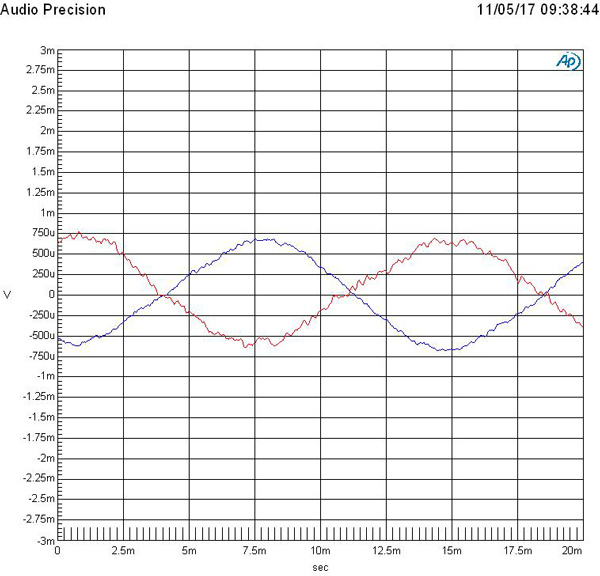 In the plot above, the left channel only (blue) is being driven by 70Hz sine wave. The right ear (red) is hearing mainly the response from the port. You can see that it is out of phase.
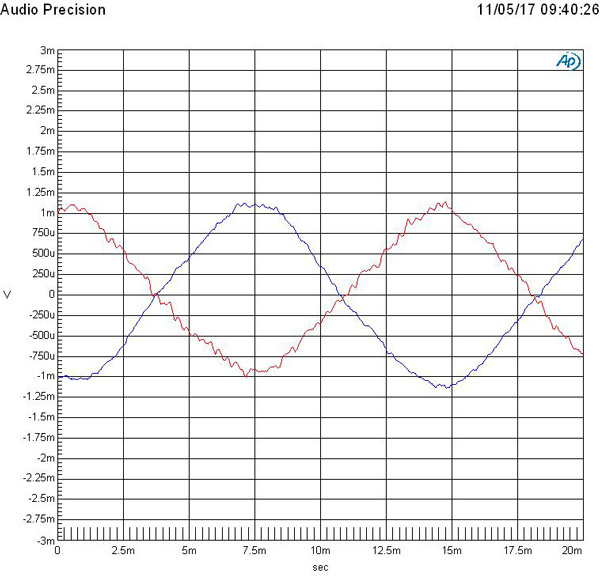 But, in the above plot, when I turned on the other channel so both were being driven, I found that the right channel was out of polarity with the left channel so that it was reinforced by inverted acoustic signal from the waveguide port, and delivered an increased response.
Embodiments may include one of the following features, or any combination thereof. The first and second acoustic drivers may be driven such that they radiate sound that is out of phase, over at least some of the spectrum.And in paragraph 0031:
Accordingly, each ear directly receives output from the front of one driver and output from the back of the other driver. If the drivers are driven out of phase, the two acoustic signals received by each ear are virtually in phase below the fundamental waveguide quarter wave resonance frequency, which in the present non-limiting example is about 130-360Hz. This ensures that low frequency radiation from each driver and the same side corresponding waveguide outlet, are in phase and do not cancel each other. At the same time the radiation from opposite side drivers and corresponding waveguides are out of phase, thus providing far field cancellation. This reduces sound spillage from the acoustic device to others who are nearby.Hoo boy. To recap: At low frequencies, the left and right speaker are being driven out of polarity with each other so that the ports reinforce bass at the ear, and also so that the low notes cancel out at a distance making the device seem less loud to others. We'll get to how this sounds a little later.
 The plot above shows a 500Hz signal from the left speaker (blue), and the signal being radiated from the port on the right side (red). As you can see, it's back in phase with the left channel after going through the acoustic half wavelength delay of the waveguide.
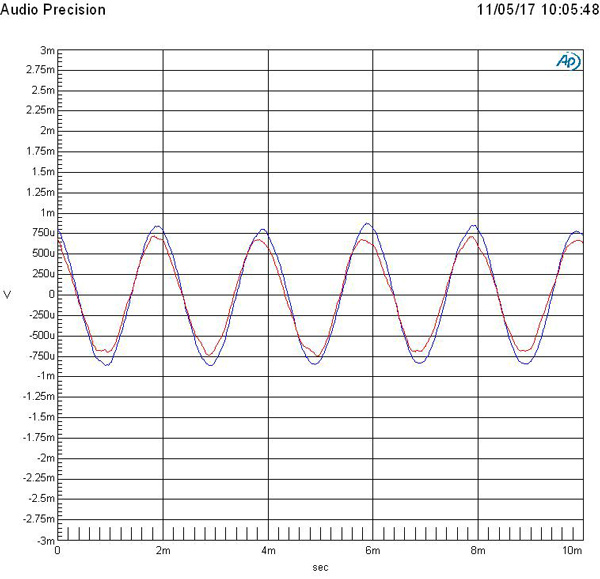 And, low and behold, when I turn on the right channel (plot above) it's back in phase with the right channel. So, somewhere between 130-360Hz, according to the patent, the DSP swaps the phase of the drivers.
 Above is a 100Hz square wave with the Bluetooth signal being sent to the left channel only. All I can tell you is that it did sound basically like a square wave, and it did sound like it was coming from the left in the acoustic image around my head, but it didn't sound like it was coming from a speaker under my left ear.
I did check for is sound coming out the right speaker with the left channel only driven, and there was signal coming from the speaker, but at a somewhat lower level than the left side. Also, using a square wave you could tell it was generally higher frequency information.
Above is a 100Hz square wave with the Bluetooth signal being sent to the left channel only. All I can tell you is that it did sound basically like a square wave, and it did sound like it was coming from the left in the acoustic image around my head, but it didn't sound like it was coming from a speaker under my left ear.
I did check for is sound coming out the right speaker with the left channel only driven, and there was signal coming from the speaker, but at a somewhat lower level than the left side. Also, using a square wave you could tell it was generally higher frequency information.
 The above plot is the measured frequency response using a swept sine wave to the left channel only. The left channel (cyan) is remarkably even it seems to me; the right channel (red) is significantly more uneven, probably filled with DSP cues. The left channel response does rise quite a bit too steeply through the midrange and low treble to a roughly 5dB too high peak at 4kHz. This response would be quite bright and too forward.
 But with pink noise driving the left channel only, the left side response (in green—sorry about the color change) is much closer to a ear drum reference point target responce. The undriven right channel also seems to have a bit more energy in general than it did with the sine sweep.
 With both channels driven by a sine sweep, the channels are quite similar but the measurement on the whole is again too bright...but not quite as bright as the left channel when driven on it's own!
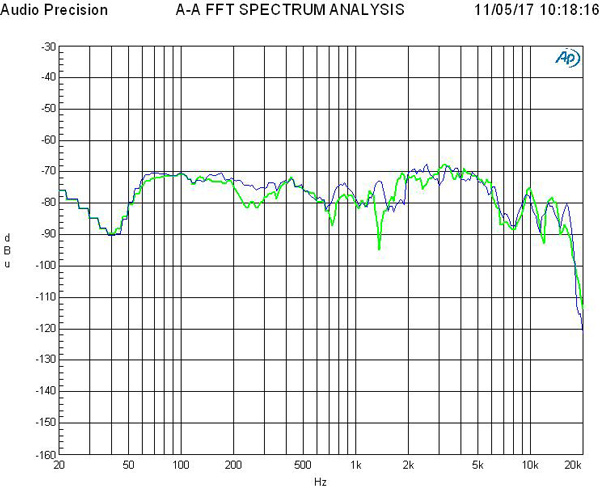 The picture again changes when uncorrelated pink noise is used to drive both channels. While the plots are somewhat noisy—in part due to the pink noise itself, but likely also caused by the DSP psychoacoustic cues being generated—the plot on the whole is remarkably well behaved and close to target.















