

 Ha!
Yes, after all that talk about how difficult it is to interpret measurements, that's exactly where I'm going to start my discussion of my listening experience.
The raw frequency response plots above compare the X1 (green and blue) to the X2 (red and orange). Plots are aligned at 800Hz. The first thing to notice is that the X1 is slightly more "U"-shaped in response than the X2. Below 800Hz the X2 plot shows essentially a flat response to 180Hz before beginning to rise about 5dB to peak at the primary driver resonance at about 60Hz. Below 60Hz the bass response falls of at about 12dB/octave which is basically unavoidable with an open headphone design. In contrast, the X1 rises slowly with decreasing frequency below 800Hz to peak at 60Hz at close to 10dB higher.
To my ears this is a very important change. When reviewing the X1 I considered it an open headphone for bassheads because of this ever increasing response and significant bass elevation. The X1 sounds warmer and thicker in the low-mids and bass than the X2. I usually site the desired neutral target for bass rise as about 3-5dB below 120Hz. It seems to me the X2 gets pretty close to this, and to my ears the bass response in the X2 is entirely appropriate. By that I mean that I consider this profile as neutral, and not bass emphasized. (See Harman response curve info here, here, and here.)
Ha!
Yes, after all that talk about how difficult it is to interpret measurements, that's exactly where I'm going to start my discussion of my listening experience.
The raw frequency response plots above compare the X1 (green and blue) to the X2 (red and orange). Plots are aligned at 800Hz. The first thing to notice is that the X1 is slightly more "U"-shaped in response than the X2. Below 800Hz the X2 plot shows essentially a flat response to 180Hz before beginning to rise about 5dB to peak at the primary driver resonance at about 60Hz. Below 60Hz the bass response falls of at about 12dB/octave which is basically unavoidable with an open headphone design. In contrast, the X1 rises slowly with decreasing frequency below 800Hz to peak at 60Hz at close to 10dB higher.
To my ears this is a very important change. When reviewing the X1 I considered it an open headphone for bassheads because of this ever increasing response and significant bass elevation. The X1 sounds warmer and thicker in the low-mids and bass than the X2. I usually site the desired neutral target for bass rise as about 3-5dB below 120Hz. It seems to me the X2 gets pretty close to this, and to my ears the bass response in the X2 is entirely appropriate. By that I mean that I consider this profile as neutral, and not bass emphasized. (See Harman response curve info here, here, and here.)
The treble with these cans has me a bit baffled. In some ways it's just a bit gritty sounding, cymbals and brushes on drums are just a tad edgier than natural. On the other hand, the imaging is quite good, and an open sense of space is apparent; these things usually require pretty good treble response.Well, I think that reduction in the mid-treble with the X2 did do some very good things to neutralize the edgy sound I was hearing from the X1. In addition, and it's not particularly easy to see, the X2 response above 10kHz is about 5dB higher in level than the X1. It's a bit noisy up there due to all the reflections, but you can see the red and orange traces are generally above the blue and green ones. What I hear is a better sense of balance throughout the treble ranges with the X2. Cymbals seem to have the right mix of crash, clang, and shimmer, while with the X1 there a sense of artificialness when the treble ranges are out of balance.
 Additionally, this particular treble response gives the X2 a much better sense of stereo imaging, delivering greater width and depth than the X1. At this point I have to bring out my one complaint with the X2: it still does seem a little gritty sounding. While the treble has terrific balance, it's not quite as refined as I'd like, but it's certainly very good for a $300 headphone.
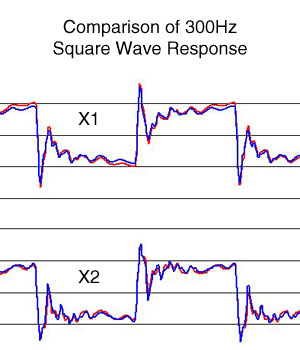
In the 300Hz square wave response shown to the right, you can see that the X1 is somewhat less noisy subsequent to the initial edge. This would normally lead me to believe the X2 is harsher sounding than the X1, but it doesn't quite come out that way perceptually. Yes, I think both cans has a slightly gritty and bothersome treble, but the treble balance of the X2 is so much better that it seems like the grittiness is significantly less apparent.
I think what we're seeing here is the iterative process of excellent product development at work. The X2 has clearly better balance than the X1 to my ears—a great step forward. I expect we'll see Philips working to keep the spectral balance spot on as they work on creating a cleaner transient response moving forward. I'll add however, it may be that methods for continued improvement may up the cost of the final product. It may very well be that the way toward better response will involve more expensive materials and methods, and the next step forward may have to be a more expensive headphone. That's fine with me, I think the X2 is an outstanding value at its price, and at this point I'd totally welcome Philips attempt at a $600 headphone.
Comparisons with the Sennheiser HD 600
Additionally, this particular treble response gives the X2 a much better sense of stereo imaging, delivering greater width and depth than the X1. At this point I have to bring out my one complaint with the X2: it still does seem a little gritty sounding. While the treble has terrific balance, it's not quite as refined as I'd like, but it's certainly very good for a $300 headphone.
In the 300Hz square wave response shown to the right, you can see that the X1 is somewhat less noisy subsequent to the initial edge. This would normally lead me to believe the X2 is harsher sounding than the X1, but it doesn't quite come out that way perceptually. Yes, I think both cans has a slightly gritty and bothersome treble, but the treble balance of the X2 is so much better that it seems like the grittiness is significantly less apparent.
I think what we're seeing here is the iterative process of excellent product development at work. The X2 has clearly better balance than the X1 to my ears—a great step forward. I expect we'll see Philips working to keep the spectral balance spot on as they work on creating a cleaner transient response moving forward. I'll add however, it may be that methods for continued improvement may up the cost of the final product. It may very well be that the way toward better response will involve more expensive materials and methods, and the next step forward may have to be a more expensive headphone. That's fine with me, I think the X2 is an outstanding value at its price, and at this point I'd totally welcome Philips attempt at a $600 headphone.
Comparisons with the Sennheiser HD 600Any of you who have read my HD 600 review will know I hold them in high regard. In fact, many enthusiasts believe they may be the most important headphone in the hobby. Well, I don't think the X2 is going to change that—the HD 600 was a great headphone very early on and will forever hold an historic place in headphonedom—but I do think the X2 is the first headphone in the mid-priced, open headphone class that might deliver a superior listening experience.
With their offerings over the past year or so, I think Philips has become one of the major power-houses in headphone development. And for me, the X2 may be their best effort yet. For the first time, I think I'm hearing a near perfect tonal balance in a headphone—it's as if the entirety of the music is front and center. On top of that, its open design and attention to detail delivers superb headphone imaging without giving up any dynamic excitement. I'll nit-pick a bit and say it doesn't have quite the bass extension and tight punch of the very best planar magnetic cans, and the treble can sound a bit gritty at times, but in this class and price range I think it tops the charts.
 The Philips Fidelio X2 is going to hit the Wall of Fame like a boss. The only thing keeping it from knocking the HD 600 off the wall is its low 35 Ohm impedance that makes it a poor match for high output impedance tube amplifiers—something that the HD 600 does very well. But for most folks seeking a solid mid-level headphone audiophile experience, the Philips Fidelio X2 may be just the ticket. A huge thumbs-up from me!
Video
The Philips Fidelio X2 is going to hit the Wall of Fame like a boss. The only thing keeping it from knocking the HD 600 off the wall is its low 35 Ohm impedance that makes it a poor match for high output impedance tube amplifiers—something that the HD 600 does very well. But for most folks seeking a solid mid-level headphone audiophile experience, the Philips Fidelio X2 may be just the ticket. A huge thumbs-up from me!
VideoResources
Philips home page, X2 product page is not up yet as of this writing.
A very good review on Head-Fi here, and X2 thread here.















