

Sidebar 3: Measurements
I used DRA Labs' MLSSA system and a calibrated DPA 4006 microphone to measure 7the Bowers & Wilkins 702 S2's frequency response in the farfield, and an Earthworks QTC-40 for the nearfield responses. My estimate of the B&W's sensitivity was a high 90.2dB(B)/2.83V/m, confirming the specified 90dB. The 702 S2's nominal impedance is specified as 8 ohms, with a minimum value of 3.1 ohms. My measurement of the impedance magnitude (fig.1, solid trace) reveals that while the impedance does lie at and above 8 ohms in the low treble and in two regions in the bass, it actually drops below 6 ohms through much the audioband, with a minimum value of 3 ohms in the upper bass. There is also a current-hungry combination of 4 ohms and a –48° electrical phase angle at 88Hz. Although technically this is an 8 ohm design, I think it should be used with amplifiers that are comfortable with 4 ohm loads.

 The saddle between 20 and 30Hz in the impedance-magnitude trace implies that the large, flared port on the rear panel is tuned to this frequency region—and, looking at the summed output of the three woofers measured in the nearfield (fig.3, blue trace; the three woofers have identical responses), this does have the expected minimum-motion notch at 26Hz. (At this frequency, the woofer cones are held stationary by the back pressure from the port resonance.) The port's output, again measured in the nearfield (red trace), peaks between 15 and 70Hz, and its upper-frequency rolloff is clean. The crossover of the woofers to the midrange unit (green trace) appears to be set just above 400Hz, with high-order rolloffs.

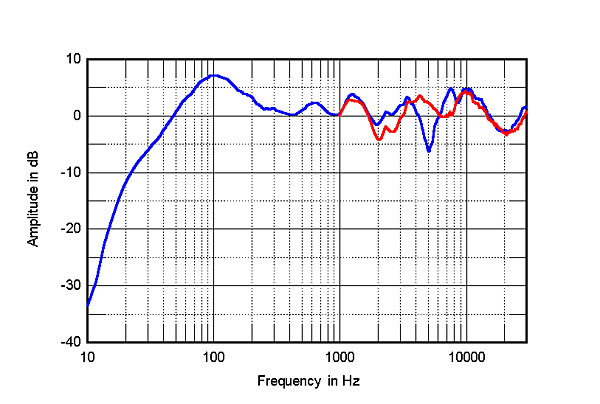


Fig.1 Bowers & Wilkins 702 S2, electrical impedance (solid) and phase (dashed) (2 ohms/vertical div.).
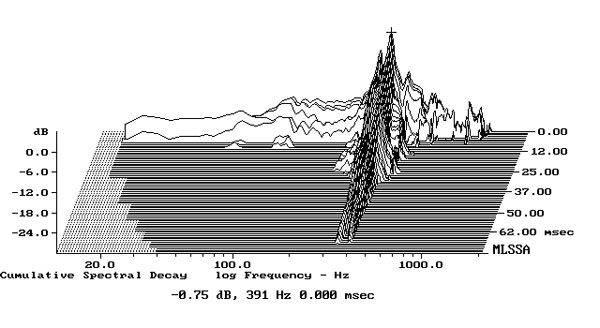
No discontinuities are visible in the impedance traces, but when I investigated the vibrational behavior of the enclosure with a simple plastic-tape accelerometer, I did find some resonant modes on the top and side panels. The highest-level mode, at 390Hz, was strongest on the side panels level with the midrange drive-unit (fig.2), accompanied by a second mode at 344Hz. As Kal Rubinson didn't comment on any midrange congestion that might have resulted from this behavior, I must assume that it looks worse than it sounds. (The audibility of panel resonances depends not only on their frequency and Q, or Quality factor, but also on the panel areas affected.)
Fig.2 Bowers & Wilkins 702 S2, cumulative spectral-decay plot calculated from output of accelerometer fastened to center of sidewall level with midrange unit (MLS driving voltage to speaker, 7.55V; measurement bandwidth, 2kHz).
Fig.3 Bowers & Wilkins 702 S2, acoustic crossover on tweeter axis, with nearfield responses of midrange unit (green), woofers (blue), and port (red), respectively plotted in the ratios of the square roots of their radiating areas below 500Hz, 350Hz, and 300Hz.
The farfield sections of the traces in fig.3 were taken on the tweeter axis, as was the blue trace in fig.4, which shows the 702 S2's farfield response averaged across a 30° horizontal window. I was surprised by the unevenness of the B&W's response on the tweeter axis, and so repeated the averaged measurements, this time centered on the midrange axis, which is 36" above the floor. (The tweeter axis is 42" high.) The result is shown by the red trace in fig.4. While still not as even as I would have expected from B&W, the mean level of the 702 S2's treble output is smoother. The sum of the nearfield outputs of the midrange, woofers, and port is shown as the black trace below 300Hz in fig.4; the apparent peak in the upper bass is entirely an artifact of the nearfield measurement technique, which assumes that the radiators are mounted in a true infinite baffle; ie, one that extends to infinity in both planes. However, the port's output doesn't fully extend the 702 S2's low-frequency response with this quasi-anechoic measurement; I suspect that this is because B&W anticipates that the port's output will benefit from some boundary reinforcement, as the port is close to the floor. KR did note that the B&W's low frequencies sounded "full and firm," though he also commented on the lack of "room boom."
Fig.4 Bowers & Wilkins 702 S2, anechoic response on tweeter axis at 50" (blue) and on midrange axis (red), both averaged across 30° horizontal window and corrected for microphone response, with complex sum of nearfield responses of midrange unit, woofers, and port plotted below 300Hz.
Fig.5 shows the 702 S2's lateral radiation pattern normalized to the tweeter-axis response, which therefore appears as a straight line. This graph reveals that the sharply defined suckout at 5kHz in the farfield response on this axis, seen in figs. 3 and 4, does fill in to the speaker's sides. The output of that relatively large-diameter midrange cone does become somewhat directional between 2 and 4kHz, but the speaker's horizontal dispersion is otherwise even. In the vertical plane (fig.6), the suckout in the tweeter-axis output at 5kHz deepens above that axis and fills in below it. KR didn't find the 702 S2s very sensitive to where he placed them in his room, but these graphs suggest that experimenting with speaker toe-in and the listener's ear height will be necessary to get the most neutral treble balance from this speaker.
Fig.5 Bowers & Wilkins 702 S2, lateral response family at 50", normalized to response on tweeter axis, from back to front: differences in response 90–5° off axis, reference response, differences in response 5–90° off axis.
Fig.6 Bowers & Wilkins 702 S2, vertical response family at 50", normalized to response on tweeter axis, from back to front: differences in response 15–5° above tweeter axis, reference response, differences in response 5–15° below tweeter axis.
Turning to the time domain, the slight discontinuity just before the 4ms mark in the tweeter-axis step response (fig.7) confirms that the optimal blend between the midrange unit and the tweeter occurs just below that axis. This graph also indicates that all five drive-units are connected in positive acoustic polarity. The cumulative spectral-decay plot on the tweeter axis (fig.8) is disturbed by the lack of drive-unit integration on this axis, but is otherwise clean in the treble.
Fig.7 Bowers & Wilkins 702 S2, step response on tweeter axis at 50" (5ms time window, 30kHz bandwidth).
Fig.8 Bowers & Wilkins 702 S2, cumulative spectral-decay plot on tweeter axis at 50" (0.15ms risetime).
Bowers & Wilkins loudspeakers tend to have somewhat idiosyncratic measured behavior, and the 702 S2 is no exception. But with careful setup and choice of ancillary components, it can produce very satisfying sound, as KR found.—John Atkinson















