Listening
Having wasted too many hours critically listening to allegedly fully-broken-in gear that was clearly still unready for prime time, I no longer take manufacturer assurances of factory break-in at face value. I cued up a Nordost break-in CD and ran both its break-in and demagnetizing tones through the system continuously at a decent volume for a good three–four days, and began each listening session with an additional 30-minute round of break-in and demagnetization. The M15's sound remained consistent throughout the listening period; it's fair to conclude that it was sufficiently broken in. Even that, however, did not result in a totally firm bass foundation from Teodor Currentzis and MusicAeterna's gut-wrenching recording of Tchaikovsky's Symphony 6, Pathétique (24/96 WAV, Sony Classical 88985 40435-2). And while the strings sounded quite liquid, even translucent, they lacked shine. The sound was darker, more tempered, less alive and involving than I'd expected. This pattern of less-than-ideal bass and a toned-down top end continued through a wide range of recordings. In the sublime aria "Se potessero i sospir' miei," from Handel's opera Imeneo, from Philippe Jaroussky and Artaserse's The Händel Album (24/96 WAV, Erato 33572994), timbres were true, but the high extension was darkened. As much as I appreciated the tanginess of theorbo and violins and the subdued tinkle of harpsichord, and could hear slight changes in the weight and color of countertenor Jaroussky's voice during one long-breathed phrase, nothing shone. Jaroussky is an exquisite artist, but a key element of his brilliance was dimmed due to the Bricasti's darker range of colors.
The M15 accurately delivered the extraordinarily wide soundstage and warm midrange captured by engineer John Atkinson in his recording of the Portland State Chamber Choir in performances of Eriks Eenvalds's Northern Lights, from Into Unknown Worlds (24/88.2 FLAC and 24/44.1 MQA.FLAC, CD Baby). However, the M15 curiously favored the voices of the men over the higher voices of the women, to the detriment of director Ethan Sperry's carefully balanced choral sound, and the radiant shimmer of glockenspiel and glass harmonica that make the conclusion of this work so mesmerizing lost some of its glisten. Through the dCS Rossini, the MQA version of this track sounded more transparent, as if a veil had been lifted, but the tonality was still a bit gray, and the "sparkle" that the choir sings of, and that Eenvalds depicts in sound, had lost its, well, spark.
There were some positives to this sort of sound. "Electrified II," from Yello's Toy (24/48 WAV, Polydor 4782160/HDtracks), is a hot recording with electronic sizzle deliberately added to voices. Not only was that annoying component of this otherwise stellar recording toned down to the point that I could raise the volume without pain, the undertones of voice and accompaniment were also well fleshed out. The music may not have been as electrifying as usual, but the ability to play it louder than before made for an exciting few minutes.
 This classical guy made a determined effort to listen to a diverse assortment of recordings. To these ears and heart, the emotional and visceral impact of Sarah Vaughan and the Count Basie Orchestra's incomparable rendition of Sondheim's "Send in the Clowns," the title track of their 1981 studio recording (Pablo/JVC-XRCD VICJ-60246), felt diminished by the muzzled bite of percussion and, in particular, the loss of the otherwise heightened intensity of carefully calculated cymbal accents and horn blatts. In addition, the midranges of voice and piano were over-emphasized, and the rasp that became part of the divine Ms. Sassy's singing later in life was toned down. The thrill this recording delivers—it once hushed to stunned silence a large group of audio-show attendees in VAC's exhibit room—was lessened.
One advantage of reviewing recordings is that, rather than brief snippets, I regularly play entire albums through equipment I'm reviewing. Listening to Debussy Songs 4 (24/96 FLAC, Hyperion CDA68075) through the dCS Rossini DAC feeding the M15, I found the voice of soprano Lucy Crowe beguilingly sweet, fresh, and clear, and ideal for Debussy's early songs. However, when I inserted the Lamm L2.1 preamp between Rossini and M15, I heard more air around her voice, and more undertones, which rendered her interpretations more profound. There was also more weight and texture to pianist Malcolm Martineau's distantly recorded accompaniment, greater substance and resonance to the voice of baritone Christopher Maltman on his two contributions to this album, and more heightened dynamic shifts. It all led me to scribble that "This tube preamp is giving me more of what the M15 solid-state amp can't supply by itself. Colors are more saturated, and voice and piano sound more substantial."
Removing the Lamm preamp from the signal path was as simple as shifting two balanced interconnects from its outputs to the Rossini's—but whenever I did, I missed the Lamm's captivating chocolatey richness and warmth. When I played Riccardo Chailly's recording, with the Lucerne Festival Orchestra, of Stravinsky's The Rite of Spring (24/96 FLAC, Decca 458142/HDtracks) through the M15 alone, I may have heard excellent three-dimensionality and fairly good color, but I lamented the overall sound's toned-down grayness and lack of light in the highs. With the Lamm relinked to the chain, I heard more substantial, airy, and colorful sound, and once again could savor that chocolatey-rich tang.
But nothing else I did delivered the bass impact and control of my reference D'Agostino Master Systems Progression monoblocks. Through the M15, the complex bass lines of Berg's atonal Three Pieces for Orchestra, in the recording by Michael Tilson Thomas leading the San Francisco Symphony, sounded muddy, verging on the swampy (24/192 FLAC, SFS Media/Primephonic)—and they were boomy in Iván Fischer and the Budapest Festival Orchestra's recording of Mahler's Symphony 5 (SACD/CD, Channel Classics 34213). The Lamm certainly helped clarify things in the bass, but it could do only so much.
This led me to ponder some comments made by John Atkinson as he measured the Wilson Audio Alexia 2. He wrote, by e-mail, that the Alexia 2 still presents "a difficult load for an amplifier to cope with, with an impedance that drops to 2.6 ohms in the midbass and with combinations of 3.5 to 4 ohms and fairly high electrical phase angle in the lower midrange. But it is very sensitive, which will to some extent ameliorate the effect of the impedance. By sensitive, I mean that because the Alexia 2 will play loudly with just a few volts, the speaker's demand for the appropriate amount of current will be reduced compared with a speaker having the same impedance but requiring lots of volts."
It's difficult and more than a bit foolhardy for this less-than-technical genius to attempt to apply JA's carefully considered observations about the Alexia 2 to its interaction with an amplifier that, as I completed this review, he had not yet measured. Whether or not his technical analysis will explain why an amp I had expected would excel in bass impact and control failed to deliver those qualities, I don't know.
Conclusions
This classical guy made a determined effort to listen to a diverse assortment of recordings. To these ears and heart, the emotional and visceral impact of Sarah Vaughan and the Count Basie Orchestra's incomparable rendition of Sondheim's "Send in the Clowns," the title track of their 1981 studio recording (Pablo/JVC-XRCD VICJ-60246), felt diminished by the muzzled bite of percussion and, in particular, the loss of the otherwise heightened intensity of carefully calculated cymbal accents and horn blatts. In addition, the midranges of voice and piano were over-emphasized, and the rasp that became part of the divine Ms. Sassy's singing later in life was toned down. The thrill this recording delivers—it once hushed to stunned silence a large group of audio-show attendees in VAC's exhibit room—was lessened.
One advantage of reviewing recordings is that, rather than brief snippets, I regularly play entire albums through equipment I'm reviewing. Listening to Debussy Songs 4 (24/96 FLAC, Hyperion CDA68075) through the dCS Rossini DAC feeding the M15, I found the voice of soprano Lucy Crowe beguilingly sweet, fresh, and clear, and ideal for Debussy's early songs. However, when I inserted the Lamm L2.1 preamp between Rossini and M15, I heard more air around her voice, and more undertones, which rendered her interpretations more profound. There was also more weight and texture to pianist Malcolm Martineau's distantly recorded accompaniment, greater substance and resonance to the voice of baritone Christopher Maltman on his two contributions to this album, and more heightened dynamic shifts. It all led me to scribble that "This tube preamp is giving me more of what the M15 solid-state amp can't supply by itself. Colors are more saturated, and voice and piano sound more substantial."
Removing the Lamm preamp from the signal path was as simple as shifting two balanced interconnects from its outputs to the Rossini's—but whenever I did, I missed the Lamm's captivating chocolatey richness and warmth. When I played Riccardo Chailly's recording, with the Lucerne Festival Orchestra, of Stravinsky's The Rite of Spring (24/96 FLAC, Decca 458142/HDtracks) through the M15 alone, I may have heard excellent three-dimensionality and fairly good color, but I lamented the overall sound's toned-down grayness and lack of light in the highs. With the Lamm relinked to the chain, I heard more substantial, airy, and colorful sound, and once again could savor that chocolatey-rich tang.
But nothing else I did delivered the bass impact and control of my reference D'Agostino Master Systems Progression monoblocks. Through the M15, the complex bass lines of Berg's atonal Three Pieces for Orchestra, in the recording by Michael Tilson Thomas leading the San Francisco Symphony, sounded muddy, verging on the swampy (24/192 FLAC, SFS Media/Primephonic)—and they were boomy in Iván Fischer and the Budapest Festival Orchestra's recording of Mahler's Symphony 5 (SACD/CD, Channel Classics 34213). The Lamm certainly helped clarify things in the bass, but it could do only so much.
This led me to ponder some comments made by John Atkinson as he measured the Wilson Audio Alexia 2. He wrote, by e-mail, that the Alexia 2 still presents "a difficult load for an amplifier to cope with, with an impedance that drops to 2.6 ohms in the midbass and with combinations of 3.5 to 4 ohms and fairly high electrical phase angle in the lower midrange. But it is very sensitive, which will to some extent ameliorate the effect of the impedance. By sensitive, I mean that because the Alexia 2 will play loudly with just a few volts, the speaker's demand for the appropriate amount of current will be reduced compared with a speaker having the same impedance but requiring lots of volts."
It's difficult and more than a bit foolhardy for this less-than-technical genius to attempt to apply JA's carefully considered observations about the Alexia 2 to its interaction with an amplifier that, as I completed this review, he had not yet measured. Whether or not his technical analysis will explain why an amp I had expected would excel in bass impact and control failed to deliver those qualities, I don't know.
Conclusions
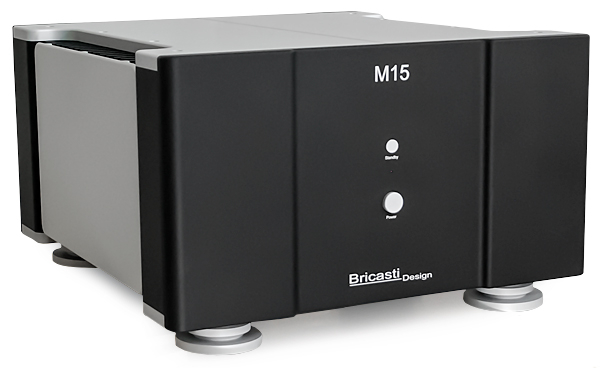
Bricasti Design's M15 stereo power amplifier lives up to designer Brian Zolner's goal of delivering "a relaxed sound that you can listen to for hours." There is nothing "hyped-up in the top end," and much to enjoy in its colorful if toned-down sound. Whether or not it will float your boat will be determined, in large part, by the load your speakers present to an amplifier, and by the other components in your system. If your combination of equipment, cabling, and room produces a sound that tends toward the harsh, the bright, and/or the overtly analytical, the Bricasti M15 could be just what the doctor ordered.
Having wasted too many hours critically listening to allegedly fully-broken-in gear that was clearly still unready for prime time, I no longer take manufacturer assurances of factory break-in at face value. I cued up a Nordost break-in CD and ran both its break-in and demagnetizing tones through the system continuously at a decent volume for a good three–four days, and began each listening session with an additional 30-minute round of break-in and demagnetization. The M15's sound remained consistent throughout the listening period; it's fair to conclude that it was sufficiently broken in. Even that, however, did not result in a totally firm bass foundation from Teodor Currentzis and MusicAeterna's gut-wrenching recording of Tchaikovsky's Symphony 6, Pathétique (24/96 WAV, Sony Classical 88985 40435-2). And while the strings sounded quite liquid, even translucent, they lacked shine. The sound was darker, more tempered, less alive and involving than I'd expected. This pattern of less-than-ideal bass and a toned-down top end continued through a wide range of recordings. In the sublime aria "Se potessero i sospir' miei," from Handel's opera Imeneo, from Philippe Jaroussky and Artaserse's The Händel Album (24/96 WAV, Erato 33572994), timbres were true, but the high extension was darkened. As much as I appreciated the tanginess of theorbo and violins and the subdued tinkle of harpsichord, and could hear slight changes in the weight and color of countertenor Jaroussky's voice during one long-breathed phrase, nothing shone. Jaroussky is an exquisite artist, but a key element of his brilliance was dimmed due to the Bricasti's darker range of colors.
This classical guy made a determined effort to listen to a diverse assortment of recordings. To these ears and heart, the emotional and visceral impact of Sarah Vaughan and the Count Basie Orchestra's incomparable rendition of Sondheim's "Send in the Clowns," the title track of their 1981 studio recording (Pablo/JVC-XRCD VICJ-60246), felt diminished by the muzzled bite of percussion and, in particular, the loss of the otherwise heightened intensity of carefully calculated cymbal accents and horn blatts. In addition, the midranges of voice and piano were over-emphasized, and the rasp that became part of the divine Ms. Sassy's singing later in life was toned down. The thrill this recording delivers—it once hushed to stunned silence a large group of audio-show attendees in VAC's exhibit room—was lessened.
Bricasti Design's M15 stereo power amplifier lives up to designer Brian Zolner's goal of delivering "a relaxed sound that you can listen to for hours." There is nothing "hyped-up in the top end," and much to enjoy in its colorful if toned-down sound. Whether or not it will float your boat will be determined, in large part, by the load your speakers present to an amplifier, and by the other components in your system. If your combination of equipment, cabling, and room produces a sound that tends toward the harsh, the bright, and/or the overtly analytical, the Bricasti M15 could be just what the doctor ordered.