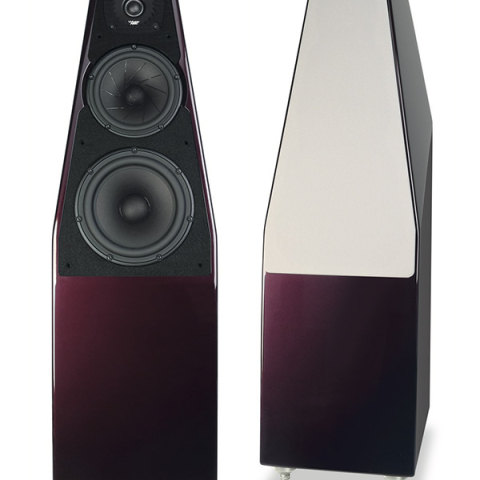
 The B&W DM-6 is the second "phase-coherent" speaker system we have tested. (The first was the Dahlquist DQ-10 in January 1977.) From what we see in the latest ads from the US, England, and Japan, there will be more forthcoming. One speaker manufacturer who has been around for a long time and is currently pushing his own "phased" systems observed that many of his competitors' designs are being introduced merely because "phase response" sells these days. Yet the truth of the matter is that the experts still do not agree as to whether linear phase has any effect on reproduced sound.
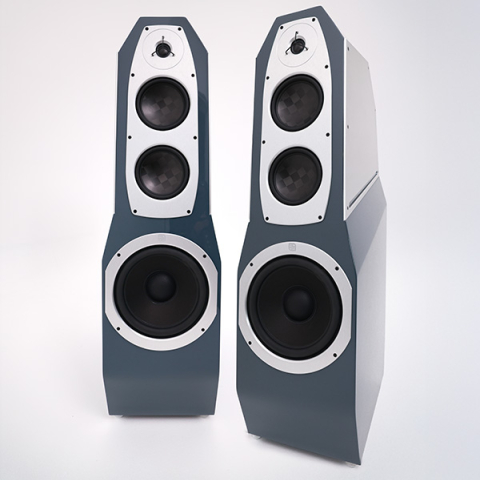
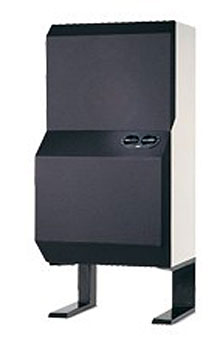
The DM-6 is an expensively made product using three drivers specially designed for it. The woofer cone is of Bextrene plastic, common in England but rare in the US. The midrange unit is a 6" cone of DuPont aromatic polyamide, "Kevlar," which is claimed to have extremely high internal damping. (This is the first acoustical use of this material that we know of.) The tweeter is a ¾" dome. The cabinet is of complex construction, heavily braced and lined with bituminous felt, which can significantly reduce cabinet resonances.
Sound Quality
The B&W DM-6 is the second "phase-coherent" speaker system we have tested. (The first was the Dahlquist DQ-10 in January 1977.) From what we see in the latest ads from the US, England, and Japan, there will be more forthcoming. One speaker manufacturer who has been around for a long time and is currently pushing his own "phased" systems observed that many of his competitors' designs are being introduced merely because "phase response" sells these days. Yet the truth of the matter is that the experts still do not agree as to whether linear phase has any effect on reproduced sound.
The DM-6 is an expensively made product using three drivers specially designed for it. The woofer cone is of Bextrene plastic, common in England but rare in the US. The midrange unit is a 6" cone of DuPont aromatic polyamide, "Kevlar," which is claimed to have extremely high internal damping. (This is the first acoustical use of this material that we know of.) The tweeter is a ¾" dome. The cabinet is of complex construction, heavily braced and lined with bituminous felt, which can significantly reduce cabinet resonances.
Sound QualitySonically, this is not a system to use with tubed electronics. With the best of the tubed power amps—the Audio Research D-150—the system had a rather loose and ill-defined low end, subtle but audible middle-range colorations (including a somewhat distant perspective), and an excessively soft high end. With good solid-state electronics, most of those problems vanished, although the mid-bass range (with the systems well away from room boundaries) was still judged to be overly heavy. Fortunately, there is a bass "contour" control at the back of each speaker (midrange and treble controls are conspicuously placed at the front), and with this set for reduced low end, bass performance was generally excellent but for the typical British rolloff toward the extreme bottom. Response was subjectively flat to around 45Hz, and weak but usable to a bit below 40. Middle-range coloration was minimal, having no detectable vowel-like anomalies but still a slight tendency to back sounds off a bit from the listener. Highs were very smooth and silky, with an almost-electrostatic-type airiness. Most remarkable, though, was their definition—a quality of razor- sharp focus and delineation of inner details, yet without the irritating bite of most other systems that are comparable in detail.
Does "coherent phase" improve sound? On the basis of these, and the Dahlquists, we would conclude that it does.—Allen Edelstein Editor's Addendum
Mr. Edelstein's report, like those by Ye Ed., represents a consensus of about five people who sit in, at different times, on listening sessions in JGH's home, and who borrow the portable items for use in their own homes.—J. Gordon Holt