

Measurements Wired
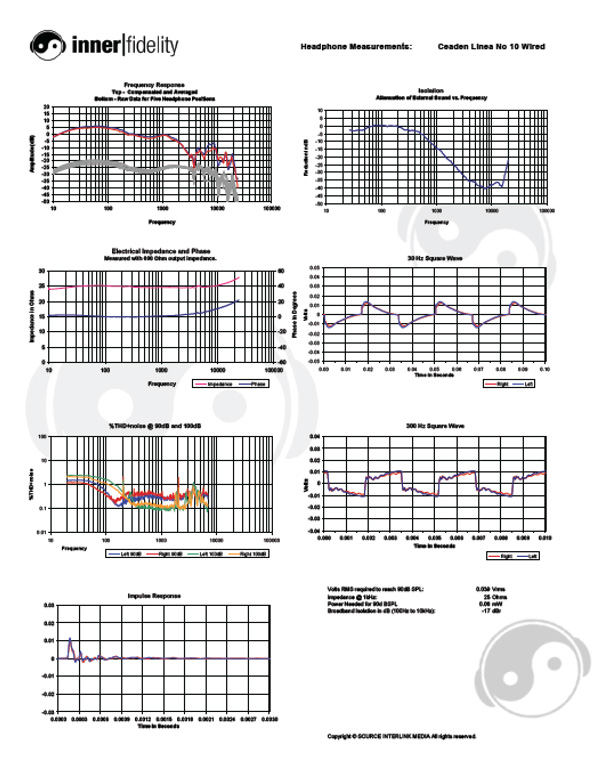
Raw frequency response plot show relatively little change when repositioning on the head indicating an earpad seal that works quite well. Roughly 5dB boost in the bass is desirable, but it extends to about 250Hz, which is about 100Hz too high causing some bloating of the lower midrange. The gentle rise in the midrange starting at about 500Hz is good; it should ideally start lower, but many headphones are flat to 1kHz, so this is a fairly good result. There should be a roughly 10-15dB peak in response at about 3kHz to mimic the concha bowl gain of your ear. The Linea No.10 only rises to about 5dB above zero reference (the dip at 500Hz at the -30dB mark), and the peak is too broad. There is a notch in response at just under 4kHz, I suspect this is designed in to kill a resonance in the headphone. This lower than optimal concha peak makes the headphone somewhat laid back; and possibly due to that and the notch at 4kHz these cans tend to make "sss" sound like "th".
Raw response profile above about 5kHz is near ideal. Though they sound a bit laid back, they retain the sparkle needed to give the impression of decent mid- and upper- treble response despite the laid back low treble.
30Hz square wave is missing a snappy leading edge due to the reduced 3kHz peak. Wave shape top has a modest swayback due to the broad bass hump. I'm actually a bit surprised by how straight it is. This means the bass is staying fairly well in phase. Elevated THD in the lows show these aren't particularly tight and detailed in the bass, but the distortion is limited and not ever-climbing. I heard the bass quality as good but not great.
300Hz squarewave is missing the leading edge spike and there is an upward trend of the waveform top; both would indicate a treble roll-off and/or muffled sound. On the other hand, the impulse response shows a fairly snappy initial impulse with only modest subsequent noise. However, initial impulse and noise do not have a clean, regular, diminishing sinusoidal shape, which usually indicates the presence of some audible artifact. Again, this may be an indicator of the "ss" vs. "th" observation.
Impedance plots shows a nominally 25 Ohm headphone. Lack of any significant artifacts in the plot between 2-8kHz means its driver is probably fairly well behaved---not exhibiting excessive modal break-up.
Isolation is -17dB broadband, which is fairly good for a headphone of this type. Isolation plot is about what I would expect in shape, but a little deeper than most on-ear headphones.
With 39mVrms needed to reach 90dBspl at the ear, these cans will be appropriately loud when used with portable devices.
Bluetooth
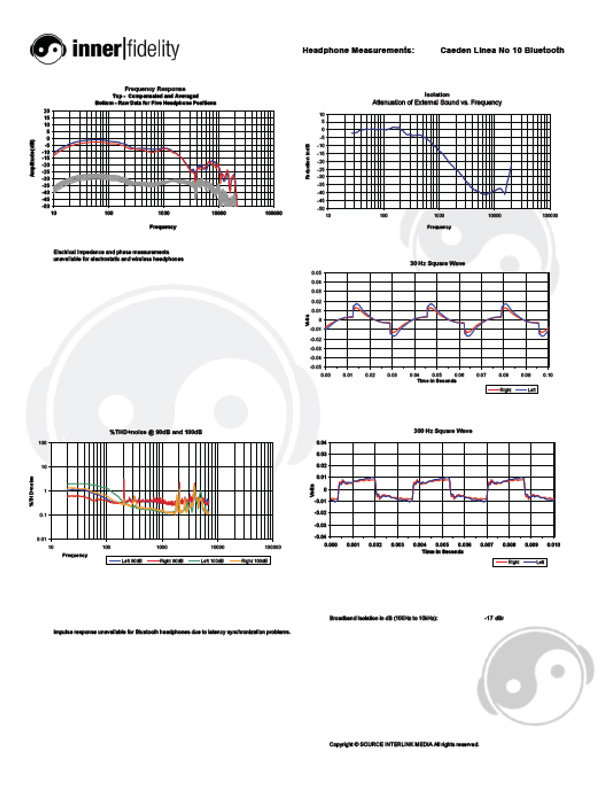
Raw frequency response plots have a very similar shape to when used on the wire. Bass does fall off a bit faster in the sub-bass. This is echoed in the 30Hz square wave response with a more swayback look and the trailing edge falling below zero. I think we may be seeing some capacitive coupling in the internal amplifier output. In listening I thought the wired and Bluetooth performance as quite close---better than most headphones of this type. Distortion plot is slightly higher, but may be due to the slightly lower volume of the test signal. (Not sure why, but that sometimes happens with Bluetooth cans.) This is an above average set of measurements for a headphone of this type and price.
Click on graphs image to download .pdf for closer inspection.
Measurements Bluetooth
Click on graphs image to download .pdf for closer inspection.
WiredRaw frequency response plot show relatively little change when repositioning on the head indicating an earpad seal that works quite well. Roughly 5dB boost in the bass is desirable, but it extends to about 250Hz, which is about 100Hz too high causing some bloating of the lower midrange. The gentle rise in the midrange starting at about 500Hz is good; it should ideally start lower, but many headphones are flat to 1kHz, so this is a fairly good result. There should be a roughly 10-15dB peak in response at about 3kHz to mimic the concha bowl gain of your ear. The Linea No.10 only rises to about 5dB above zero reference (the dip at 500Hz at the -30dB mark), and the peak is too broad. There is a notch in response at just under 4kHz, I suspect this is designed in to kill a resonance in the headphone. This lower than optimal concha peak makes the headphone somewhat laid back; and possibly due to that and the notch at 4kHz these cans tend to make "sss" sound like "th".
Raw frequency response plots have a very similar shape to when used on the wire. Bass does fall off a bit faster in the sub-bass. This is echoed in the 30Hz square wave response with a more swayback look and the trailing edge falling below zero. I think we may be seeing some capacitive coupling in the internal amplifier output. In listening I thought the wired and Bluetooth performance as quite close---better than most headphones of this type. Distortion plot is slightly higher, but may be due to the slightly lower volume of the test signal. (Not sure why, but that sometimes happens with Bluetooth cans.) This is an above average set of measurements for a headphone of this type and price.















