Sidebar 3: Measurements
I tested the Cambridge Audio CXA81 with my Audio Precision SYS2722 system (see the January 2008 "As We See It"). I first preconditioned the amplifier by following the CEA's recommendation of operating it at one-eighth the specified power into 8 ohms for 30 minutes. At the end of that time, the top panel was warm, at 98°F (36.7°C), with the grille over the heatsinks and transformer hotter, at 133.1°F (56.2°C). I then performed my usual thermal stress test by running the amplifier at one-third power into 8 ohms for an hour. After 30 minutes, the grille's temperature in places was 147.1°F (63.4°C). Although this is a little too hot to keep your hand on, the Cambridge amplifier does have enough thermal capacity for its power rating, despite its relatively affordable price.
I looked first at the Cambridge's performance via its line inputs. As I often find with European amplifiers, the balanced inputs offered a lower maximum gain at the speaker outputs than the unbalanced inputs: 31dB into 8 ohms, compared with 40dB. (The latter is typical for an integrated amplifier.) The maximum gain at the unbalanced preamplifier outputs was 9.2dB for an unbalanced input signal. The maximum gain at the 3.5mm headphone jack was 18.6dB for the balanced input, 6dB higher for the unbalanced input. The amplifier preserved absolute polarity at all sets of outputs for both unbalanced and balanced input signals. (The balanced input jacks are wired with pin 2 positive, the AES standard.)
The single-ended line input impedance was close to the specified 43k ohms at a usefully high 41k ohms at 20Hz and 1kHz. It dropped slightly and inconsequentially at 20kHz to 32.5k ohms. The balanced input impedance was 100k ohms across the audioband, ie, the specified 50k ohms per phase. The preamplifier output impedance was an appropriately low 48 ohms in the midrange and treble, rising to 77 ohms in the low bass. The headphone output impedance was a relatively low 33 ohms across the band.
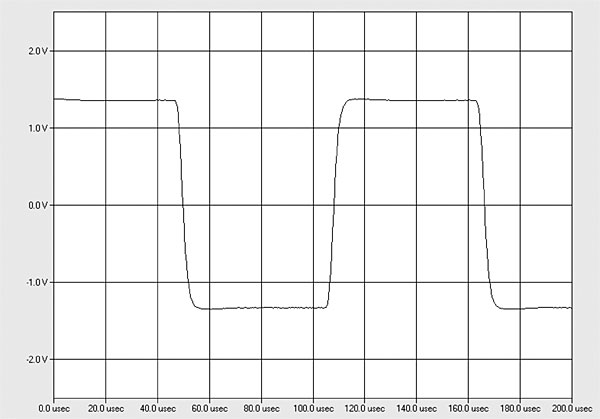
The Cambridge amplifier's output impedance at the loudspeaker terminals was 0.115 ohm at 20Hz and 1kHz, rising to 0.16 ohm at 20kHz. (The figures include the series impedance of 6' of spaced-pair loudspeaker cable.) The modulation of the amplifier's frequency response, due to the Ohm's law interaction between this source impedance and the impedance of my standard simulated loudspeaker, was ±0.1dB (fig.1, gray trace). The response into an 8 ohm resistive load (fig.1, blue and red traces) was down by 3dB just above 100kHz, which correlates with the Cambridge's accurate reproduction of a 10kHz squarewave into that load (fig.2). Fig.1 was taken with the volume control set to its maximum; neither the frequency response nor the excellent channel matching changed at lower settings of the volume control. The response at the headphone output extended a little higher in frequency; it was down by just 1dB at 100kHz. The subwoofer output rolled off above 1kHz, meaning that the subwoofer used with this output needs to have its own low-pass filter.





 The Cambridge's USB and S/PDIF inputs all inverted absolute polarity, which can be seen in their impulse response with 44.1kHz data (fig.10). This graph indicates that the reconstruction filter is a conventional linear-phase type, with time-symmetrical ringing on either side of the single sample at 0dBFS. With 44.1kHz-sampled white noise (fig.11, red and magenta traces), the CXA81's response rolled off sharply above 20kHz, reaching full stop-band suppression just above half the sample rate (vertical green line). An aliased image at 25kHz of a full-scale tone at 19.1kHz (blue and cyan traces) is only just visible above the noise floor, though the distortion harmonics of the 19.1kHz tone can be seen, with the third the highest in level at just below –80dB (0.01%). The CXA81's digital-input frequency response was flat in the audioband and follows the same basic shape, with then a sharp rolloff just below half of each sample rate (fig.12). This graph shows that the right channel was 0.25dB higher in level than the left.



 The performance of the CXA81's digital inputs seemed very familiar. I checked recent reviews and it turned out that, other than the polarity inversion, they behaved identically to the digital inputs of Musical Fidelity's M8xi integrated amplifier, which Jason Victor Serinus reviewed in the October 2020 issue. It's possible that the two manufacturers use the same OEM digital module.
Cambridge's CXA81 performed well on the test bench. It offers relatively high power with very low harmonic and intermodulation distortion.—John Atkinson
The performance of the CXA81's digital inputs seemed very familiar. I checked recent reviews and it turned out that, other than the polarity inversion, they behaved identically to the digital inputs of Musical Fidelity's M8xi integrated amplifier, which Jason Victor Serinus reviewed in the October 2020 issue. It's possible that the two manufacturers use the same OEM digital module.
Cambridge's CXA81 performed well on the test bench. It offers relatively high power with very low harmonic and intermodulation distortion.—John Atkinson
Fig.1 Cambridge CXA81, volume control set to maximum, frequency response at 2.83V into: simulated loudspeaker load (gray), 8 ohms (left channel blue, right red) 4 ohms (left cyan, right magenta), (left green) (1dB/vertical div.).
Fig.2 Cambridge CXA81, small-signal 10kHz squarewave into 8 ohms.
Channel separation was good, at >80dB in both directions below 3kHz, and still 65dB at the top of the audioband. The Cambridge's unweighted, wideband signal/noise ratio, taken with the unbalanced line inputs shorted to ground but the volume control set to its maximum, was okay, at 68.2dB ref. 2.83V into 8 ohms (average of both channels). This ratio improved to 77.4dB when the measurement bandwidth was restricted to the audioband, and to 80.1dB when A-weighted. The background noise included spuriae at 60Hz and its even- and odd-order harmonics (fig.3), but these are all relatively low in level.
Fig.3 Cambridge CXA81, spectrum of 1kHz sinewave, DC–1kHz, at 1W into 8 ohms, volume control set to maximum (left channel cyan, right magenta; linear frequency scale).
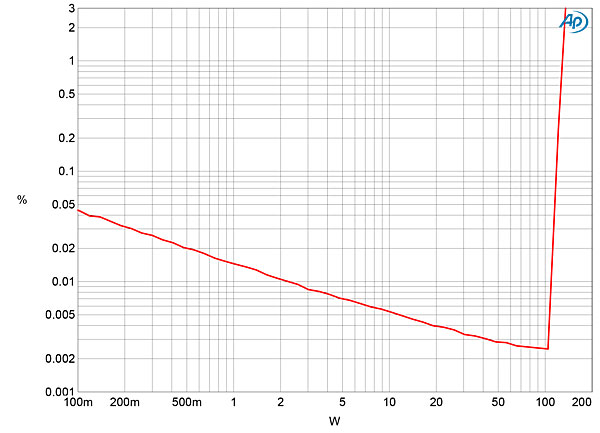
With both channels driven, the CXA81 exceeded its specified maximum power into 8 ohms of 80Wpc (19dBW), clipping at 1% THD+noise at 89Wpc (19.5dBW, fig.4). The Cambridge just exceeded its specified maximum power into 4 ohms, clipping at 128Wpc (18.1dBW, fig.5) compared with the specified 120W into this load (17.8dBW). The downward slope of the traces in these two graphs below the clipping power is due to distortion lying beneath the noise floor. (A constant level of noise becomes an increasing percentage of the output signal as the power drops.) It implies that the CXA81's output stage uses a relatively high amount of loop negative feedback.
Fig.4 Cambridge CXA81, distortion (%) vs 1kHz continuous output power into 8 ohms.
Fig.5 Cambridge CXA81, distortion (%) vs 1kHz continuous output power into 4 ohms.
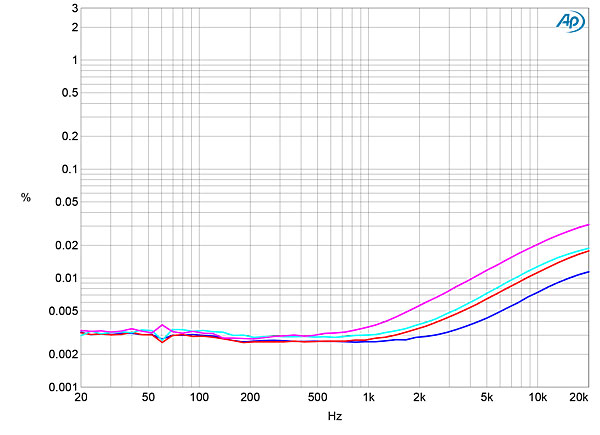
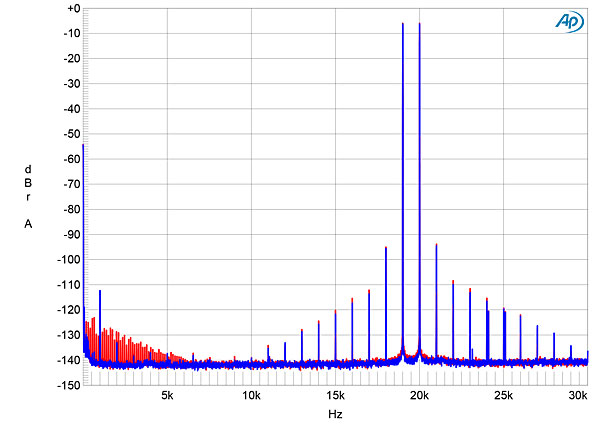
I examined how the THD+N percentage changed with frequency at 12.67V, which is equivalent to 20W into 8 ohms and 40W into 4 ohms. The distortion was very low in the bass and midrange into both loads (fig.6), and though it rose in the top octaves, it was well below 0.1%. The distortion was predominantly the third harmonic, though the spikiness of the spuriae waveform (fig.7) suggests that higher harmonics are also present. The fifth and seventh harmonics can be seen in the CXA81's output at a level just below clipping into 4 ohms (fig.8), but these both lie close to –110dB (0.0003%). When the CXA81 drove an equal mix of 19 and 20kHz tones at 25W peak into 8 ohms, all the intermodulation products were low in level (fig.9).
Fig.6 Cambridge CXA81, THD+N (%) vs frequency at 12.67V into: 8 ohms (left channel blue, right red), 4 ohms (left cyan, right magenta).
Fig.7 Cambridge CXA81, 1kHz waveform at 50W into 8 ohms, 0.003% THD+N (top); distortion and noise waveform with fundamental notched out (bottom, not to scale).
Fig.8 Cambridge CXA81, spectrum of 50Hz sinewave, DC–1kHz, at 100W into 4 ohms (left channel blue, right red; linear frequency scale).
Fig.9 Cambridge CXA81, HF intermodulation spectrum, DC–30kHz, 19+20kHz at 25W peak into 8 ohms (left channel blue, right red; linear frequency scale).
The Cambridge CXA81's optical and coaxial S/PDIF digital inputs locked to data sampled up to 192kHz. Apple's USB Prober utility, running on my battery-powered MacBook Pro, identified the Cambridge as "CA CXA81 2.0" from "CA." The USB port operated in the optimal isochronous asynchronous mode, and Apple's Audio MIDI utility revealed that via USB the CXA81 accepted 16- and 24-bit integer data sampled at all rates from 44.1kHz to 705.6kHz. The USB port has a ground/ lift switch adjacent to it. I left the port grounded, as a lot of power supply– related noise was present with the ground lifted.
With the volume control set to its maximum, a 1kHz digital signal at –20dBFS resulted in a level at the loudspeaker outputs of 13.41V, which is 7.3dB below the clipping voltage and equivalent to 22.5W into 8 ohms. It appears, therefore, that the CXA81's digital inputs have around 13dB of excess gain. The –20dBFS digital signal results in levels of 548mV at the preamplifier output and 3.22V at the headphone output. To avoid damaging the Cambridge's power amplifier stage with high-level digital signals, I performed all the measurements of the digital inputs' performance at the headphone output; inserting the headphone plug into the front-panel jack mutes the preamplifier and loudspeaker outputs. The headphone output clips with full-scale digital signals with the volume control set to its maximum; I examined the digital inputs' behavior with the volume control at 1 o'clock, which was just below the setting where the distortion started to rise. The output level at this volume-control setting was 6V.
Fig.10 Cambridge CXA81, digital input, impulse response (one sample at 0dBFS, 44.1kHz sampling, 4ms time window).
Fig.11 Cambridge CXA81, digital input, wideband spectrum of white noise at –4dBFS (left channel red, right magenta) and 19.1kHz tone at 0dBFS (left blue, right cyan), with data sampled at 44.1kHz (20dB/vertical div.).
Fig.12 Cambridge CXA81, digital input, frequency response at –12dBFS into 100k ohms with data sampled at: 44.1kHz (left channel green, right gray), 96kHz (left channel cyan, right magenta), 192kHz (left blue, right red) (1dB/vertical div.).
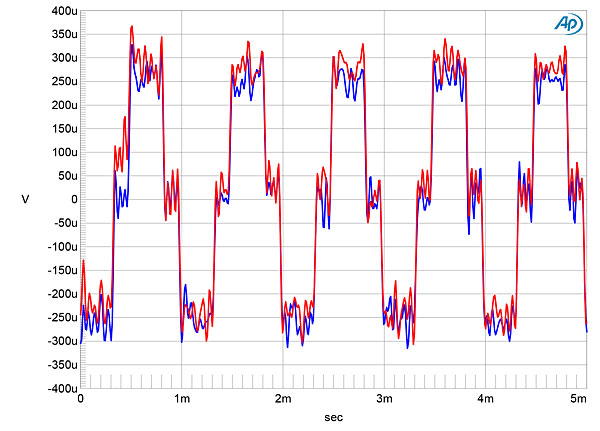
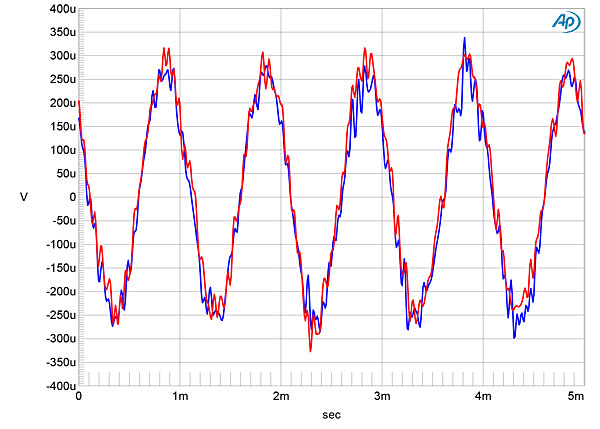
Channel separation via the digital inputs was a very good 90dB across the audioband. When I increased the bit depth from 16 to 24 with a dithered 1kHz tone at –90dBFS (fig.13), the noise-floor components dropped by around 18dB, which implies that the CXA81 offers close to 19 bits' worth of resolution. However, the noise floor contains a large number of low-level, power-supply–related spuriae, particularly in the right channel (red trace). With undithered data representing a tone at exactly –90.31dBFS (fig.14), the three DC voltage levels described by the data were well resolved. With undithered 24-bit data (fig.15), the result was a somewhat noisy sinewave.
Fig.13 Cambridge CXA81, digital input, spectrum with noise and spuriae of dithered 1kHz tone at –90dBFS with: 16-bit data (left channel cyan, right magenta), 24-bit data (left blue, right red) (20dB/vertical div.).
Fig.14 Cambridge CXA81, digital input, waveform of undithered 16-bit, 1kHz sinewave at –90.31dBFS (left channel blue, right red).
Fig.15 Cambridge CXA81, digital input, waveform of undithered 24-bit, 1kHz sinewave at –90.31dBFS (left channel blue, right red).
Intermodulation distortion via the Cambridge amplifier's digital inputs (fig.16) was as low as it had been for analog input signals. I tested the CXA81 for its rejection of word-clock jitter via both its TosLink and USB inputs. Though all the odd-order harmonics of the 16-bit J-Test signal's LSB-level, low-frequency squarewave were at the correct levels (fig.17, sloping green line), the spectral spike that represents the high-level tone at exactly one-quarter the sample rate was significantly broadened at its base. This suggests that the Cambridge's digital inputs are affected by random, low-frequency jitter. With 24-bit J-Test data (fig.18), no jitter-related sidebands were present, but the spectral broadening could still be seen.
Fig.16 Cambridge CXA81, digital input, HF intermodulation spectrum, DC–30kHz, 19+20kHz at 0dBS peak (left channel blue, right red; linear frequency scale)..
Fig.17 Cambridge CXA81, digital input, high-resolution jitter spectrum of analog output signal, 11.025kHz at –6dBFS, sampled at 44.1kHz with LSB toggled at 229Hz: 16-bit Toslink data (left channel blue, right red). Center frequency of trace, 11.025kHz; frequency range, ±3.5kHz.
Fig.18 Cambridge CXA81, digital input, high-resolution jitter spectrum of analog output signal, 11.025kHz at –6dBFS, sampled at 44.1kHz with LSB toggled at 229Hz: 24-bit Toslink data (left channel blue, right red). Center frequency of trace, 11.025kHz; frequency range, ±3.5kHz.