

Out of the gate, the EVO 150 sounded good even on MP3 radio broadcasts. The sound was fresh-faced and convivial, with a dynamic spring in its step. There was a confident, unforced quality that let the music unfold gracefully. I instantly liked how the EVO pitched a circa 6' × 6' virtual space into my room and filled it with clear sounds, and how it maintained its composure at high volume. A promising start.
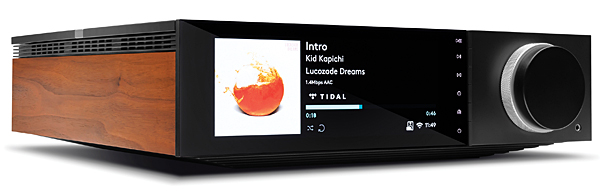
When music is playing, the EVO's screen displays, along with the album cover, the song and album titles, the artist's name, the stream resolution, the file format, the track's total and elapsed time, and—if the track is MQA—the MQA logo accompanied by either a green or a blue dot indicating whether that MQA recording is engineer- or artist-approved (blue, "MQA Studio"). If the dot is green, it means that the file being streamed is intact MQA, but it may not be the most recent or definitive version of the recording.
I got a kick out of seeing my first blue authentication dot. I thought: "This recording is the real deal!" It appeared on the 24/192 MQA version of John Coltrane's cover of "My Favorite Things" (Atlantic/Qobuz) which I heard after I'd heard that same track on a green-lighted 16/44.1 MQA mix. That lower-rez version had sounded fine—big soundstage with big bass lines, tinkling piano chords without glare, and fluttering sax solos that made me notice how temporally undistorted the music sounded through the EVO. I was perfectly content with this version—until I switched to the blue-dotted one, which blew the studio space wide open and gelled it geometrically (footnote 2). With more breathing room and clearer spatial lines, sounds took on more of the shape of the instruments and the pathways of their soundwave trajectories; Elvin Jones's cymbal shots sprayed along more linear paths, Coltrane's sax and McCoy Tyner's piano had more bite and substance, and Steve Davis's double bass sounded springier and better defined: there it was on the right, next to the sax where it should be, blowing musically charged air leftward across my front periphery.
 On the green-lit 16/44.1 MQA version, the bass is squeezed in slightly left of center, encroaching on the space shared by the piano and drum. The bass on this version sounds woolly and directionless.
That's when it hit me: What a treasure trove of digital remixes and reissues streaming makes possible with a device like the EVO 150 and Roon! Roon organizes all the file-based music you have access to, whether locally stored or on streaming services (at the moment, only Tidal is available via Roon here in Canada; Qobuz is available elsewhere), and puts it all in one place so it's easier to find the music you're looking for—and also music you weren't looking for. Did you know there are 10 versions of Getz/Gilberto just on Tidal? (footnote 3)
Not once during the two years I've been a Tidal subscriber did the thought of comparing more than a couple of album versions side by side cross my mind. But now? With Roon's alternate-versions list and the EVO's transparent-to-the-source, hi-rez capabilities, the prospect of comparing albums was tempting. Scratch that. It sounded fun. I wanted to do it, and as I was doing it, the idea of including my favorite versions in my library never made more sense. Yes, it's virtual—ephemeral—but isn't all music just airwaves? Streaming has unique advantages.
Can you imagine comparing 10 versions of Getz/Gilberto on physical media, in one sitting? How many versions have you heard on CD or LP? And what version do you own? Is it the best-sounding one?
The number of Getz/Gilberto releases I had at my disposal—11 if you count the 24/96 file I downloaded a few years back—comprised remastered editions, expanded editions, different MQA resolutions, and versions where the channels are reversed, L–R.
Of the six MQA versions of Getz/Gilberto, not one was blue-dot authenticated, but it didn't matter. None of that paralyzing "did I hear a difference?" self-doubt: The EVO made obvious how the standard 16/44.1kHz version, warm and sweet as it was, was outclassed by the more ambient, tonally weightier 24/96 MQA version, on which everything with air blowing out of it sounded more phlegm-filled, reverberant, and corporeal (footnote 4). As the sample rate went up, Gilberto's voice got richer and chestier, to the point that in 24/192 MQA I felt it vibrating against my ribcage. I've never had a voice do that to me before.
To see if this effect was exacerbated by the Focals' rich midband, I listened to the same parts through my Grado Labs GS3000e headphones—themselves a bit rich in character—plugged into the EVO's headphone jack. While the stereo effect through this setup wasn't as pronounced as through the Focals, tonally things sounded similar. Gilberto's voice became weightier as the file resolution went up, if not ribcage-rattlingly so.
Back to speakers, I tried some of the 24/96 files I had on hand on an external hard drive, of music by Crosby, Stills, Nash & Young; Yes; Art Blakey; and Herbie Hancock. I never liked the sound of these files being streamed from my hard drive, finding it flat and sterile and putting an early kibosh on my hi-rez downloading days. The EVO made things better on all the tracks, but in every case, at the same resolution, Tidal-sourced MQA-encoded counterparts sounded better than the local FLAC downloads: more impactful, realistic, more like a walk in the park and less like a walk in the cemetery.
In the mood for a touchable medium, I connected my Moon CD transport into the EVO's digital input and played an album Michael Fremer wrote the liner notes for: Patricia Barber's Companion (CD, Blue Note 7243 5 22963 2 3). Via the Focal speakers, the EVO's class-D amplifier couldn't reproduce the live energy atmosphere of this live performance the way the $15,000 Grandinote Shinai can, but it wasn't that far off. The musicians and crowd sounded visceral, imaging was spot-on, and a few times, when the pace picked up and the sound got big and spacious, I'd look at the EVO with befuddled amusement and wonder how such a compact, unassuming-looking thing could deliver such big sound all by itself.
The EVO does something special—it did it as well on Dominique Fils-Aimé's vocally luminous album Nameless (CD, Ensoul Records)—and it's what I imagine the English mean by insight: the feeling of being able to peer deep into the music, maybe even of feeling you've been sucked into it physically, like Flynn in the game Tron. It's a magnetic effect and has nothing to do with fake detail derived from a tipped-up balance. Remember those annoying sibilants on Patricia's voice? Practically all scrubbed. There was just more voice there, as there was more voice and insight in the multitracked vocals on Fils-Aimé's album.
On the green-lit 16/44.1 MQA version, the bass is squeezed in slightly left of center, encroaching on the space shared by the piano and drum. The bass on this version sounds woolly and directionless.
That's when it hit me: What a treasure trove of digital remixes and reissues streaming makes possible with a device like the EVO 150 and Roon! Roon organizes all the file-based music you have access to, whether locally stored or on streaming services (at the moment, only Tidal is available via Roon here in Canada; Qobuz is available elsewhere), and puts it all in one place so it's easier to find the music you're looking for—and also music you weren't looking for. Did you know there are 10 versions of Getz/Gilberto just on Tidal? (footnote 3)
Not once during the two years I've been a Tidal subscriber did the thought of comparing more than a couple of album versions side by side cross my mind. But now? With Roon's alternate-versions list and the EVO's transparent-to-the-source, hi-rez capabilities, the prospect of comparing albums was tempting. Scratch that. It sounded fun. I wanted to do it, and as I was doing it, the idea of including my favorite versions in my library never made more sense. Yes, it's virtual—ephemeral—but isn't all music just airwaves? Streaming has unique advantages.
Can you imagine comparing 10 versions of Getz/Gilberto on physical media, in one sitting? How many versions have you heard on CD or LP? And what version do you own? Is it the best-sounding one?
The number of Getz/Gilberto releases I had at my disposal—11 if you count the 24/96 file I downloaded a few years back—comprised remastered editions, expanded editions, different MQA resolutions, and versions where the channels are reversed, L–R.
Of the six MQA versions of Getz/Gilberto, not one was blue-dot authenticated, but it didn't matter. None of that paralyzing "did I hear a difference?" self-doubt: The EVO made obvious how the standard 16/44.1kHz version, warm and sweet as it was, was outclassed by the more ambient, tonally weightier 24/96 MQA version, on which everything with air blowing out of it sounded more phlegm-filled, reverberant, and corporeal (footnote 4). As the sample rate went up, Gilberto's voice got richer and chestier, to the point that in 24/192 MQA I felt it vibrating against my ribcage. I've never had a voice do that to me before.
To see if this effect was exacerbated by the Focals' rich midband, I listened to the same parts through my Grado Labs GS3000e headphones—themselves a bit rich in character—plugged into the EVO's headphone jack. While the stereo effect through this setup wasn't as pronounced as through the Focals, tonally things sounded similar. Gilberto's voice became weightier as the file resolution went up, if not ribcage-rattlingly so.
Back to speakers, I tried some of the 24/96 files I had on hand on an external hard drive, of music by Crosby, Stills, Nash & Young; Yes; Art Blakey; and Herbie Hancock. I never liked the sound of these files being streamed from my hard drive, finding it flat and sterile and putting an early kibosh on my hi-rez downloading days. The EVO made things better on all the tracks, but in every case, at the same resolution, Tidal-sourced MQA-encoded counterparts sounded better than the local FLAC downloads: more impactful, realistic, more like a walk in the park and less like a walk in the cemetery.
In the mood for a touchable medium, I connected my Moon CD transport into the EVO's digital input and played an album Michael Fremer wrote the liner notes for: Patricia Barber's Companion (CD, Blue Note 7243 5 22963 2 3). Via the Focal speakers, the EVO's class-D amplifier couldn't reproduce the live energy atmosphere of this live performance the way the $15,000 Grandinote Shinai can, but it wasn't that far off. The musicians and crowd sounded visceral, imaging was spot-on, and a few times, when the pace picked up and the sound got big and spacious, I'd look at the EVO with befuddled amusement and wonder how such a compact, unassuming-looking thing could deliver such big sound all by itself.
The EVO does something special—it did it as well on Dominique Fils-Aimé's vocally luminous album Nameless (CD, Ensoul Records)—and it's what I imagine the English mean by insight: the feeling of being able to peer deep into the music, maybe even of feeling you've been sucked into it physically, like Flynn in the game Tron. It's a magnetic effect and has nothing to do with fake detail derived from a tipped-up balance. Remember those annoying sibilants on Patricia's voice? Practically all scrubbed. There was just more voice there, as there was more voice and insight in the multitracked vocals on Fils-Aimé's album.
 And then there's this: The EVO delivers solid bass and not the one-tone kind that shows up in every track. The Medeski Martin & Wood track "Chubb Sub" from their Last Chance to Dance Trance (Perhaps) compilation album (CD, Gramavision GCD 79520) is a chunky, propulsive groove of bass and percussive tones from keyboards, double bass, and drums that threaten to override each other, especially since the stereo image is concentrated mostly in a narrow area where everyone's packed together. The EVO made it easy to parse the sonic underbrush and hear each instrument and its reverberant offshoots.
Any attempt to try my Rega turntable and its 0.3mV output Musikraft Denon DL-103 cartridge with the EVO's MM-only phono stage would be ludicrous and inconclusive, so of course I tried it. No, there wasn't enough gain or dynamics or freewheeling momentum, nor did I hear the palpability and color of my tubed phono stage. And yet! With the volume set at 99 out of 100, across a subsection of cuts from Alice Coltrane's Journey to Satchidananda (LP, Impulse! IMP-228), Miles Davis's Miles in the Sky (LP, Columbia PC 9628), and Can's Future Days (LP, United Artists Records UA S 29505), music emerged from a silent background and sounded more suave, substantial, tactile, and natural than I expected. However silly, it was an auspicious experiment.
Conclusion
And then there's this: The EVO delivers solid bass and not the one-tone kind that shows up in every track. The Medeski Martin & Wood track "Chubb Sub" from their Last Chance to Dance Trance (Perhaps) compilation album (CD, Gramavision GCD 79520) is a chunky, propulsive groove of bass and percussive tones from keyboards, double bass, and drums that threaten to override each other, especially since the stereo image is concentrated mostly in a narrow area where everyone's packed together. The EVO made it easy to parse the sonic underbrush and hear each instrument and its reverberant offshoots.
Any attempt to try my Rega turntable and its 0.3mV output Musikraft Denon DL-103 cartridge with the EVO's MM-only phono stage would be ludicrous and inconclusive, so of course I tried it. No, there wasn't enough gain or dynamics or freewheeling momentum, nor did I hear the palpability and color of my tubed phono stage. And yet! With the volume set at 99 out of 100, across a subsection of cuts from Alice Coltrane's Journey to Satchidananda (LP, Impulse! IMP-228), Miles Davis's Miles in the Sky (LP, Columbia PC 9628), and Can's Future Days (LP, United Artists Records UA S 29505), music emerged from a silent background and sounded more suave, substantial, tactile, and natural than I expected. However silly, it was an auspicious experiment.
Conclusion
The EVO 150 changed my opinion about streaming's potential and also about class-D amplification. Both technologies may still have a ways to go before they're universally embraced by the audiophile community, but the EVO did something I didn't expect going into this review: It made me care about streamed music. It made me want to stream, to check out streaming libraries, to compare hi-rez files, to find new music to play on my big hi-fi. The EVO turned streaming into a central listening activity and, in doing so, instilled in my belief system a new dictate that I have Cambridge to thank for: When streaming is done right, as it is in the EVO 150, it deserves a place at the big table alongside the LP and CD (both of which the EVO can play, with the appropriate transport of course). The EVO 150 possesses a spirit of no-compromise, by which I don't mean it performs like a cost-no-object product. I mean that everything about it—its ergonomics, features, streaming app, remote, and, most essentially, sound quality—operates at a high standard. The EVO 150 is what I would hope a product of its type that costs $3000 would be. Make no mistake, the Cambridge EVO 150 is a serious piece of equipment. It looks snazzy and makes sophisticated sound. It delivers on streaming's theoretical promise as a super-convenient way to discover new music and enjoy better-sounding, streamed hi-rez reissues of our favorite music.
Footnote 2: There's obviously more going on here than the difference in resolution or MQA light color. These two versions of "My Favorite Things" are from different masters—indeed, different mixes.—Jim Austin Footnote 3: Here in the US, I counted nine versions. That's still a lot.—Jim Austin Footnote 4: Again, as with the Coltrane, the difference here is (to my ear) more the difference in mastering than the difference MQA makes.—Jim Austin
On the green-lit 16/44.1 MQA version, the bass is squeezed in slightly left of center, encroaching on the space shared by the piano and drum. The bass on this version sounds woolly and directionless.
That's when it hit me: What a treasure trove of digital remixes and reissues streaming makes possible with a device like the EVO 150 and Roon! Roon organizes all the file-based music you have access to, whether locally stored or on streaming services (at the moment, only Tidal is available via Roon here in Canada; Qobuz is available elsewhere), and puts it all in one place so it's easier to find the music you're looking for—and also music you weren't looking for. Did you know there are 10 versions of Getz/Gilberto just on Tidal? (footnote 3)
Not once during the two years I've been a Tidal subscriber did the thought of comparing more than a couple of album versions side by side cross my mind. But now? With Roon's alternate-versions list and the EVO's transparent-to-the-source, hi-rez capabilities, the prospect of comparing albums was tempting. Scratch that. It sounded fun. I wanted to do it, and as I was doing it, the idea of including my favorite versions in my library never made more sense. Yes, it's virtual—ephemeral—but isn't all music just airwaves? Streaming has unique advantages.
And then there's this: The EVO delivers solid bass and not the one-tone kind that shows up in every track. The Medeski Martin & Wood track "Chubb Sub" from their Last Chance to Dance Trance (Perhaps) compilation album (CD, Gramavision GCD 79520) is a chunky, propulsive groove of bass and percussive tones from keyboards, double bass, and drums that threaten to override each other, especially since the stereo image is concentrated mostly in a narrow area where everyone's packed together. The EVO made it easy to parse the sonic underbrush and hear each instrument and its reverberant offshoots.
Any attempt to try my Rega turntable and its 0.3mV output Musikraft Denon DL-103 cartridge with the EVO's MM-only phono stage would be ludicrous and inconclusive, so of course I tried it. No, there wasn't enough gain or dynamics or freewheeling momentum, nor did I hear the palpability and color of my tubed phono stage. And yet! With the volume set at 99 out of 100, across a subsection of cuts from Alice Coltrane's Journey to Satchidananda (LP, Impulse! IMP-228), Miles Davis's Miles in the Sky (LP, Columbia PC 9628), and Can's Future Days (LP, United Artists Records UA S 29505), music emerged from a silent background and sounded more suave, substantial, tactile, and natural than I expected. However silly, it was an auspicious experiment.
The EVO 150 changed my opinion about streaming's potential and also about class-D amplification. Both technologies may still have a ways to go before they're universally embraced by the audiophile community, but the EVO did something I didn't expect going into this review: It made me care about streamed music. It made me want to stream, to check out streaming libraries, to compare hi-rez files, to find new music to play on my big hi-fi. The EVO turned streaming into a central listening activity and, in doing so, instilled in my belief system a new dictate that I have Cambridge to thank for: When streaming is done right, as it is in the EVO 150, it deserves a place at the big table alongside the LP and CD (both of which the EVO can play, with the appropriate transport of course). The EVO 150 possesses a spirit of no-compromise, by which I don't mean it performs like a cost-no-object product. I mean that everything about it—its ergonomics, features, streaming app, remote, and, most essentially, sound quality—operates at a high standard. The EVO 150 is what I would hope a product of its type that costs $3000 would be. Make no mistake, the Cambridge EVO 150 is a serious piece of equipment. It looks snazzy and makes sophisticated sound. It delivers on streaming's theoretical promise as a super-convenient way to discover new music and enjoy better-sounding, streamed hi-rez reissues of our favorite music.
Footnote 2: There's obviously more going on here than the difference in resolution or MQA light color. These two versions of "My Favorite Things" are from different masters—indeed, different mixes.—Jim Austin Footnote 3: Here in the US, I counted nine versions. That's still a lot.—Jim Austin Footnote 4: Again, as with the Coltrane, the difference here is (to my ear) more the difference in mastering than the difference MQA makes.—Jim Austin















