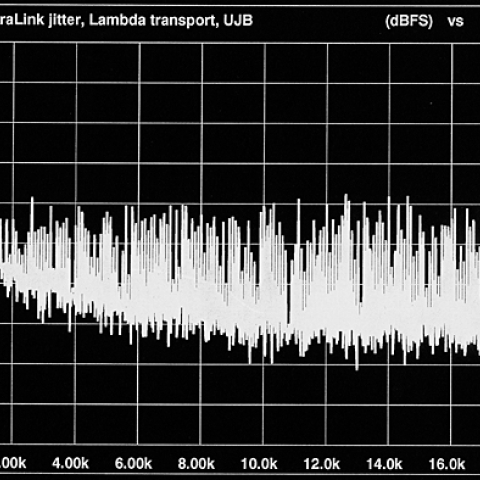
The jitter measurements that I carried out raised more questions than they answered. As with error rates, none of the devices or treatments reduced jitter in the HF signal. During the testing, I had no idea how much jitter reduction to anticipate, and consequently set the measurement parameters so that even the smallest change would be detected. When I measured no change in jitter, I thought that perhaps the jitter analyzer, or my interpretation of the results, lacked sufficient resolution. However, after completing the jitter measurements, I received the Esoteric PD2, a $4000 CD transport. It had enormously lower jitter than the Magnavox player that I had used in conjunction with the error analyzer. Any concerns about the jitter analyzer's resolution were thus allayed. The PD2's jitter reduction was an order of magnitude greater than what I had been looking for during the tweak-effect measurements.
Thoughts and speculation
Instead of shedding light on the causes of sonic differences, the jitter measurements only deepened the mystery. First, because the tweaks produced no change in jitter, other unidentified optical phenomena must be occurring during CD playback. Just how some of these treatments affect sound quality is an enigma waiting to be solved. Second, the jitter measurements led to a train of thought that produced a startling hypothesis: different CD mastering machines, and the optical and chemical conditions present when the CD master disc is made, could affect the musicality of the CD. If this proves true, the revelation is a bombshell, both technically and commercially. What led to consideration of this possibility was the fact that the amount of intrinsic jitter varied enormously between discs. Indeed, the disc-to-disc variation in jitter was much greater than the difference in jitter between a fairly cheap Magnavox CD player and the Esoteric PD2 transport. The measurements indicated that some of this jitter was inherent in the disc, and not solely the result of the CD transport's speed instability. If CD transports with lower jitter provide greater soundstage depth, better low-level resolution, and more liquid textures, then it follows that CDs manufactured with less jitter will exhibit the same increase in musicality when played on the same transport. In auditioning the PD2, I heard more depth, space, and fine detail than when the data stream came from a Marantz CD-94.
Jitter in the HF signal is created when the period of the light-intensity modulation moves around an ideal value. This can be caused by variations in the rotational speed of the CD drive, or, significantly, slightly longer or shorter pit lengths on the CD. Both conditions will produce identical results: the zero crossings of the HF signal will continually shift in time. Jitter in the HF signal is thus a combination of small variations in pit length (intrinsic to the particular disc), and imperfections in the transport's rotational speed.
With the idea that the CD mastering process could have an effect on reproduced sound, I immediately measured the jitter of discs made on known mastering machines (footnote 8). It was important to establish if the jitter amount was inherent in a particular mastering machine, or if jitter was dependent on other factors. I found no correlation between jitter amount and a specific mastering machine. This led to the conclusion that other factors in the mastering and chemical developing process introduce slight changes in pit length, which is manifested as increased jitter in the HF signal.
The hypothesis that a CD's sonic character is affected by the mastering process is predicated on the assumption that jitter in the HF signal produces audible changes in the analog output. There are compelling reasons to believe this is true. During the development of the Proceed CD player, Madrigal engineers performed blind listening tests, varying the quality of the HF signal. They concluded that the HF signal does have an audible effect, and subsequently designed a circuit that cleans it up before it reaches the decoder. Moreover, the enhanced musicality offered by the Esoteric PD2 transport is most likely due to its lower jitter. Since CDs exhibit greater variations in jitter than that between a cheap transport and a state-of-the-art transport, the inexorable conclusion is that CDs made under different conditions have different sonic characteristics.
Several experiments may help prove or disprove this theory. One would be to make two CD manufacturing runs from the same master tape, but at different mastering and pressing plants. If they have different amounts of jitter and different sonic characteristics, it will be one piece of evidence that supports the theory. However, it will be difficult to isolate jitter as the cause of sonic changes: According to some listeners, discs made by PDO (Philips DuPont Optical Corporation) sound better than discs made at other manufacturing facilities. (PDO-made discs did not have lower jitter than other discs, at least in my initial survey.) This could be attributed to the fact that PDO uses a slightly different process in creating the center hole. Instead of molding the disc with the hole, it is punched after the disc has been made. This process reportedly results in lower eccentricity (out of round), which would lower the tracking servo's current demands. At any rate, the ramifications of this theory are so far-reaching that a full investigation is called for.
An interesting aspect of this CD tweaking, brought to my attention by Doug Sax, is that all of these optical-related tweaks improve the listening experience and none makes it worse. This implies that perhaps the CD format can be greatly improved by an understanding of these phenomena. If green paint around the edge of the disc, or Finyl on its surface, can improve musicality, imagine the results of intensive research by the CD's designers into why this occurs. Ironically, the engineers responsible for this marvel of technology are the least likely to believe sonic differences exist, and the most likely to dismiss such claims as rantings of the lunatic fringe.
One encouraging bit of news, however, comes from a representative of PDO. He admitted that engineers at the PDO plant in Hanover, West Germany, heard a difference between a CD made on a "write once" system and a plastic replicated disc made from the same master tape. Their testing revealed a higher error rate on the one-off disc, but with no uncorrectable errors. As a result, they have launched an investigation into why a sonic difference exists between these discs, and also into the effects of Armor All and CD Stoplight.
Another interesting item comes from a company called Hi Bright, which represents a Japanese CD manufacturer. This manufacturer claims to have discovered sonic differences among various molding materials, and concludes that polycarbonate (used in virtually all CDs) is not sonically ideal. They pressed discs in polycarbonate and their own material, called APO (Amorphous Poly-Olefin), from the same stamper, and claim better sonics from their proprietary molding compound. At the time of writing, I had not been able to get samples of each disc for comparison. I will, however, report my findings in a future article.
That the disc material could affect musicality is certainly plausible. If green paint and Armor All affect sound quality, it follows that the substrate material would have an even greater effect on reproduced sound. One aspect of CD molding that is not widely known is a phenomenon called birefringence, a double refraction of the playback beam. When the beam enters the polycarbonate, part of the beam travels at a different velocity and polarization, caused by changes in the refractive index of the polycarbonate. The changes in refractive index are caused by stresses induced in the polycarbonate during the injection-molding process. A certain amount of birefringence is inherent, but if it is excessive, degradation of the HF signal results. Birefringence is measured by the relative phase shift of the refracted beams, and specified in the "Red Book" to be less than 100 nanometers, double pass. Birefringence, which varies in amount between manufacturing runs, should certainly be considered a potential source of musical degradation.
Conclusion
From my measurements, it is apparent that none of these CD tweaks have any effect on a player's error-correction ability or on the amount of jitter in the HF signal. However, it is beyond doubt that they increase the musicality of CDs. Just as in analog audio, there are things going on in digital audio that have not been identified, but influence sonic characteristics. There is a real need to explore these questions through empirical measurement and by listening. I am convinced that undiscovered optical phenomena in CD playback affect sound quality. Only by combining critical listening with the scientific method can these mysteries be solved.
Although I had wanted to find measurable differences with the tweaks, the experiments at least ruled out data errors and jitter as the cause of audible differences. More significantly, however, the jitter measurements led to the hypothesis that the conditions under which CDs are made have audible effects on playback quality. This idea has profound ramifications, warranting a full investigation to reveal its merit.
This is an exciting time to witness digital audio's evolution. We are on the verge of identifying and understanding the subtle mechanisms that affect the digital musical experience. We may one day look back on today's digital audio quality the way we now look at a 1950s-era black-and-white television, considered a miracle of technology in its day. Only by realizing digital audio's flaws can real improvement be made.
"All our knowledge brings us nearer to our ignorance."
Footnote 8: Most CD mastering machines can be identified by the writing style on the disc's inside ring. Although some machines share the same type style, enough variations exist to know which machine cut a particular disc. One engineer I worked with could spot a machine by its track-pitch variations. Imperfections in the drive mechanism produce tiny changes in track pitch, unique to that machine.—Robert Harley
Instead of shedding light on the causes of sonic differences, the jitter measurements only deepened the mystery. First, because the tweaks produced no change in jitter, other unidentified optical phenomena must be occurring during CD playback. Just how some of these treatments affect sound quality is an enigma waiting to be solved. Second, the jitter measurements led to a train of thought that produced a startling hypothesis: different CD mastering machines, and the optical and chemical conditions present when the CD master disc is made, could affect the musicality of the CD. If this proves true, the revelation is a bombshell, both technically and commercially. What led to consideration of this possibility was the fact that the amount of intrinsic jitter varied enormously between discs. Indeed, the disc-to-disc variation in jitter was much greater than the difference in jitter between a fairly cheap Magnavox CD player and the Esoteric PD2 transport. The measurements indicated that some of this jitter was inherent in the disc, and not solely the result of the CD transport's speed instability. If CD transports with lower jitter provide greater soundstage depth, better low-level resolution, and more liquid textures, then it follows that CDs manufactured with less jitter will exhibit the same increase in musicality when played on the same transport. In auditioning the PD2, I heard more depth, space, and fine detail than when the data stream came from a Marantz CD-94.
From my measurements, it is apparent that none of these CD tweaks have any effect on a player's error-correction ability or on the amount of jitter in the HF signal. However, it is beyond doubt that they increase the musicality of CDs. Just as in analog audio, there are things going on in digital audio that have not been identified, but influence sonic characteristics. There is a real need to explore these questions through empirical measurement and by listening. I am convinced that undiscovered optical phenomena in CD playback affect sound quality. Only by combining critical listening with the scientific method can these mysteries be solved.
Footnote 8: Most CD mastering machines can be identified by the writing style on the disc's inside ring. Although some machines share the same type style, enough variations exist to know which machine cut a particular disc. One engineer I worked with could spot a machine by its track-pitch variations. Imperfections in the drive mechanism produce tiny changes in track pitch, unique to that machine.—Robert Harley