

 "Why does John Atkinson devote so much of his time to loudspeakers selling for under a [sic] $1000?" wrote a correspondent to The Audiophile Network bulletin board in August, there being a clear implication in this question that "more expensive" always equates with "better" when it comes to loudspeakers. While it is true that the best-sounding, most neutral loudspeakers possessing the most extended low-frequency responses are always expensive, in my experience this most definitely does not mean that there is an automatic correlation between price and performance. I have heard many, many expensive loudspeakers whose higher prices merely buy grosser sets of tonal aberrations. For those on modest budgets, provided they have good turntables or CD players, a good pair of under-$1000 loudspeakers, coupled with good amplification, will always give a more musical sound than twice-the-price speakers driven by indifferent amplification and a compromised front end.
End of discussion.
Having spent time in recent issues with relatively expensive speakers, ranging from the $1195/pair Vandersteen 2Ci to the $4000/pair Pioneer TZ-9, with stops along the way at the $1999/pair Celestion SL600Si and the $2500/pair MartinLogan Sequel II, I thought it appropriate that I should return to my Cheapskate roots by looking at a small, insensitive, sealed-box design featuring limited low-frequency extension that, while epitomizing the adjective "cheap," does have a high-end pedigree.
Celestion 3: $250/pair
"Why does John Atkinson devote so much of his time to loudspeakers selling for under a [sic] $1000?" wrote a correspondent to The Audiophile Network bulletin board in August, there being a clear implication in this question that "more expensive" always equates with "better" when it comes to loudspeakers. While it is true that the best-sounding, most neutral loudspeakers possessing the most extended low-frequency responses are always expensive, in my experience this most definitely does not mean that there is an automatic correlation between price and performance. I have heard many, many expensive loudspeakers whose higher prices merely buy grosser sets of tonal aberrations. For those on modest budgets, provided they have good turntables or CD players, a good pair of under-$1000 loudspeakers, coupled with good amplification, will always give a more musical sound than twice-the-price speakers driven by indifferent amplification and a compromised front end.
End of discussion.
Having spent time in recent issues with relatively expensive speakers, ranging from the $1195/pair Vandersteen 2Ci to the $4000/pair Pioneer TZ-9, with stops along the way at the $1999/pair Celestion SL600Si and the $2500/pair MartinLogan Sequel II, I thought it appropriate that I should return to my Cheapskate roots by looking at a small, insensitive, sealed-box design featuring limited low-frequency extension that, while epitomizing the adjective "cheap," does have a high-end pedigree.
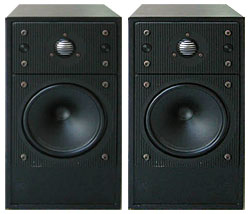
Celestion 3: $250/pairWith the exception of Infinity's Infinitesimal from the early 1980s, the short-lived AR-1M, and Koss's various permutations on their "Dyna-Mite" design (footnote 1), it seems a peculiar European obsession to try to make tiny loudspeakers capable of genuine hi-fi performance. England, in particular, has led the world in these Lilliputian endeavors, with first the venerable LS3/5a redefining what a speaker should produce in terms of imaging accuracy, then the Linn Kan showing that this performance needn't be at the expense of dynamics and musical feel. The various generations of the Wharfedale Diamond showed that small and cheap didn't necessarily mean "unmusical." Then, at the 1989 Las Vegas CES, Celestion raised the stakes by introducing a speaker intended to sell for just $250/pair that nevertheless featured a metal-dome tweeter! The Celestion 3 uses a 1" titanium-dome HF unit with a narrow surround to cover the two audio octaves from 5kHz on up. This is constructed on a rectangular plastic plate that bolts to the baffle, with three narrow, horizontal strips providing a degree of protection. Covering what in effect is the remaining 61/3 octaves is a conventional-looking paper-cone unit, again constructed on a rectangular plastic plate. A large half-roll surround suggests some serious excursion capability; bass alignment is sealed-box.
With the speakers out in the room on the 24" stands in the same positions where the Spica TC-50s had sounded reasonably rich, the sound of the 3s was unmusically thin—it was hard to believe that there was any bass reproduction at all. The 3 is definitely a loudspeaker needing all the help it can get in the lows, and I ended up with them 3" away from the rear wall. (This is also a big plus point, in my opinion, as those restricted to a loudspeaker budget of $250/pair will undoubtedly have small rooms where a pair of speakers out in the room will represent an imposition.) In their terse but comprehensive manual, Celestion recommends a minimum spacing of 2", but warns against placing the speakers too close to the side walls, 24" being the absolute minimum. Having settled on optimum siting and then broken the speakers in for a day with the appropriate Kraftwerk album—an album recorded by machines, it seems only fitting that I not be in the room when it was playing—I sat down to some intensive listening. Well, the 3 is still a small loudspeaker, there still being no low bass to speak of. However, the rear-wall placement does usefully bring up the upper bass—electric bass and double bass now both purring appropriately—at the expense of adding a slight chestiness to male speaking voice. Low-frequency definition was still quite good, however, with bass instruments sounding quite "fast." The exact listening axis and degree of toe-in proved quite critical. Sitting so that you can see the cabinet top, the midrange sounds too hollow. With the listener directly on the tweeter axis, the presence region becomes a little too lively, but when the speakers were facing straight ahead, the extreme HF sounds a little depressed, imaging specificity suffers, and a hardness in the lower treble is accentuated. Ultimately, I found the sound to be best integrated across the upper midrange and treble when the speakers were toed-in a little, but not all the way to the listening position.
Should Stereophile's readers be considering a speaker as inexpensive as the Celestion 3? It depends on their individual needs. A pair of good stands will add at least $100 to the price, which starts to put the 3s' price nearer that of such floor-standing bargains as the $495/pair Magnepan SMGas. The little Maggies will go louder than the 3s, with lower levels of midband coloration. However, they do need considerably more room to breathe than the Celestions, and can't be placed near a rear wall. For someone on a restricted budget, with a small listening room, therefore, a pair of 3s on good stands will mate well with inexpensive electronics (provided that these don't have too dry or bright a treble) to produce what, while not scaling high-end heights, will almost always be a musical sound, without significant failings.
Footnote 1: I don't consider the Bose Roommate to have hi-fi pretensions.















