

Sidebar 1: Equalization Setup
To set the Classé's parametric equalization filters, I used the Dayton Audio OmniMic measurement system. While less sophisticated than the setup John Atkinson uses for his in-room measurements, this relatively affordable device ($298 list) is a way for the tech-savvy audiophile to make good use of the PEQ offered in the Sigma 2200i.
The measurements I made were performed at the listening seat, with 1?6-octave smoothing. I made only single-point (not position-averaged) readings, as that was the only way to ensure consistent microphone positions pre- and post-equalization. As for my listening, the speakers were my Monitor Audio Silver 10s, and the subwoofer, when used, was a Revel B15.
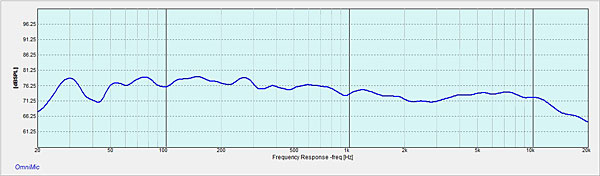
The pre-equalized result for the left speaker (fig.1) was taken only with the treble control on +1, and show the sort of bass lumpiness found in all too many listening rooms. The deepest bass was down in level, with a significant dip in both channels at around 40Hz, though this recovered somewhat at 30Hz. A broad elevation centered at around 100Hz leveled out above 400Hz. The latter isn't surprising, as most room-caused response errors occur below this frequency. (It's also possible that some of this rise could be due to the speakers themselves.) Altering the listener and/or speaker positions can often help with this—and should be tried before equalization, if possible—but in my situation the left and right front speakers, and my listening seat, must be placed to accommodate a projection screen for my work for Sound & Vision magazine. The screen is retracted for serious music listening, as for this review, but only small tweaks of the speaker positions are possible.

 The measured response with a well-positioned and equalized subwoofer in the system, using the high/low-pass filter configuration set to 24dB/octave at 80Hz (fig.3), was dramatically better than with the main speakers alone. But, as I describe in the review, this didn't work well in my situation, due to subwoofer limits and my very large listening space.—Thomas J. Norton
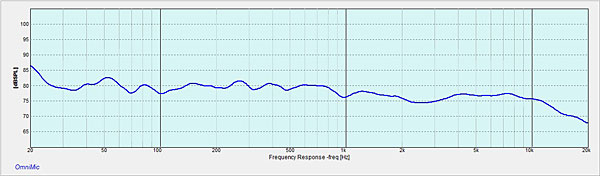
Fig.1 Monitor Audio Silver 10 (left), 1/6-octave response at listening position without EQ.
I used all of the Sigma 2200i's available parametric equalizers: six per channel. The post-equalization response was much smoother (fig.2). The rise at 30Hz and the dip at 40Hz couldn't be completely tamed (each band of equalization is limited to a maximum of +3dB for good reason), but the remainder of the response is relatively smooth, with a desirable downward slope from below 100Hz to 10kHz; still, some experts might prefer a more aggressive slope.
Fig.2 Monitor Audio Silver 10 (left), 1/6-octave response at listening position with EQ provided by Classé Sigma 2200i.
None of the equalization I employed here, either with or without the subwoofer, was above 400Hz. I wanted to keep the characteristic sound of the Silver 10s as close to their unequalized state as possible across the critical midrange and highs. I wouldn't be using these speakers if I didn't like the way they sounded!
Fig.3 Monitor Audio Silver 10 (left) with Revel B15 subwoofer, 1/6-octave response at listening position with EQ provided by Classé Sigma 2200i.















