

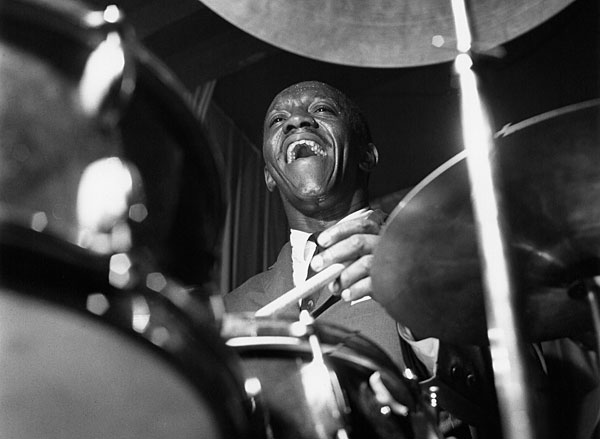
Art Blakey (photo by Francis Wolff, courtesy of Blue Note)
Celebrated New York City–based jazz drummer Billy Drummond recalls his first visit, with the group OTB ("Out of The Blue"), to the Mount Fuji Jazz Festival in Yamanashi Prefecture, Japan. It was 1988. The Festival's elite drummers ranged in age from 69 (Art Blakey) to 26 (Ralph Peterson). In between were Roy Haynes, Tony Williams, Clifford Barbaro, Victor Lewis, Lewis Nash, Kenny Washington, Cindy Blackman—"and me," Drummond told me, by phone.

Billy Drummond (photo by Roberto Cifarelli)
Drummond, who is working on his fourth album as leader and teaches drumming at Julliard and NYU, continued. "Everyone was killing, then Roy Haynes played, and he's taking it out. He walked to the front of the stage and played an entire solo on the hi-hat. The people went berserk. We're going nuts. Afterwards, Haynes comes off the stage and says to us, 'Take that you young m***** ******s!' We fell out, because he just served us, man. Remarkable."

Cindy Blackman (photo by Hal Miller).
Art Blakey. Roy Haynes. Tony Williams—three of the greatest jazz drummers ever. Blackman, Nash, Peterson (footnote 1), Washington, Drummond: Five of the best young jazz drummers of the era.

Paul Wells (photo by John Rogers).
I interviewed Drummond—who played on the Stereophile album Rendezvous—for this article, seeking his commentary on the best drummers in the history of jazz: what made them special, what to listen for in their music. I also talked to Paul Wells, the drummer for Vince Giordano's Nighthawks, who play mainly jazz from the '20s and '30s. Wells's repertoire is much wider than that, though: He has also worked with the Vanguard Jazz Orchestra, the Jazz at Lincoln Center Orchestra, Wynton Marsalis, and Elvis Costello, among others. You can hear him on the soundtracks of The Irishman, Boardwalk Empire, and The Marvelous Mrs. Maisel. He's a Professor of Jazz Drums at the Juilliard School and an audiophile.

John Riley (photo by Kengo)
I also talked to John Riley, the drummer who replaced the legendary Mel Lewis in the Village Vanguard Orchestra (formerly the Thad Jones/Mel Lewis Orchestra) after the latter passed in 1990. Riley has recorded dozens of albums and written a book, The Art of Bop Drumming. He is a Professor of Music at Manhattan School of Music and at Kutztown University in Pennsylvania.
Much of the commentary that follows is from Drummond, Wells, and Riley. Uncredited commentary is from me.

Baby Dodds (photo by William Gottlieb).
A concise jazz historyJazz drumming can be traced to the drum circles of Congo Square, in New Orleans, which birthed the "hot jazz" styles of the 1910s and '20s, later called "trad jazz" or "Dixieland." The most prominent jazz groups of the era include Jelly Roll Morton's Red Hot Peppers, Louis Armstrong's Hot Fives and Sevens, and Johnny Dodds's Black Bottom Stompers. The New Orleans drummers in these bands—"Baby" Dodds, Zutty Singleton, etc.—laid the foundation for contemporary jazz drumming. Even before Dixieland launched jazz as an art form—before the first "jass" recording—James Lent recorded a drum solo, "The Ragtime Drummer," in 1912, a swinging workout of brash rudimental rolls, playful temple blocks, and zippy brass, climaxing in a forceful snare drum solo. The first jazz drum solo preceded jazz. Dixieland's popularity led to the swing craze of the late '30s and '40s, when the music was at its most popular, when drummers Gene Krupa and Buddy Rich and bandleaders including Benny Goodman and Artie Shaw—not to mention Duke Ellington and Count Basie—became international celebrities.
"All of these drummers had a certain energy in the way they hit the drums and how they played accents—a certain pop and tightness combined with a way of phrasing eighth notes," Wells told me. "It's a consistent sound, the feeling and energy of Black American music, and it's present throughout the history of this music."
Warren "Baby" Dodds had a long career and played with King Oliver, Louis Armstrong, and Sidney Bechet. It's hard to hear the drums on some historic recordings, but Dodds's drums are clear enough on Footnotes to Jazz, Vol. 1: Talking and Drum Solos. Dodds was well known for his "shimmy beat," which he described in his autobiography: "One night a French soldier came in. When he heard the music, he couldn't dance to it, but he just started to shake all over. That's the way it affected me. I saw him do it, and I did it, too."—Wells Zutty Singleton played a lot of press rolls, a lot of colors. He might play snare drum time for the first chorus, then accents on the tom-toms and little cymbal hits. Zutty's on Louis Armstrong's Hot Five recordings, including "West End Blues," where he plays "pop" cymbals, a precursor to the hi-hat.—Wells Paul Barbarin: Drumming style was changing, early jazz melding into swing; timekeeping moved from the snare drum to the hi-hat. Barbarin did both, depending on the era. In the '30s, Barbarin played with the Louis Armstrong Orchestra on a ton of great recordings. "Cuban Pete," with Armstrong, has Barbarin playing in a swing style, playing time on the hi-hats.—Wells
Gene Krupa was a swing-era superstar, perhaps most famous for Benny Goodman's "Sing, Sing, Sing." On Goodman's "Sometimes I'm Happy," Krupa plays brushes in traditional style, moves to the cymbal for the trumpet solo, press-rolls on the snare drum, then keeps time on the hi-hat during the brass shout.—Wells "Papa" Jo Jones's style of playing time on the hi-hat was revolutionary. It felt great, especially with bassist Walter Page in Count Basie's band. He was one of the first drummers to play time on the ride cymbal.—Wells

Kenny Clarke
1950s and '60s landmark drummersKenny Clarke was an extraordinarily innovative pioneer of bebop styles and one of the most in-demand drummers for record and jazz dates until '56, when he moved to Paris and never came back. He was practically the house drummer for Savoy Records.—Wells

Louie Bellson
Louie Bellson pioneered double bass drums. He made many records as a sideman, particularly on Verve and Pablo. Bellson was in Ellington's band in the early '50s, which is significant because it was unusual for a white drummer to join a major Black band during that period.—Wells

Max Roach (photo by William Gottlieb)
Max Roach developed a jazz language between the individual drums, an accompaniment language, and a soloing language still used today. An entire vocabulary of patterns, ideas, and melodic figures came out of Max's genius. He defined the bebop drum sound using smaller tom-toms tuned very high that were clean and articulate.—Wells
Footnote 1: Ralph Peterson died last year at age 58.















