Sidebar 3: Measurements
I measured the Constellation Performance Centaur II 500 using my Audio Precision SYS2722 system (see the January 2008 "As We See It"). Before I test an amplifier, I precondition it with both channels driving a 1kHz tone at one-third power into 8 ohms for an hour. At the end of that time, the Constellation's enclosure was hottest toward the rear of the top panel, at 101.3°F (38.5°C).
The voltage gain at 1kHz from the speaker terminals into 8 ohms measured 25.9dB for both balanced and unbalanced signals, and 12dB for the Direct input. All sets of inputs preserved absolute polarity (ie, were non-inverting). The unbalanced input impedance was 10k ohms and the balanced input impedance 20k ohms, both from 20Hz to 20kHz. These impedances are significantly lower than the specified 100k ohms unbalanced and 200k ohms balanced, but are identical to those published for the original Centaur II amplifier.
The output impedance, including a 6', spaced-pair speaker cable, was a very low 0.08 ohm at low and middle frequencies, rising to 0.1 ohm at the top of the audioband. As a result, the modulation of the Constellation's frequency response with our standard simulated loudspeaker was less than ±0.1dB (fig.1, gray trace). The Centaur II 500's frequency response into 8 ohms was down by just 0.5dB at 200kHz (fig.1, blue and red traces); as a result, a 10kHz squarewave was reproduced with very short risetimes (fig.2), and there was no overshoot or ringing. Fig.1 reveals that the ultrasonic output rolls off a little earlier with lower impedances, but the response into 2 ohms (green trace) is still flat within the audioband.


 The Centaur II 500 is specified as outputting 500Wpc into 8 ohms (27dBW), 1000Wpc into 4 ohms (27dBW), or 1600Wpc into 2 ohms (26dBW). With clipping defined as when the THD+noise in the output reaches 1%, I measured clipping powers of 550Wpc into 8 ohms (27.4dBW, fig.4) and 880Wpc into 4 ohms (26.4dBW, fig.5). While this latter power is less than specified, note that I do not hold the wall voltage constant during these tests. The 0.6dB measured shortfall into 4 ohms will not be any kind of problem. However, when I tried to measure the maximum output power into 2 ohms with one channel driven, that channel turned off at 700W (22.4dBW) and wouldn't turn back on. Each channel is protected by two 10A and two 30A fuses, and it turned out that one of the 10A fuses had blown. Replacing the fuse brought that channel back to life.


 The THD+N waveform at this level into 8 ohms (fig.7) indicates that the distortion is predominantly third-harmonic in nature, at –80dB (0.01%), though there was also some second harmonic present in the left channel (fig.8, blue trace). At the same voltage into 4 ohms (fig.9), the third harmonic dropped and the second harmonic became the highest in level in both channels, and was almost matched by the fifth harmonic at –94dB (0.002%). Tested with an equal mix of 19 and 20kHz tones, the Constellation produced low levels of intermodulation distortion, even at high powers into low impedances (fig.10), with the difference product at 1kHz lying at –86dB (0.005%), and the higher-order products at or below –84dB (0.006%).


Fig.1 Constellation Centaur II 500, frequency response at 2.83V into: simulated loudspeaker load (gray), 8 ohms (left channel blue, right red), 4 ohms (left cyan, right magenta), 2 ohms (green) (1dB/vertical div.).
Fig.2 Constellation Centaur II 500, small-signal 10kHz squarewave into 8 ohms.
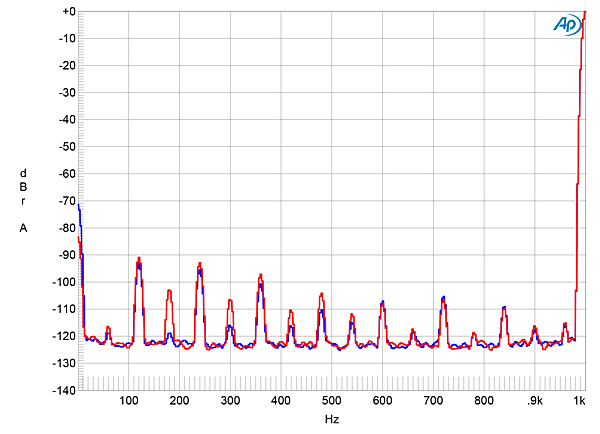
Channel separation was >90dB in both directions in the midrange and below, and still 83dB at the top of the audioband. The unweighted, wideband signal/noise ratio, taken with the inputs shorted to ground, was a high 74.1dB ref. 1W into 8 ohms. This ratio improved to an excellent 85dB when the measurement bandwidth was restricted to 22Hz–22kHz, and to 89dB with an A-weighting filter in circuit. Spectral analysis of the low-frequency noise floor (fig.3) indicated that the AC power-supply–related harmonics were primarily at 120Hz and its harmonics, but some odd-order harmonics of the 60Hz line frequency were present in the right channel (red trace). All of these spuriae lay at or below –90dB (0.003%), however.
Fig.3 Constellation Centaur II 500, spectrum of 1kHz sinewave, DC–1kHz, at 1W into 8 ohms (left channel blue, right red; linear frequency scale).
Fig.4 Constellation Centaur II 500, distortion (%) vs 1kHz continuous output power into 8 ohms.
Fig.5 Constellation Centaur II 500, distortion (%) vs 1kHz continuous output power into 4 ohms.
To be certain that I was measuring actual distortion, I examined how the M15's percentage of THD+N varied with frequency at a fairly high level: 20V (equivalent to 50W into 8 ohms, 100W into 4 ohms, and 200W into 2 ohms). The percentage of THD+N was extremely low in the bass and midrange (fig.6), and while there was the usual rise in the treble due to the decrease in open-loop voltage gain as the frequency increases, this was still not to a significant amount.
Fig.6 Constellation Centaur II 500, THD+N (%) vs frequency at 20V into: 8 ohms (left channel blue, right red), 4 ohms (left cyan, right magenta), 2 ohms (gray).
Fig.7 Constellation Centaur II 500, 1kHz waveform at 50W into 8 ohms, 0.0012% THD+N (blue); distortion and noise waveform with fundamental notched out (red, not to scale).
Fig.8 Constellation Centaur II 500, spectrum of 50Hz sinewave, DC–1kHz, at 80W into 8 ohms (left channel blue, right red; linear frequency scale).
Fig.9 Constellation Centaur II 500, spectrum of 50Hz sinewave, DC–1kHz, at 160W into 4 ohms (left channel blue, right red; linear frequency scale).
Fig.10 Constellation Centaur II 500, HF intermodulation spectrum, DC–30kHz, 19+20kHz at 160W peak into 4 ohms (left channel blue, right red; linear frequency scale).
Its measured performance indicates that Constellation's Centaur II 500 is a powerhouse of an amplifier.—John Atkinson