

Sidebar 3: Measurements
I used DRA Labs' MLSSA system and a calibrated DPA 4006 microphone to measure the Arabesque Minissimo Diamond's frequency response in the farfield, and an Earthworks QTC-40 for the nearfield and in-room responses.
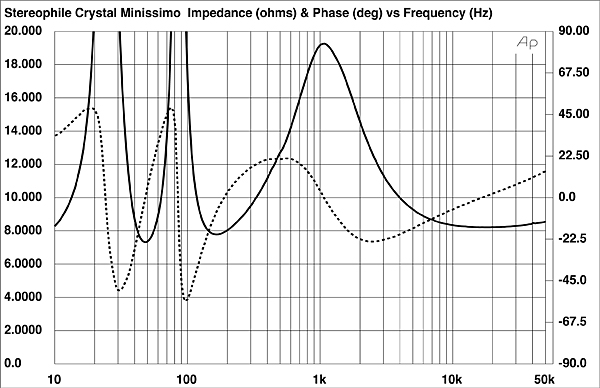
My estimate of the Minissimo Diamond's voltage sensitivity was 81dB/2.83V/m, which is both well below average and lower than the specified 83.5dB. This speaker needs a relatively powerful amplifier to play at satisfactory levels, but as it has a small-diameter woofer, its user will have to be careful not to overdrive it. However, as the solid trace in fig.1 reveals, it is a very easy load for the partnering amplifier to drive, with an impedance that remains above the specified 8 ohms for much of the audioband, and a minimum magnitude of 7.8 ohms at 177Hz. The electrical phase angle (fig.1, dotted trace) is generally benign; when it is extreme, at two instances in the bass, the magnitude is very high, ameliorating any drive difficulty.
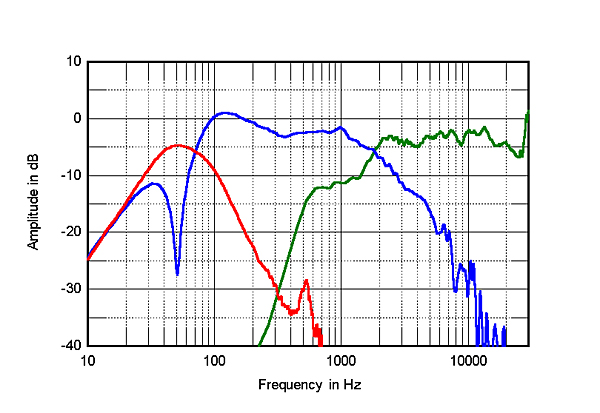
 Visible in the right-hand portion of fig.2 is the Minissimo Diamond's acoustic crossover on the tweeter axis. The woofer (blue trace) hands off to the tweeter (green) at the specified 1.8kHz. The tweeter's average level appears to be a couple of dB lower than that of the woofer, and while the crossover filter slopes appear gentle, the woofer's upper-frequency rolloff is clean. The apparent rise in the woofer's output in the upper bass will be due in part to the nearfield measurement technique, which assumes that the drive-unit is mounted in a baffle that extends to infinity in both planes. The sharply defined notch at 51Hz in the woofer's output indicates that this is the tuning frequency of the port that fires down from the speaker's base, and the port's response (red trace) peaks between 35 and 90Hz. The port's output rolls off smoothly, and though a peak can be seen at 520Hz, this is well down in level.


 In the bass, neither the Crystal nor the KEF have much output apparent below 50Hz, even with the help of the lowest mode in my room, around 32Hz. But the higher-Q tuning of the Minissimo's woofer results in a little too much upper-bass energy in-room compared with the LS50.
One thing I noted while doing these in-room measurements was that while the two Minissimo Diamonds matched very well in the midrange and treble, the left speaker, featured in figs. 2 and 3, had more energy apparent between 25 and 30kHz than the right. It's fair to note that this would have had no effect on my auditioning, as my hearing sensitivity dies above 15kHz.
Turning to the time domain, the Minissimo Diamond's step response on the tweeter axis (fig.7) reveals that while the woofer is connected in positive acoustic polarity, the tweeter's polarity is inverted. However, of greater importance is the fact that the decay of the tweeter's step (the sharp down/up spike at 3.75ms) blends smoothly with the start of the woofer's step. While the Crystal speaker's output isn't time-coincident—possible with a first-order crossover only if the baffle tilts back to align the drive-units' acoustic centers—it is time-coherent. Finally, the Minissimo Diamond's cumulative spectral-decay or waterfall plot (fig.8) is impressively clean, suggesting that the diamond-diaphragm tweeter's first breakup mode doesn't occur until 30kHz or so.
In the bass, neither the Crystal nor the KEF have much output apparent below 50Hz, even with the help of the lowest mode in my room, around 32Hz. But the higher-Q tuning of the Minissimo's woofer results in a little too much upper-bass energy in-room compared with the LS50.
One thing I noted while doing these in-room measurements was that while the two Minissimo Diamonds matched very well in the midrange and treble, the left speaker, featured in figs. 2 and 3, had more energy apparent between 25 and 30kHz than the right. It's fair to note that this would have had no effect on my auditioning, as my hearing sensitivity dies above 15kHz.
Turning to the time domain, the Minissimo Diamond's step response on the tweeter axis (fig.7) reveals that while the woofer is connected in positive acoustic polarity, the tweeter's polarity is inverted. However, of greater importance is the fact that the decay of the tweeter's step (the sharp down/up spike at 3.75ms) blends smoothly with the start of the woofer's step. While the Crystal speaker's output isn't time-coincident—possible with a first-order crossover only if the baffle tilts back to align the drive-units' acoustic centers—it is time-coherent. Finally, the Minissimo Diamond's cumulative spectral-decay or waterfall plot (fig.8) is impressively clean, suggesting that the diamond-diaphragm tweeter's first breakup mode doesn't occur until 30kHz or so.
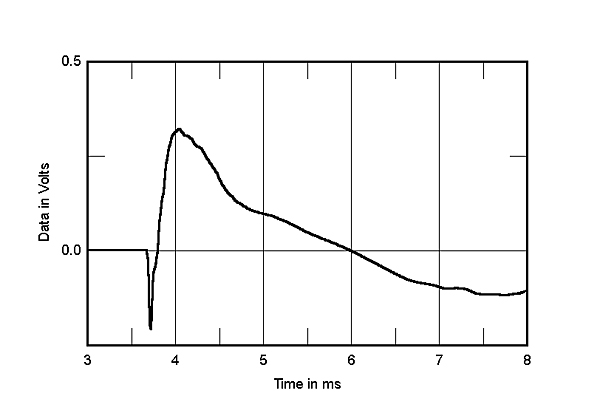
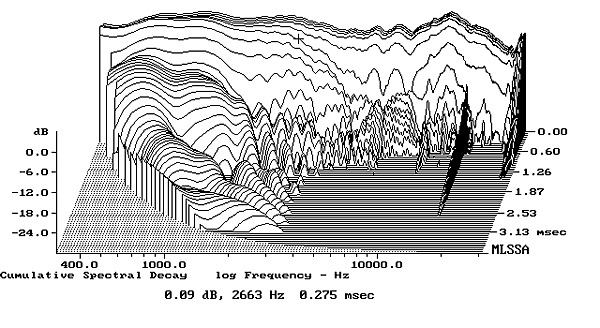
Fig.1 Crystal Minissimo Diamond, electrical impedance (solid) and phase (dashed) (5 ohms/vertical div.).
There are no wrinkles in the impedance traces that would suggest the presence of cabinet-wall resonances, and the unusually shaped enclosure felt inert to a knuckle-rap test. However, I did find a couple of high Quality factor (Q) modes present at narrowly defined places on the enclosure's baffle and top and bottom panels, at 463, 485, and 560Hz.
Fig.2 Crystal Minissimo Diamond, acoustic crossover on tweeter axis, corrected for microphone response, with nearfield responses of woofer (blue) and port (red), plotted in the ratios of their radiating diameters.
Fig.3 shows the Crystal's response averaged across a 30° horizontal window centered on the tweeter axis, spliced at 300Hz to the complex sum of the nearfield woofer and port responses. The response rolls off with the usual fourth-order slope below 80Hz to reach –6dB at the port tuning frequency, and again, the boost in the upper bass is mostly due to the nearfield measurement technique.
Fig.3 Crystal Minissimo Diamond, anechoic response on tweeter axis at 50", averaged across 30° horizontal window and corrected for microphone response, with complex sum of nearfield woofer and port responses plotted below 300Hz.
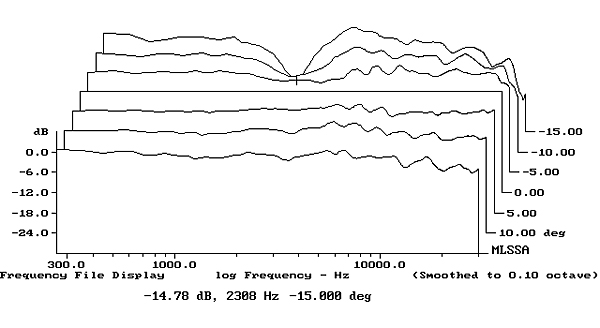
The tweeter's level is now 4–5dB below that of the speaker in the midrange, which is due not only to the relative levels of the two drive-units seen in fig.2, but also to the tweeter's output becoming increasingly directional above 7kHz (fig.4). Below that frequency, however, the Crystal speaker's dispersion is wide and even—which, all else being equal, correlates with stable, accurate stereo imaging. In the vertical plane (fig.5), the response doesn't change significantly for several degrees below the tweeter axis, which is 36" from the floor, but a suckout in the low treble does develop above the tweeter axis.
Fig.4 Crystal Minissimo Diamond, lateral response family at 50", normalized to response on tweeter axis, from back to front: differences in response 90–5° off axis on large curved side, reference response, differences in response 5–90° off axis on small curved side.
Fig.5 Crystal Minissimo Diamond, vertical response family at 50", normalized to response on tweeter axis, from back to front: differences in response 15–5° above axis, reference response, differences in response 5–15° below axis.
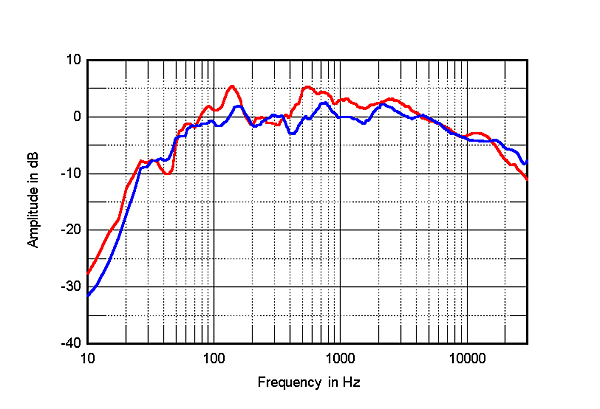
Over the years, I have found that a speaker's spatially averaged response, which integrates the speakers' direct sound with the in-room energy generated by the speakers, correlates relatively well with its perceived balance. I average 20 1/6-octave–smoothed spectra, individually taken for the left and right speakers using SMUGSoftware's FuzzMeasure 3.0 program and a 96kHz sample rate, in a rectangular grid 36" wide by 18" high and centered on the positions of my ears. This mostly eliminates the room acoustic's effects, and in fig.6 I have overlaid the Crystal's response (red trace) with that of the similarly sized KEF LS50 (blue) so that their mid–high-treble outputs are similar in level. The Dutch speaker thus appears to produce too much upper-midrange energy compared with the British speaker; if the music being played allows the listener's ears to latch on to the treble output as its reference, the Minissimo Diamond will sound a little midrange-dominant. But if the music makes the listener take the midrange as being correct in level, the upper octaves will then sound too mellow.
Fig.6 Crystal Minissimo Diamond, spatially averaged, 1/6-octave response in JA's listening room (red); and of KEF LS50 (blue).
Fig.7 Crystal Minissimo Diamond, step response on tweeter axis at 50" (5ms time window, 30kHz bandwidth).
Fig.8 Crystal Minissimo Diamond, cumulative spectral-decay plot on tweeter axis at 50" (0.15ms risetime).
In many respects, Crystal Cable's Arabesque Minissimo Diamond offers respectable measured performance. But its deliberately tailored treble response is going to make judgments of the speaker's sound quality dependent on the music being played, as I found in my auditioning.—John Atkinson















