

Sidebar 3: Measurements
I used DRA Labs' MLSSA system and a calibrated DPA 4006 microphone to measure the Callisto 6 C's frequency response in the farfield, and an Earthworks QTC-40 mike for the nearfield and in-room responses. I fed the test signals to one of the speaker's analog inputs. The volume control is deactivated with the analog input, and the DALI's specified sensitivity with analog signals is 1.85V for maximum output. Pink noise with a level of 100mV RMS gave a sound pressure level of 91dB(B) at 1m on the supertweeter axis. The volume control is active with digital input signals fed via the Sound Hub; with the volume set to two-thirds (33 out of the maximum of 50), which is the level I used for most of my classical-music auditioning, pink noise at –20dBFS resulted in an spl of 85.0dB(C) on the supertweeter axis at 1m. The Callistos will have no problem playing at satisfyingly loud levels.
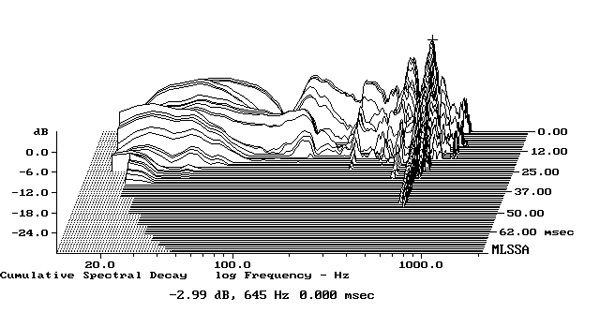
When I investigated the enclosure's vibrational behavior with a plastic-tape accelerometer, I found some resonant modes in the upper midrange on the side panels, the strongest of which lay at 645Hz (fig.1). This mode was accompanied by another at 545Hz on the back panel. Both modes were audible with a stethoscope but were relatively low in level and, coupled with their high frequencies, shouldn't result in any midrange congestion at the listening position.
 The two woofers appear to behave identically, as do the two ports. The blue trace in fig.2 shows the sum of the woofers' outputs, measured in the nearfield and plotted below 300Hz. It has the expected minimum-motion notch at 38Hz, which is the frequency where the back pressure from the reflex port resonance holds the woofer cones stationary. The summed outputs of the ports, again measured in the nearfield (red trace), plotted in the ratios of the square roots of the radiating areas of the ports and woofers, peaks between 25 and 50Hz. The ports' upper-frequency rolloff is smooth through the upper-bass region, but there are then two low-level resonant modes apparent in the midrange and a higher-level mode just above 900Hz. I could just hear this resonance as a slight whistle with my ear close to the ports, but it was inaudible at the listening position.
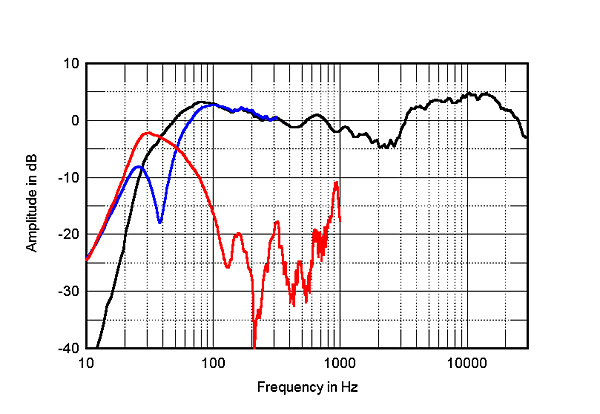 Higher in frequency, in fig.2, the black trace shows the DALI's farfield response, taken without the grilles and averaged across a 30° horizontal window centered on the supertweeter axis. Although the midrange balance is even, there is then a lack of energy between 1kHz and 3kHz, above which the region covered by the two tweeters is 3–5dB too high in level. This behavior is not dissimilar to that of DALI's Rubicon 8; as with that speaker, it is why DALI recommends firing the Callistos straight ahead rather than toeing them in to the listening position.
The plot of the Callisto 6 C's horizontal dispersion (fig.3) indicates that the speaker starts to become increasingly directional as the frequency rises throughout the treble. As I found in my auditioning, the DALI's balance in the top two octaves can be fine-tuned by experimenting with toe-in if the sound lacks "air" when the loudspeakers are firing straight ahead. The Callisto's vertical dispersion is shown in fig.4, normalized to the supertweeter axis, which is 37" from the floor. A suckout in the crossover region develops more than 5° above that axis, while the lack of energy in the low treble tends to fill in 5–10° below that axis. That represents an unusually low ear height, however.
Higher in frequency, in fig.2, the black trace shows the DALI's farfield response, taken without the grilles and averaged across a 30° horizontal window centered on the supertweeter axis. Although the midrange balance is even, there is then a lack of energy between 1kHz and 3kHz, above which the region covered by the two tweeters is 3–5dB too high in level. This behavior is not dissimilar to that of DALI's Rubicon 8; as with that speaker, it is why DALI recommends firing the Callistos straight ahead rather than toeing them in to the listening position.
The plot of the Callisto 6 C's horizontal dispersion (fig.3) indicates that the speaker starts to become increasingly directional as the frequency rises throughout the treble. As I found in my auditioning, the DALI's balance in the top two octaves can be fine-tuned by experimenting with toe-in if the sound lacks "air" when the loudspeakers are firing straight ahead. The Callisto's vertical dispersion is shown in fig.4, normalized to the supertweeter axis, which is 37" from the floor. A suckout in the crossover region develops more than 5° above that axis, while the lack of energy in the low treble tends to fill in 5–10° below that axis. That represents an unusually low ear height, however.


 In the time domain, the Callisto 6 C's step response (fig.6) suggests that the ribbon tweeter—the sharply defined down/up spike at 3.7ms—is connected in inverted acoustic polarity, while the dome tweeter and the woofers are connected in positive acoustic polarity. The positive-going decay of the supertweeter's step smoothly blends with the start of the dome tweeter's step, which suggests an optimally implemented blend between them. The slight discontinuity at 3.75ms reinforces the implication of the vertical radiation pattern in fig.4 that the best integration of the outputs of the tweeter and woofers actually occurs just below the tweeter axis. The DALI's cumulative spectral-decay plot (fig.7) is very clean, if not quite equaling that of the DALI Rubicon 8 in this respect.
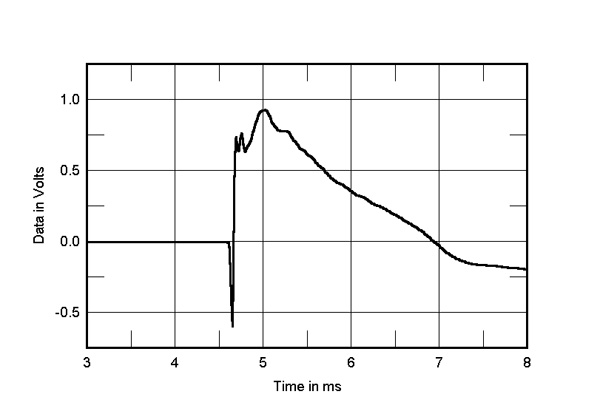
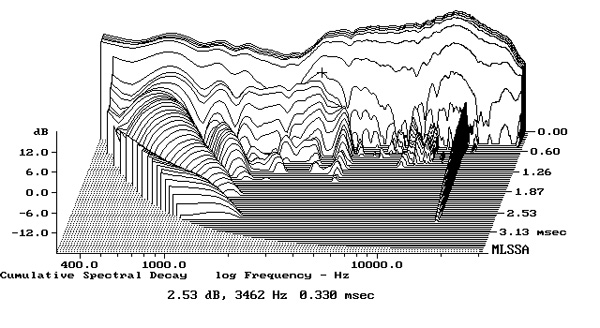
Fig.1 DALI Callisto 6C, cumulative spectral-decay plot calculated from output of accelerometer fastened to sidewall level with upper woofer (measurement bandwidth, 2kHz).
Fig.2 DALI Callisto 6C, anechoic response on supertweeter axis at 50", averaged across 30° horizontal window and corrected for microphone response, with the nearfield midrange woofer (blue), and port (red) responses and their complex sum (black), respectively plotted below 350Hz, 1kHz, and 300Hz.
The black trace below 300Hz in fig.2 shows the complex sum of the nearfield woofer and port responses, taking into account acoustic phase and the different distances of each radiator from a nominal farfield microphone position. The rise in the mid- and upper-bass is due to the nearfield measurement technique but is lower than usual, suggesting that the Callisto 6 C's woofer alignment is tuned for articulation rather than maximum low-frequency extension, as described by DALI's Lars Worre.
Fig.3 DALI Callisto 6C, lateral response family at 50", normalized to response on supertweeter axis, from back to front: differences in response 90–5° off axis, reference response, differences in response 5–90° off axis.
Fig.4 DALI Callisto 6C, vertical response family at 50", normalized to response on supertweeter axis, from back to front: differences in response 15–5° above axis, reference response, differences in response 5–15° below axis.
I examined the Callisto 6 C's spatially averaged response in my listening room, with the speakers toed-in by 5°, which is how I ended up using them. (For this I average 20 1/6-octave–smoothed spectra, taken using a 96kHz sample rate, first for the left-hand speaker then for the right-hand speaker in a vertical rectangular grid 36" wide by 18" high and centered on the positions of my ears.) The result is shown in fig.5 (red trace). For reference, this graph also shows the spatially averaged response of the similarly sized Joseph Audio Perspective2 Graphene (blue trace), which I reviewed in July 2019. The two speakers produce remarkably similar in-room responses in the midrange and bass, where the effects of the room's acoustic modes below 300Hz or so dominate a speaker's intrinsic behavior. The Callisto 6 C's lack of energy between 1kHz and 3kHz in the quasi-anechoic response has almost completely filled-in in this graph, and while the DALI has more energy in the mid- and high treble than the Perpective2, this is not to as extreme a degree as fig.2 would suggest.
Fig.5 DALI Callisto 6C, spatially averaged, 1/6-octave response in JA's listening room (red), and of Joseph Perspective2 Graphene (blue).
Fig.6 DALI Callisto 6C, step response on supertweeter axis at 50" (5ms time window, 30kHz bandwidth).
Fig.7 DALI Callisto 6C, cumulative spectral-decay plot on supertweeter axis at 50" (0.15ms risetime).
Overall, the Callisto 6 C offers good measured performance, its on-axis behavior carefully balanced by its horizontal and vertical dispersion.—John Atkinson















