

Sidebar 2: Measurements
I began the measurements with the Listening Environment Diagnostic Recording (LEDR) described by Bob Katz in Vol.12 No.12 and found on the Chesky Jazz Sampler CD. The LEDR test consists of a sampled cabasa (a percussion instrument) that has had its sound manipulated by a computer to give the illusion of the instrument moving in three-dimensional space. Three tests comprise LEDR: in "Up," the sound should appear to move up in a straight line from the loudspeaker; the "Over" test is also called the "rainbow" since the image should follow a rainbow-shaped arc above the two loudspeakers; and the "Lateral" test should produce an image that moves in an unbroken straight line from one loudspeaker to the other. The LEDR test reveals a loudspeaker's ability to throw an image, provided the listening room itself doesn't destroy the imaging.
The Dana Model 1s did fairly well on the "Up" test, but with the image stopping below the point heard through the Hales Signatures. The "Over" test was better, but with some discontinuities in the image. The "Lateral" was fairly good, the Model 1s producing a stable image between the loudspeakers.
I drove the Model 1s with a variable-frequency sinewave oscillator, with my hand on the cabinet to detect resonances. Surprisingly, the 1s exhibited no major cabinet resonances. Instead, there were many low-Q resonances throughout the entire low-frequency band. The highest-amplitude resonance was at 170Hz, when there was a buzzing sound from the cabinet.
The Model 1's impedance magnitude and phase are shown in fig.1. The overall impedance is quite high, dropping near the 8 ohm specification below about 40Hz and again at 200Hz. In addition, the phase angle is minimal throughout the midrange and treble. The Model 1 should thus be an easy load to drive. The sealed-box woofer tuning is revealed by the narrow impedance peak centered on 73Hz.


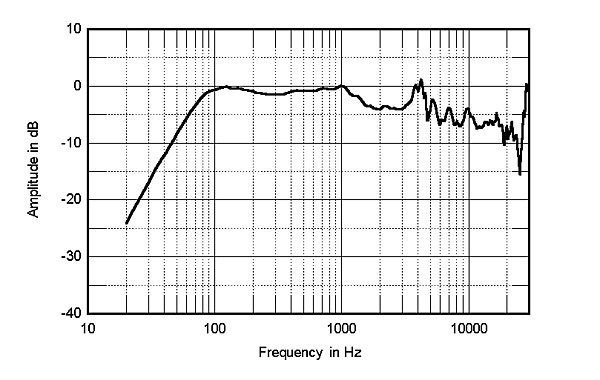
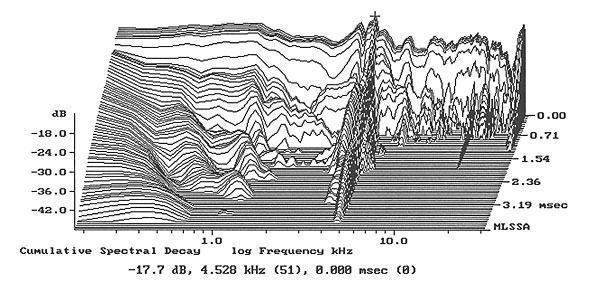
Fig.1 Dana Model 1, electrical impedance (solid) and phase (dashed) (2 ohms/vertical div.).
Looking at the time domain, fig.2 shows the anechoic portion of the Model 1's impulse response taken at 48" on the tweeter axis. I was able to get a fairly long anechoic "window" by placing the Model 1s on stacked Celestion stands, which, coupled with my listening room's high ceiling, pushed the first reflections more than 5ms away from the loudspeaker's direct response. (The frequency resolution of these FFT tests is proportional to the time window before the first reflection of the pulse, normally that from the floor, arrives at the microphone position. 5ms' worth of anechoic impulse response corresponds, therefore, to 200Hz resolution.) The jaggedness after the initial pulse is most likely the result of a tweeter resonance.
Fig.2 Dana Model 1, impulse response on tweeter axis at 48" (5ms time window, 30kHz bandwidth).
Fig.3 shows the Model 1's FFT-derived frequency response averaged over a 30° lateral window. A nearfield measurement of the woofer, taken with the microphone capsule almost touching the dustcap, has been appended to the left-hand side of the spatially averaged frequency response, revealing a –6dB point at 58Hz, correlating with the 73Hz woofer tuning. The woofer's rolloff is 12dB/octave, as expected from the sealed-box alignment. The midrange is remarkably smooth up to about 4kHz, while the overall lower level of treble energy apparent in the plot correlates with my impression of the Model 1's somewhat depressed treble balance. Unfortunately, the large peak in the response falls just above 4kHz, a region where the ear is quite sensitive to amplitude irregularities. Although the region between 1kHz and 4kHz is somewhat lower than that between 100Hz and 1kHz, the "forward" midrange character I noted is most likely the result of this peak.
Fig.3 Dana Model 1, anechoic response on tweeter axis at 48", averaged across 30° horizontal window and corrected for microphone response, with nearfield responses of woofer plotted below 300Hz.
Looking at how the FFT-derived frequency response changes over time after the stimulus has been removed (fig.4), the Model 1's decay characteristics are quite good. The treble decays cleanly and rapidly. However, there is a severe ridge visible at 4.5kHz, the energy at this frequency taking a long time to decay. (The small dark ridge near 16kHz is the computer monitor's scanning frequency, not part of the loudspeaker's behavior.) The titanium-coated tweeter's primary resonance is apparent at about 28kHz.
Fig.4 Dana Model 1, cumulative spectral-decay plot on tweeter axis at 48" (0.15ms risetime).
Overall, the Dana Model 1 measured very well for such an inexpensive product.—Robert Harley















