Sidebar 2: Measurements
The frequency response the speaker was measured in the listening window—spatially averaged to minimize room standing-wave problems—using a 1/3-octave warble-tone generator, which is said to be a little more analytical than the filtered pink-noise signal I have used in the past; in addition, the nearfield low-frequency response of each speaker was measured with a sinewave sweep to get an idea of the true bass extension relative to the level at 100Hz. The change of impedance with frequency and the voltage sensitivity (using 1/3-octave pink noise centered on 1kHz) were also measured.
Measured sensitivity at 1kHz is high, at around 95dB/W, rather higher than specification and something for which I have no explanation. Looking at the impedance curve (fig.1), the main LF resonance can be seen at 43Hz, with the line/port tuned to 27Hz, suggesting, all things being equal, that the TF1000 should have good LF extension. In general, the TF1000 should not be a hard load to drive, though as the impedance drops to below 5 ohms through the upper bass as well as in the mid treble, reasonably gutsy amplification, in current-delivery terms, would be best. (Even considering the high sensitivity, the TF1000s would not be an optimum match for an inexpensive Japanese receiver.)
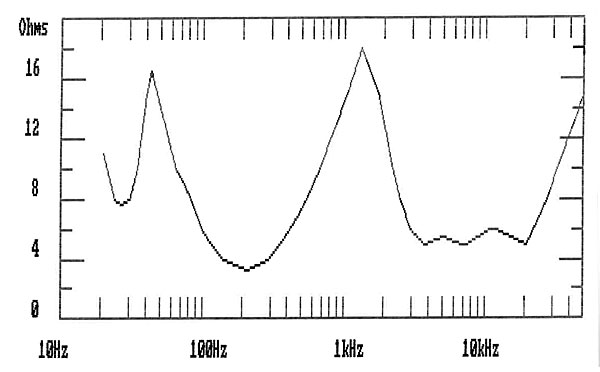

Fig.1 DCM TF1000, electrical impedance (solid) (2 ohms/vertical div.).
The measured nearfield LF extension gave a –6dB point at 39Hz (rel. to 100Hz), though this does not take into account the reinforcement of low bass from the port. In-room, the low bass rolled off quite gradually, with useful extension down to 30Hz (fig.2). Given the well-damped nature of the low frequencies, the TF1000s could be positioned closer to the rear wall to boost the upper bass without a resultant boom, if this were felt necessary. The tweeter response seemed civilized on-axis, without too much of the presence-region emphasis endemic among soft-dome units. It was also well-controlled off-axis, suggesting that the lens used by DCM does do the job. The slightly rising response through the midrange suggests a somewhat, though not excessively, forward balance.—John Atkinson
Fig.2 DCM TF1000, spatially averaged, 1/6-octave response in JA's original Santa Fe listening room.