

 Turning to the sound of DSD files: The only UPnP server I have on my Mac mini is Twonky Server, which doesn't play DSD files (footnote 2), but I could play DSD recordings via the Rossini Player's USB port, sourced from my Aurender N10 server. As I mentioned earlier this year, in constant rotation these past months has been the complete set of Brahms Piano Trios performed by violinist Christian Tetzlaff, cellist Tanja Tetzlaff, and pianist Lars Vogt (DSD128 files, Ondine/HDtracks), and engineered by René LaFlamme. (The Rossini app reported these files as having a sample rate of 5644.8kHz and a depth of 1 bit.) The sound was on the forward side, but with the three instruments set within a believable if subtle acoustic. The Rossini presented this robust music making in an appropriately robust manner, especially in the joyful final movement of Trio 1, but without any unwanted aggression. There was also the necessary hushed sense of expectancy in the slow movement. I drove myself crazy trying to decide if I could hear any difference at all among the four DSD low-pass filters. I couldn't, so for all my DSD listening I stuck with Filter 1, which has the widest bandwidth.
 Turning to PCM, I could hear no significant difference between CDs and the same recordings played via USB from the Aurender N10, even though I was using both an AudioQuest JitterBug and UpTone Audio's USB Regen (that belt-and-suspenders thing again). This is a superb CD player.
There was some confusion about the file format when, via uPnP over my network, I played "North Dakota," from Lyle Lovett's Live in Texas. I'd ripped this track from CD (Curb/MCA MCAD-11964) as an Apple Lossless file, but the iPad app identified it as "44.1kHz, 32 bits," the Player's front-panel display as "24/44.1k." Not that it mattered—the purr of Viktor Krauss's double bass and the palpability of Rickie Lee Jones's soft scatting at the end of the song were both striking.
Turning to PCM, I could hear no significant difference between CDs and the same recordings played via USB from the Aurender N10, even though I was using both an AudioQuest JitterBug and UpTone Audio's USB Regen (that belt-and-suspenders thing again). This is a superb CD player.
There was some confusion about the file format when, via uPnP over my network, I played "North Dakota," from Lyle Lovett's Live in Texas. I'd ripped this track from CD (Curb/MCA MCAD-11964) as an Apple Lossless file, but the iPad app identified it as "44.1kHz, 32 bits," the Player's front-panel display as "24/44.1k." Not that it mattered—the purr of Viktor Krauss's double bass and the palpability of Rickie Lee Jones's soft scatting at the end of the song were both striking.
 Filters
The Rossini remembers which filter you prefer for each sample rate, so you're not driven crazy experimenting with every track every time you play it. For CD playback, Filter 1 sounded too upfront for my taste, and while Filters 2–4 sounded convincing with some recordings, overall I preferred Filter 5 for the sense of slightly enhanced palpability I experienced. By contrast, Filter 4 sounded best with 24/96 recordings of solo piano. In Tor Espen Aspaas's performance of Beethoven's Piano Sonata 32, from his album Mirror Canon (FLAC download, 2L 2L-049-SACD), the piano's left-hand register was reproduced with optimal authority. However, with some private, purist 24/88.2 recordings of a Mendelssohn string quartet, Filter 1 sounded more natural, while Filter 4 emphasized the rosiny nature of the strings' sounds. Fortunately, changing the filter takes no more than a couple of taps on the app screen.
I've been using the review sample of PS Audio's PerfectWave DirectStream D/A converter ($5999), which I bought following Art Dudley's review of it in our September 2014 issue. Comparing the dCS and PSA DACs with levels matched at 1kHz and "Lover You Should Have Come Over," from Jeff Buckley's Grace (ALAC file ripped from CD, Columbia CK 57528), and with both DACs directly driving the Pass Labs XA60.5 amplifiers, it sounded as if the kick drum and bass guitar had an extra half-octave of extension through the Rossini that they didn't have through the PerfectWave. Back in 2009, I recorded a band called Heroes of the Open End, for which then-Stereophile staffer Ariel Bitran played lead guitar. In the 24/44.1k mix I tried to re-create some of the magnificent low frequencies you hear from rock bands in live performance. With "New York Afterparty," a song by singer Mike Baglivi, the PS Audio made the bass sound a little too much of a muchness, whereas the dCS better held on to the low frequencies—the intentionally phat bass-guitar lines were better differentiated from the kick drum, especially when the bassist drops an octave at the start of a phrase.
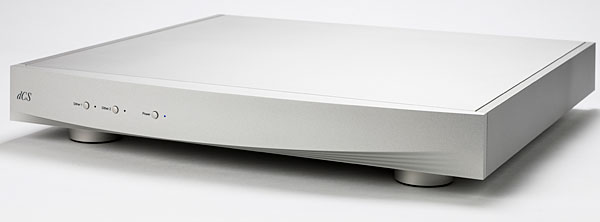 Similarly, the kick drum in "Rambling," from the Ginger Baker Trio's Going Back Home (ALAC file ripped from CD, Atlantic 82652-2), had more impact through the dCS, and with a little more space around the kit. But the PS Audio was a bit more believable in the sound of Charlie Haden's double bass on this track—the American DAC overall had a smoother sound. If the Rossini fully presented the impact of the music, the PS Audio focuses more on its approachability, perhaps sacrificing some resolution in the process. However, it's fair to note that I'm still running the earlier Yale firmware in the DirectStream DAC, rather than the latest Torreys OS, which Robert Deutsch discussed in October 2016.
The combination of the dCS Rossini Player and Clock produced what was, overall, the best sound from digital I have experienced in my system. While not as laid-back as the sound of my long-term reference PS Audio DAC, it didn't suffer from the glare that often accompanies digital components that concentrate on resolution at the expense of listenability. With the Rossini I got both, whether from CDs or files played via Ethernet or USB. But the question you'll be asking as you read this is, "Given how impressed you were with the sound of MQA-encoded files in the September issue, will dCS be incorporating MQA in its products?" I asked the question of Data Conversion Systems America's John Quick, who responded that they do have a software MQA decoder running on a Rossini, but the design work is still a work in progress and that they intend to complete the work and support MQA when enough recordings have become available.
Footnote 2: After the review had been published, I discovered that a transcode string in Twonky Server can be set to package DFF/DSF files as DoP.















