

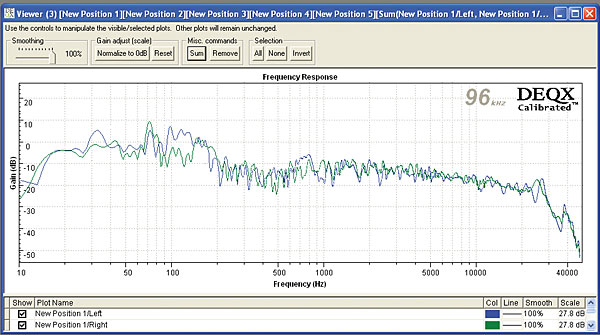
Here, DEQX adds a wrinkle that I love. I'd already measured the speakers and created the correction filters, but how did I know if it all did what was intended? Sure, I can trust my ears; below, I tell you what they told me. I could also pull out another toolbox and hope that the configuration and mike setup matched. However, DEQX provides a Verification Wizard that actually repeats the measurement procedure with the correction filters in place. If you've left the speakers and mike in the same positions, the resulting graph is very impressive.
Room Correction
The next step is to build on that work, but that required moving the speakers into the proper position for listening. It also means that it's necessary to move the mike back to the main listening position. DEQX permits using as many mike measuring positions as you wish, in a procedure that will be familiar to anyone who has done room correction with other systems. Each position is named, allowing you to use any combination or selection on which to base the correction filters.
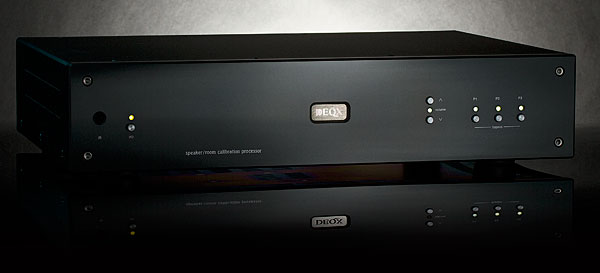
At first, I inserted the PreMate in my system, set to P0 (bypass), between the analog preamp and power amp, and between the Oppo BDP-105 universal BD player and the analog preamp. Since the bypass setting still subjects the signal to the DEQX electronics and DSP, albeit configured as a bypass and flat, these connections permitted me to hear how transparent the PreMate was compared to a physical bypass from the player. The results were equivocal—I sometimes thought the physical bypass was somewhat cleaner and more dynamic—but these weren't blind tests, and even those differences were elusive.
Later, I inserted the PreMate between the Baetis XR-2 S/PDIF output and the analog input on the preamp, and also compared it with S/PDIF output playing through the Mytek Stereo 192-DSD DAC. Again, it was difficult to fault its performance in any of these configurations, and it was definitely competitive with the Mytek. However, I was most happy letting the PreMate stand on its own as an EQ, preamp and DAC by slapping together a dedicated stereo system consisting of the Sony XA-5400ES feeding the DEQX's analog XLR inputs, a PC laptop feeding the PreMate's USB audio input, and the PreMate's XLR outputs connected to the Parasound Halo A 31. I ran this with either the B&W 800 Diamond or Bryston Middle T speakers.
Boy, was that a pleasure! With the PreMate as the core, the little system was tight and dynamic, even with EQ bypassed. Selecting the speaker-only correction with the B&Ws made an undeniable improvement in top-to-near-bottom integration in ways I would not have expected. Bass was not much changed, but the midrange was noticeably more open from the upper bass up. Treble seemed a bit softer but, most important, it was more difficult than ever to tell that there were four separate drivers in the box. Especially for dense and complex music, such as a revelatory new recording of George Antheil's Ballet Mécanique by Gil Rose and the Boston Modern Orchestra Project (SACD/CD, BMOP 1033). The PreMate clarified and illuminated details in the stereo soundstage that were murky without it, even in multichannel. Listening impressions of the two room-correction options were less impressive; I ended up unable to choose between the sub-200Hz option, which very slightly tightened the midbass low strings and timpani, and using only the speaker-calibration filters. That correction alone justified use of the DEQX: It made the 800 Ds sound like better 800 Ds.
 After switching to the Brystons and downloading the filter configurations I'd sweated over on my own, I had slightly different reactions. There was much less effect when going from bypass to speaker-only correction with the Brystons than with the B&Ws. This should not have been a surprise—in my room, the Brystons measured flatter, with smoother phase response. I preferred the wider correction window (150Hz–25kHz), but only marginally, as both made for a more spacious and clearer soundstage. It was primarily with soprano voices and strings that I appreciated the value of the wider correction. Try the Boccherini (or anything else) on the Stuttgart Chamber Orchestra's classic Die Rohre (SACD, Tacet 0074-4), which has always been a reference for string tone and ensemble balance. Switching in DEQX correction improves them and better delineates the spaces between players. It is just such subtle and salubrious improvements that drive us to choose one speaker over another, and DEQX throws a big new wrinkle into the calculation. Why would you not want to improve whatever speaker you have?
As for room correction, the first, default Autoset EQ correction really tightened up the bass, but there was simply too much bass. Looking back at the in-room responses and the displayed filters, it was apparent that unnecessary corrections for a slight FR sag in the 200–400Hz range were at fault. The second filter set, which limited correction to 200hz, did the trick, restoring balance while maintaining the tautness of the extended bass. I noticed that best with Jordi Savall and Le Concert des Nations' recording of Marin Marais's Alcione: Suites des Airs à joüer (SACD, Alia Vox AVSA9903), in which the essential bass lines underpinning the harmony were finely characterized. It did the same for the bass in Eric Clapton's Unplugged (CD, Reprise 45024-2), including incidental noises as well as the music. This made the room EQ, when combined with the wide-range correction speaker calibration, the icing on the cake.
It's all good . . .
After switching to the Brystons and downloading the filter configurations I'd sweated over on my own, I had slightly different reactions. There was much less effect when going from bypass to speaker-only correction with the Brystons than with the B&Ws. This should not have been a surprise—in my room, the Brystons measured flatter, with smoother phase response. I preferred the wider correction window (150Hz–25kHz), but only marginally, as both made for a more spacious and clearer soundstage. It was primarily with soprano voices and strings that I appreciated the value of the wider correction. Try the Boccherini (or anything else) on the Stuttgart Chamber Orchestra's classic Die Rohre (SACD, Tacet 0074-4), which has always been a reference for string tone and ensemble balance. Switching in DEQX correction improves them and better delineates the spaces between players. It is just such subtle and salubrious improvements that drive us to choose one speaker over another, and DEQX throws a big new wrinkle into the calculation. Why would you not want to improve whatever speaker you have?
As for room correction, the first, default Autoset EQ correction really tightened up the bass, but there was simply too much bass. Looking back at the in-room responses and the displayed filters, it was apparent that unnecessary corrections for a slight FR sag in the 200–400Hz range were at fault. The second filter set, which limited correction to 200hz, did the trick, restoring balance while maintaining the tautness of the extended bass. I noticed that best with Jordi Savall and Le Concert des Nations' recording of Marin Marais's Alcione: Suites des Airs à joüer (SACD, Alia Vox AVSA9903), in which the essential bass lines underpinning the harmony were finely characterized. It did the same for the bass in Eric Clapton's Unplugged (CD, Reprise 45024-2), including incidental noises as well as the music. This made the room EQ, when combined with the wide-range correction speaker calibration, the icing on the cake.
It's all good . . .
DEQX's speaker calibration is an unmitigated success. The PreMate's digital and analog performances are outstanding. What's not to like? Well, the learning curve is steep, and the documentation isn't particularly well organized. Part of the problem is the very richness of the PreMate's feature set, which revealed more and more to me as I continued to use it. The manual, on CD-ROM only, prints out as 143 pages of consistently dense information. However, I couldn't discern a clear path for the novice who needs step-by-step guidance. It was always bumping me back and forth, usually between a simple instruction and the remotely located but essential support information. The lack of an index is critical. Nor was the Help function embedded in the control application much better. My other concern is with the room-correction and Autoset EQ results. Admittedly, I'm used to more automated systems, but I would like to see more advice about the defaults, and a greater emphasis on guidelines for experimenting with this function. In some ways, the PreMate's requirement of hands-on adjustment reminded me of my experience with the Trinnov Room Optimizer I reviewed in May 2010 and September 2013, which also lacked adequate instructions for its powerful software. On the other hand, the instructions provided with Dirac Live are almost unnecessary for achieving excellent results. In fact, my most thoroughly satisfying sound was obtained by combining DEQX's speaker calibration with Dirac Live's room EQ. I firmly believe that equal or better can be achieved with DEQX's Autoset EQ or manual EQ, but only with much greater investments of time and effort.
 Conclusions
I am unequivocal about my enthusiasm for the speaker-calibration capabilities of the DEQX PreMate. It made my very good speakers undeniably better, smoother and cleaner, and endowed them with a bigger soundstage. It made dense, complicated music easier to resolve, and all music more of a joy to hear. Add to that the PreMate's DAC, whose outstanding performance was clearly revealed by feeding it a diet of standard and high-definition (up to 24-bit/192kHz) digital sources via its S/PDIF and USB inputs. The user must be prepared to spend time and pay close attention to learning how to apply DEQX, but the rewards will amply justify those efforts. A paradigm for future stereo systems should be the one I put together, with source selection, processing, control, DSP, and DAC all contained in a single remote-controlled component: the DEQX PreMate. I can't imagine what more one could ask for.
The next step is to build on that work, but that required moving the speakers into the proper position for listening. It also means that it's necessary to move the mike back to the main listening position. DEQX permits using as many mike measuring positions as you wish, in a procedure that will be familiar to anyone who has done room correction with other systems. Each position is named, allowing you to use any combination or selection on which to base the correction filters.
The result of applying the DEQX filters.
Using the Autoset EQ option, you prescribe the frequency and amplitude windows for the correction, as well as limit the amount of boost and cut, and predetermine the number of filters to be created. More significant, PreMate can take into account the measured responses of all the speakers, applying filters only "at frequencies where all relevant room measurements (not just one) need correction." It is also fairly conservative: Autoset EQ defaults to a "minimal disturbance" mode, which applies only very subtle amplitude corrections. DEQX advises the user to experiment with more complete corrections by manually adjusting the various parameters as music is being played.
The result of applying the DEQX filters (red trace) is an exceptionally smooth in-room response (blue and green).
The resulting filters can be displayed as PEQ filters or as a graphic EQ, and they are editable in several forms. I uploaded Profile 3 to the PreMate with the calibration filters from Profile 2 plus the room EQ filters calculated by Autoset with the default upper limit of 550Hz. Later, I calculated another room-EQ filter set with an upper limit of 200Hz and uploaded that as well.
PerformanceAt first, I inserted the PreMate in my system, set to P0 (bypass), between the analog preamp and power amp, and between the Oppo BDP-105 universal BD player and the analog preamp. Since the bypass setting still subjects the signal to the DEQX electronics and DSP, albeit configured as a bypass and flat, these connections permitted me to hear how transparent the PreMate was compared to a physical bypass from the player. The results were equivocal—I sometimes thought the physical bypass was somewhat cleaner and more dynamic—but these weren't blind tests, and even those differences were elusive.
After switching to the Brystons and downloading the filter configurations I'd sweated over on my own, I had slightly different reactions. There was much less effect when going from bypass to speaker-only correction with the Brystons than with the B&Ws. This should not have been a surprise—in my room, the Brystons measured flatter, with smoother phase response. I preferred the wider correction window (150Hz–25kHz), but only marginally, as both made for a more spacious and clearer soundstage. It was primarily with soprano voices and strings that I appreciated the value of the wider correction. Try the Boccherini (or anything else) on the Stuttgart Chamber Orchestra's classic Die Rohre (SACD, Tacet 0074-4), which has always been a reference for string tone and ensemble balance. Switching in DEQX correction improves them and better delineates the spaces between players. It is just such subtle and salubrious improvements that drive us to choose one speaker over another, and DEQX throws a big new wrinkle into the calculation. Why would you not want to improve whatever speaker you have?
DEQX's speaker calibration is an unmitigated success. The PreMate's digital and analog performances are outstanding. What's not to like? Well, the learning curve is steep, and the documentation isn't particularly well organized. Part of the problem is the very richness of the PreMate's feature set, which revealed more and more to me as I continued to use it. The manual, on CD-ROM only, prints out as 143 pages of consistently dense information. However, I couldn't discern a clear path for the novice who needs step-by-step guidance. It was always bumping me back and forth, usually between a simple instruction and the remotely located but essential support information. The lack of an index is critical. Nor was the Help function embedded in the control application much better. My other concern is with the room-correction and Autoset EQ results. Admittedly, I'm used to more automated systems, but I would like to see more advice about the defaults, and a greater emphasis on guidelines for experimenting with this function. In some ways, the PreMate's requirement of hands-on adjustment reminded me of my experience with the Trinnov Room Optimizer I reviewed in May 2010 and September 2013, which also lacked adequate instructions for its powerful software. On the other hand, the instructions provided with Dirac Live are almost unnecessary for achieving excellent results. In fact, my most thoroughly satisfying sound was obtained by combining DEQX's speaker calibration with Dirac Live's room EQ. I firmly believe that equal or better can be achieved with DEQX's Autoset EQ or manual EQ, but only with much greater investments of time and effort.
ConclusionsI am unequivocal about my enthusiasm for the speaker-calibration capabilities of the DEQX PreMate. It made my very good speakers undeniably better, smoother and cleaner, and endowed them with a bigger soundstage. It made dense, complicated music easier to resolve, and all music more of a joy to hear. Add to that the PreMate's DAC, whose outstanding performance was clearly revealed by feeding it a diet of standard and high-definition (up to 24-bit/192kHz) digital sources via its S/PDIF and USB inputs. The user must be prepared to spend time and pay close attention to learning how to apply DEQX, but the rewards will amply justify those efforts. A paradigm for future stereo systems should be the one I put together, with source selection, processing, control, DSP, and DAC all contained in a single remote-controlled component: the DEQX PreMate. I can't imagine what more one could ask for.















