

"Young people don't listen to music together like we used to do." I have been running into various versions of this opinion in the audiophile world ever since 'personal listening' critical mass was first achieved by ear-buds and iPods in the early 2000s. Hi-fi buffs who are now banking those Senior Discounts think back fondly to that particular dorm room, where they first heard that Van Dyke Parks album their friend turned them on to. (Substitute your own title here . . .)
 Time has a funny way of circling around though, almost like the spinning vinyl many of us had thought we had seen and heard the last of. There I was, at my son Peter's thirtieth birthday party at Black Flamingo in Brooklyn, staring at a large, floorstanding speaker cabinet. Then it hit me—"This is a Klipsch La Scala II!" (above). Yes, young people (or people younger than myself) are gathering in groups to listen and dance to high-quality music playback—just like we used to do!
Among the musical hats my son Peter wears, is being a professional DJ. And Peter knows a lot of other DJs in the New York area. So I asked if there were other clubs in the New York area that feature high-quality music playback.—thus we embarked on a brief tour of the "DJ Club Sound Systems of Brooklyn."
Time has a funny way of circling around though, almost like the spinning vinyl many of us had thought we had seen and heard the last of. There I was, at my son Peter's thirtieth birthday party at Black Flamingo in Brooklyn, staring at a large, floorstanding speaker cabinet. Then it hit me—"This is a Klipsch La Scala II!" (above). Yes, young people (or people younger than myself) are gathering in groups to listen and dance to high-quality music playback—just like we used to do!
Among the musical hats my son Peter wears, is being a professional DJ. And Peter knows a lot of other DJs in the New York area. So I asked if there were other clubs in the New York area that feature high-quality music playback.—thus we embarked on a brief tour of the "DJ Club Sound Systems of Brooklyn."
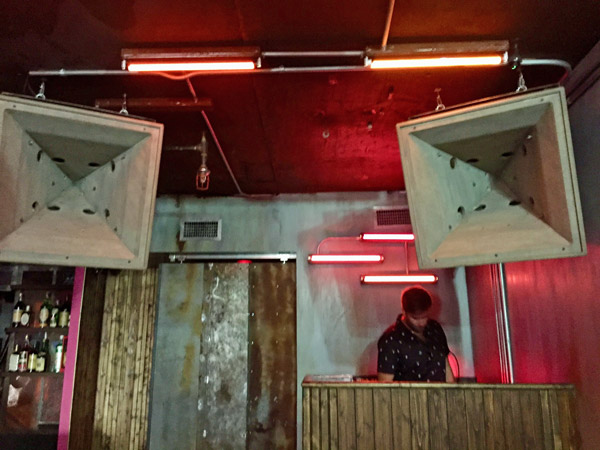
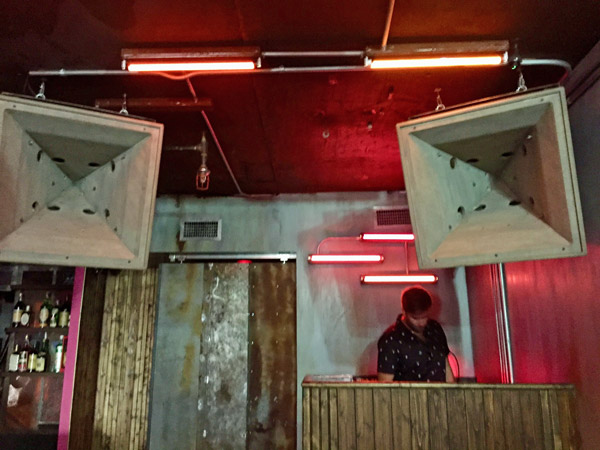 The first club we hit, out Flushing Avenue in the 'hood of Bushwick, was Jupiter Disco (1237 Flushing Ave., Brooklyn, NY 11237). You will need your electronic devices to find the unmarked entrance in this light industrial neighborhood. Once inside this medium-sized rectangular barroom, you can enjoy the retro-sci-fi décor, and imbibe till 4:00am if you wish!
The DJ pulpit is located at one end. Jupiter Disco Partner Maks Pazuniak showed me the fine audio system, designed for the club by Danny Taylor. From front-end to back: two Pioneer PLX-1000 turntables (DJs are asked to supply their own cartridges for maintenance reasons), a Condesa Carmen mixer (which is an Australian-made tubed unit), Powersoft M20D amps, into a pair of Danley SH-50 horn loudspeakers suspended from the ceiling, and Danley subwoofers, (an ass-shaking experience as they are cleverly installed under some of the booth seats), with a couple Bose satellite speakers. There is no CD playback.
Peter cranked up a George Clinton LP re-mix, and I got out my phone and turned on my spectrum analyzer app. The Danley horn speaker's sweet spot was dialed in to focus on the small dance area. I saw quite a flat frequency curve up to 20kHz. Lots of juice at the low-end at 20Hz, with no low roll-off. There was a small peak at 70Hz. The sound was not thumpy, and quite balanced—with that extra visceral kick if you were sitting in a booth! Maks Pazuniak described the DJs they use as "genre agnostic, with Techno." If I ever stay up that late again, I will be back.
The first club we hit, out Flushing Avenue in the 'hood of Bushwick, was Jupiter Disco (1237 Flushing Ave., Brooklyn, NY 11237). You will need your electronic devices to find the unmarked entrance in this light industrial neighborhood. Once inside this medium-sized rectangular barroom, you can enjoy the retro-sci-fi décor, and imbibe till 4:00am if you wish!
The DJ pulpit is located at one end. Jupiter Disco Partner Maks Pazuniak showed me the fine audio system, designed for the club by Danny Taylor. From front-end to back: two Pioneer PLX-1000 turntables (DJs are asked to supply their own cartridges for maintenance reasons), a Condesa Carmen mixer (which is an Australian-made tubed unit), Powersoft M20D amps, into a pair of Danley SH-50 horn loudspeakers suspended from the ceiling, and Danley subwoofers, (an ass-shaking experience as they are cleverly installed under some of the booth seats), with a couple Bose satellite speakers. There is no CD playback.
Peter cranked up a George Clinton LP re-mix, and I got out my phone and turned on my spectrum analyzer app. The Danley horn speaker's sweet spot was dialed in to focus on the small dance area. I saw quite a flat frequency curve up to 20kHz. Lots of juice at the low-end at 20Hz, with no low roll-off. There was a small peak at 70Hz. The sound was not thumpy, and quite balanced—with that extra visceral kick if you were sitting in a booth! Maks Pazuniak described the DJs they use as "genre agnostic, with Techno." If I ever stay up that late again, I will be back.
 Summoning up an Uber ride—which has made getting around Brooklyn clubs a whole lot easier than it once was—we made our way to the older residential part of Bushwick. Veteran DJ Cecily Pinkerton (above right with the author) hosts her semi-public venue Starvue (c/o Cecily Pinkerton, Starvue234@gmail.com) in a ground floor studio-type space in a mixed-use building. If you can name it, it exists somewhere today in Brooklyn.
The space would work as a dance studio—with a high industrial ceiling, and a large rectangular single-room floor. Cecily Pinkerton told me she first started DJ-ing in Chicago about 14 years ago, and specifically described what she does as descending in a direct line from noted early New York DJ David Mancuso—who passed away in 2016 at the age of 72.
Cecily traces her use in the Starvue room of Klipsch loudspeakers, as an influence from Mancuso. It was hard to miss the sight of two stacked pairs of Klipschorn speakers, one pair in each corner at the short end of the room. (Cecily proudly states that one pair was made in 1960, the other pair in 1980.) The room includes some acoustic wall paneling and treatments to mitigate the sheetrock, and wood flooring instead of exposed cement. The Klipsch towers were driven by a pair of McIntosh MC 2105 solid-state stereo amps, and Cecily pointed out in particular the 1970s vintage solid-state Bozak CMA 10 2DL preamp she felt was meant for classic DJ's. Also included is a new Allen & Heath mixer "for those who want it." A Yorkville stereo sub cabinet filled out the low-end in this large room.
I asked Cecily what she likes to feature music-wise, and she said "Afro-Beat and funk, all the way to Detroit Techno, and a lot of Prince." So what did we listen to? The Reiner Sound, of course—the opening Ravel. Yum! I loved it. I also put on Mighty Sam McClain's Give It Up to Love. Wasn't expecting the sound in that kind of room to feel as warm and solid as it did—but I am sure the Klipsch speakers were a part of accomplishing that. I hope to get to a full session at Starvue in future.
Summoning up an Uber ride—which has made getting around Brooklyn clubs a whole lot easier than it once was—we made our way to the older residential part of Bushwick. Veteran DJ Cecily Pinkerton (above right with the author) hosts her semi-public venue Starvue (c/o Cecily Pinkerton, Starvue234@gmail.com) in a ground floor studio-type space in a mixed-use building. If you can name it, it exists somewhere today in Brooklyn.
The space would work as a dance studio—with a high industrial ceiling, and a large rectangular single-room floor. Cecily Pinkerton told me she first started DJ-ing in Chicago about 14 years ago, and specifically described what she does as descending in a direct line from noted early New York DJ David Mancuso—who passed away in 2016 at the age of 72.
Cecily traces her use in the Starvue room of Klipsch loudspeakers, as an influence from Mancuso. It was hard to miss the sight of two stacked pairs of Klipschorn speakers, one pair in each corner at the short end of the room. (Cecily proudly states that one pair was made in 1960, the other pair in 1980.) The room includes some acoustic wall paneling and treatments to mitigate the sheetrock, and wood flooring instead of exposed cement. The Klipsch towers were driven by a pair of McIntosh MC 2105 solid-state stereo amps, and Cecily pointed out in particular the 1970s vintage solid-state Bozak CMA 10 2DL preamp she felt was meant for classic DJ's. Also included is a new Allen & Heath mixer "for those who want it." A Yorkville stereo sub cabinet filled out the low-end in this large room.
I asked Cecily what she likes to feature music-wise, and she said "Afro-Beat and funk, all the way to Detroit Techno, and a lot of Prince." So what did we listen to? The Reiner Sound, of course—the opening Ravel. Yum! I loved it. I also put on Mighty Sam McClain's Give It Up to Love. Wasn't expecting the sound in that kind of room to feel as warm and solid as it did—but I am sure the Klipsch speakers were a part of accomplishing that. I hope to get to a full session at Starvue in future.
 We returned to Black Flamingo (168 Borinquen Place, Brooklyn, NY 11211. Tel: (718) 387-3337) for another listen/look. The club describes itself as a "Plant Based Taqueria & Discotheque," and is known for promoting high-end dedicated listening, and touring DJs as well as local talent who can make use of that. And though I am not a restaurant critic, I can also tell you the food is delish!
Co-owner Bryce David and sound technician Frank Favia met us, and I got to hear the system at greater length than I had on my first visit. A pattern was starting to emerge—Klipsch! There obviously is a respect and fondness for this brand, built over many years now, among people in the DJ club world. Black Flamingo has a large bar and restaurant on the street level, and down the stairs is the listening/dancing room and DJ podium. It makes sense in New York that it is easiest to create a sound-insulated studio-type room below street level noise and windows. An irregular shaped room here, treated all in wood paneling. A low ceiling contributes to the tight and rockin' sound I heard. As did the pair of Klipsch LaScala II loudspeakers sitting on top of subwoofers. (You can see one to Peter Matson's left in the above photo). The system also includes a pair of Klipsch Heresy speakers used to fill in on the sides.
Frank Favia explained to me his expertise with repairing Klipsch drivers—as from time to time they get blown up by overly enthusiastic DJ's. Frank has interfaced extensively with the people at Klipsch, even having items modified to handle power amp clipping and assorted abuse. The speakers are currently driven by Crown 2/300 amps. Frank shared with me his fix—of soldering into the circuits light bulbs, that act like limiters and reduce the damage caused by squarewaves.
The system was rounded out by a Rane mixer, and a pair of Technics SL-1200 turntables. We listened off LP to Lee Morgan's Search for the New Land album. Morgan's trumpet sounded full and brassy, with no hint of etchy grain or anything of that nature. Frank pointed out that the decibel levels come down in these rooms when they fill up with people, and then DJs can start pushing the system hard.
We returned to Black Flamingo (168 Borinquen Place, Brooklyn, NY 11211. Tel: (718) 387-3337) for another listen/look. The club describes itself as a "Plant Based Taqueria & Discotheque," and is known for promoting high-end dedicated listening, and touring DJs as well as local talent who can make use of that. And though I am not a restaurant critic, I can also tell you the food is delish!
Co-owner Bryce David and sound technician Frank Favia met us, and I got to hear the system at greater length than I had on my first visit. A pattern was starting to emerge—Klipsch! There obviously is a respect and fondness for this brand, built over many years now, among people in the DJ club world. Black Flamingo has a large bar and restaurant on the street level, and down the stairs is the listening/dancing room and DJ podium. It makes sense in New York that it is easiest to create a sound-insulated studio-type room below street level noise and windows. An irregular shaped room here, treated all in wood paneling. A low ceiling contributes to the tight and rockin' sound I heard. As did the pair of Klipsch LaScala II loudspeakers sitting on top of subwoofers. (You can see one to Peter Matson's left in the above photo). The system also includes a pair of Klipsch Heresy speakers used to fill in on the sides.
Frank Favia explained to me his expertise with repairing Klipsch drivers—as from time to time they get blown up by overly enthusiastic DJ's. Frank has interfaced extensively with the people at Klipsch, even having items modified to handle power amp clipping and assorted abuse. The speakers are currently driven by Crown 2/300 amps. Frank shared with me his fix—of soldering into the circuits light bulbs, that act like limiters and reduce the damage caused by squarewaves.
The system was rounded out by a Rane mixer, and a pair of Technics SL-1200 turntables. We listened off LP to Lee Morgan's Search for the New Land album. Morgan's trumpet sounded full and brassy, with no hint of etchy grain or anything of that nature. Frank pointed out that the decibel levels come down in these rooms when they fill up with people, and then DJs can start pushing the system hard.
 On the southern flank of Williamsburg you can still soak up some older Puerto Rican and Dominican real deal. Mezcaleria La Milagrosa (149 Havemeyer Street, Brooklyn, NY 11211. Tel: (718) 599-1499) is a recent addition to other venues owned and operated by Felipe Mendez Candelas (shown in the above photo, at the DJ station). You are going to need to call ahead to get in here. Felipe is also a DJ, has a radio show, and the 15,000 LPs to prove it. I told him he is working too hard! Hidden away on Havemeyer Street in back of a laundromat, Candelas has built a wonderful wine cellar-like room, totally treated sonically all in wood, with a curved ceiling and a bar on one side. Though it's not about wine here—it's about Mezcal and sound!
 More Klipsch! Another pair of Klipsch Klipschorns, made in 1981, using the two corners of the long side of the room for reinforcement as they are designed to do. Displayed above the bar hangs a set of all-McIntosh amps, bi-amping the system. At the other end is the DJ installation. Felipe showed me his custom fail-safe box he had designed, to help mitigate destruction of the speakers by enthused DJs, a unit sitting back of the bar that includes limiting and compression that can be dialed in by the bartenders if they hear things getting out of hand.
Sourced from a pair of Technics turntables, Felipe chose a selection of LPs—Alice Coltrane for starters. And a 1970s Lyn Christopher album, Take Me With You, which caught my ear. It all sounded incredibly solid and full, without any deadness. Electronica harshness—come not here. I loved this room and what Felipe Mendez Candelas is doing with it. I just wish I was still young enough to handle Mezcal!
These four clubs are but a small slice of quality venues that feature high-end audio in Brooklyn. I am sure there are many others there, and in the other New York City boroughs. As I assume there are in other American cities, and beyond. If you want to get out of the house and have a good time, it is now also possible to listen to music at a level of quality that most audiophiles strive to attain in their home listening environments. Dorm rooms? They are a happy memory.
More Klipsch! Another pair of Klipsch Klipschorns, made in 1981, using the two corners of the long side of the room for reinforcement as they are designed to do. Displayed above the bar hangs a set of all-McIntosh amps, bi-amping the system. At the other end is the DJ installation. Felipe showed me his custom fail-safe box he had designed, to help mitigate destruction of the speakers by enthused DJs, a unit sitting back of the bar that includes limiting and compression that can be dialed in by the bartenders if they hear things getting out of hand.
Sourced from a pair of Technics turntables, Felipe chose a selection of LPs—Alice Coltrane for starters. And a 1970s Lyn Christopher album, Take Me With You, which caught my ear. It all sounded incredibly solid and full, without any deadness. Electronica harshness—come not here. I loved this room and what Felipe Mendez Candelas is doing with it. I just wish I was still young enough to handle Mezcal!
These four clubs are but a small slice of quality venues that feature high-end audio in Brooklyn. I am sure there are many others there, and in the other New York City boroughs. As I assume there are in other American cities, and beyond. If you want to get out of the house and have a good time, it is now also possible to listen to music at a level of quality that most audiophiles strive to attain in their home listening environments. Dorm rooms? They are a happy memory.
Time has a funny way of circling around though, almost like the spinning vinyl many of us had thought we had seen and heard the last of. There I was, at my son Peter's thirtieth birthday party at Black Flamingo in Brooklyn, staring at a large, floorstanding speaker cabinet. Then it hit me—"This is a Klipsch La Scala II!" (above). Yes, young people (or people younger than myself) are gathering in groups to listen and dance to high-quality music playback—just like we used to do!
Among the musical hats my son Peter wears, is being a professional DJ. And Peter knows a lot of other DJs in the New York area. So I asked if there were other clubs in the New York area that feature high-quality music playback.—thus we embarked on a brief tour of the "DJ Club Sound Systems of Brooklyn."
The first club we hit, out Flushing Avenue in the 'hood of Bushwick, was Jupiter Disco (1237 Flushing Ave., Brooklyn, NY 11237). You will need your electronic devices to find the unmarked entrance in this light industrial neighborhood. Once inside this medium-sized rectangular barroom, you can enjoy the retro-sci-fi décor, and imbibe till 4:00am if you wish!
The DJ pulpit is located at one end. Jupiter Disco Partner Maks Pazuniak showed me the fine audio system, designed for the club by Danny Taylor. From front-end to back: two Pioneer PLX-1000 turntables (DJs are asked to supply their own cartridges for maintenance reasons), a Condesa Carmen mixer (which is an Australian-made tubed unit), Powersoft M20D amps, into a pair of Danley SH-50 horn loudspeakers suspended from the ceiling, and Danley subwoofers, (an ass-shaking experience as they are cleverly installed under some of the booth seats), with a couple Bose satellite speakers. There is no CD playback.
Peter cranked up a George Clinton LP re-mix, and I got out my phone and turned on my spectrum analyzer app. The Danley horn speaker's sweet spot was dialed in to focus on the small dance area. I saw quite a flat frequency curve up to 20kHz. Lots of juice at the low-end at 20Hz, with no low roll-off. There was a small peak at 70Hz. The sound was not thumpy, and quite balanced—with that extra visceral kick if you were sitting in a booth! Maks Pazuniak described the DJs they use as "genre agnostic, with Techno." If I ever stay up that late again, I will be back.
Summoning up an Uber ride—which has made getting around Brooklyn clubs a whole lot easier than it once was—we made our way to the older residential part of Bushwick. Veteran DJ Cecily Pinkerton (above right with the author) hosts her semi-public venue Starvue (c/o Cecily Pinkerton, Starvue234@gmail.com) in a ground floor studio-type space in a mixed-use building. If you can name it, it exists somewhere today in Brooklyn.
The space would work as a dance studio—with a high industrial ceiling, and a large rectangular single-room floor. Cecily Pinkerton told me she first started DJ-ing in Chicago about 14 years ago, and specifically described what she does as descending in a direct line from noted early New York DJ David Mancuso—who passed away in 2016 at the age of 72.
Cecily traces her use in the Starvue room of Klipsch loudspeakers, as an influence from Mancuso. It was hard to miss the sight of two stacked pairs of Klipschorn speakers, one pair in each corner at the short end of the room. (Cecily proudly states that one pair was made in 1960, the other pair in 1980.) The room includes some acoustic wall paneling and treatments to mitigate the sheetrock, and wood flooring instead of exposed cement. The Klipsch towers were driven by a pair of McIntosh MC 2105 solid-state stereo amps, and Cecily pointed out in particular the 1970s vintage solid-state Bozak CMA 10 2DL preamp she felt was meant for classic DJ's. Also included is a new Allen & Heath mixer "for those who want it." A Yorkville stereo sub cabinet filled out the low-end in this large room.
We returned to Black Flamingo (168 Borinquen Place, Brooklyn, NY 11211. Tel: (718) 387-3337) for another listen/look. The club describes itself as a "Plant Based Taqueria & Discotheque," and is known for promoting high-end dedicated listening, and touring DJs as well as local talent who can make use of that. And though I am not a restaurant critic, I can also tell you the food is delish!
Co-owner Bryce David and sound technician Frank Favia met us, and I got to hear the system at greater length than I had on my first visit. A pattern was starting to emerge—Klipsch! There obviously is a respect and fondness for this brand, built over many years now, among people in the DJ club world. Black Flamingo has a large bar and restaurant on the street level, and down the stairs is the listening/dancing room and DJ podium. It makes sense in New York that it is easiest to create a sound-insulated studio-type room below street level noise and windows. An irregular shaped room here, treated all in wood paneling. A low ceiling contributes to the tight and rockin' sound I heard. As did the pair of Klipsch LaScala II loudspeakers sitting on top of subwoofers. (You can see one to Peter Matson's left in the above photo). The system also includes a pair of Klipsch Heresy speakers used to fill in on the sides.
On the southern flank of Williamsburg you can still soak up some older Puerto Rican and Dominican real deal. Mezcaleria La Milagrosa (149 Havemeyer Street, Brooklyn, NY 11211. Tel: (718) 599-1499) is a recent addition to other venues owned and operated by Felipe Mendez Candelas (shown in the above photo, at the DJ station). You are going to need to call ahead to get in here. Felipe is also a DJ, has a radio show, and the 15,000 LPs to prove it. I told him he is working too hard! Hidden away on Havemeyer Street in back of a laundromat, Candelas has built a wonderful wine cellar-like room, totally treated sonically all in wood, with a curved ceiling and a bar on one side. Though it's not about wine here—it's about Mezcal and sound!
More Klipsch! Another pair of Klipsch Klipschorns, made in 1981, using the two corners of the long side of the room for reinforcement as they are designed to do. Displayed above the bar hangs a set of all-McIntosh amps, bi-amping the system. At the other end is the DJ installation. Felipe showed me his custom fail-safe box he had designed, to help mitigate destruction of the speakers by enthused DJs, a unit sitting back of the bar that includes limiting and compression that can be dialed in by the bartenders if they hear things getting out of hand.
Sourced from a pair of Technics turntables, Felipe chose a selection of LPs—Alice Coltrane for starters. And a 1970s Lyn Christopher album, Take Me With You, which caught my ear. It all sounded incredibly solid and full, without any deadness. Electronica harshness—come not here. I loved this room and what Felipe Mendez Candelas is doing with it. I just wish I was still young enough to handle Mezcal!
These four clubs are but a small slice of quality venues that feature high-end audio in Brooklyn. I am sure there are many others there, and in the other New York City boroughs. As I assume there are in other American cities, and beyond. If you want to get out of the house and have a good time, it is now also possible to listen to music at a level of quality that most audiophiles strive to attain in their home listening environments. Dorm rooms? They are a happy memory.















