

Sidebar 3: Measurements
I used DRA Labs' MLSSA system and a calibrated DPA 4006 microphone to measure the Elac Adante AF-61's frequency response in the farfield, and an Earthworks QTC-40 for the nearfield responses. (I didn't use the grilles.) My estimate of the Adante AF-61's voltage sensitivity was 86.1dB/2.83V/m, slightly below the specified 87dB/2.83V/m. The specified nominal impedance is 6 ohms. Fig.1 shows that the impedance magnitude remains above 6 ohms for much of the audioband, with minimum values of 4.75 ohms at 92Hz, 5.25 ohms at 240Hz, and 5.1 ohms at 9.1k ohms. However, there is a current-hungry combination of 5.3 ohms magnitude and electrical phase angle of –43° at 75Hz (fig.1). This speaker would work best with an amplifier that is comfortable driving 4 ohm loads.

 There are several impedance peaks in the bass in fig.1, these due to the AF-61's unusual low-frequency alignment, in which each of three internally mounted woofers fires into a ported cavity coupled to the outside world with a passive radiator (footnote 1). The three radiators behave identically, and the sum of their nearfield responses is shown as the red trace in fig.3. This is crossed over to the midrange unit, whose nearfield response is shown as the blue trace, at the specified 200Hz with what appear to be symmetrical fourth-order, 24dB/octave slopes. The lower-frequency rolloff is also fourth-order, with an approximate –6dB frequency of 40Hz—higher than I would have expected for such a large loudspeaker.



Footnote 1: See my video interview with the AF-61's designer, Andrew Jones here.
Fig.1 Elac Adante AF-61, electrical impedance (solid) and phase (dashed) (2 ohms/vertical div.).
The traces in fig.1 are free from the small wrinkles that would imply the presence of cabinet-wall resonances. However, I did find a mode at 333Hz on the sidewalls level with the woofers (fig.2), and this was also present on the rear and top panels. This is high enough in Q, and sufficiently low in level, that it shouldn't give rise to any coloration.
Fig.2 Elac Adante AF-61, cumulative spectral-decay plot calculated from output of accelerometer fastened to center of sidewall level with middle passive radiator (MLS driving voltage to speaker, 7.55V; measurement bandwidth, 2kHz).
Fig.3 Elac Adante AF-61, anechoic response on tweeter axis at 50", averaged across 30° horizontal window and corrected for microphone response, with nearfield responses of passive radiators (red), midrange unit (blue), and their complex sum, respectively plotted below 375Hz, 875Hz, and 300Hz.
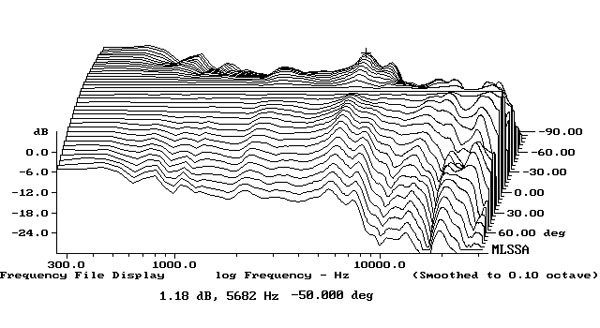
The black trace above 300Hz in fig.3 shows the farfield output of the Adante AF-61's coaxial midrange/treble unit on the tweeter axis. Other than a slight lack of energy in the mid-treble and a small peak centered on 10kHz, the Elac's response is superbly flat and even. The plot of the Adante AF-61's lateral dispersion, normalized to the tweeter-axis response (fig.4), reveals that these on-axis features disappear to the speaker's sides, meaning that, as Andrew Jones told TJN, the perceived treble balance in a normal-size room will be neutral. As anticipated, the tweeter begins to become directional above 12kHz, which might make the AF-61 sound a little airless in large or overdamped rooms, as TJN found in his room. In the vertical plane (fig.5), the Adante's even tweeter-axis balance is maintained across a wide window—just as well, considering that the tweeter is a high 46" above the floor.
Fig.4 Elac Adante AF-61, lateral response family at 50", normalized to response on tweeter axis, from back to front: differences in response 90–5° off axis, reference response, differences in response 5–90° off axis.
Fig.5 Elac Adante AF-61, vertical response family at 50", normalized to response on tweeter axis, from back to front: differences in response 15–5° above axis, reference response, differences in response 5–15° below axis.
In the time domain, the Adante AF-61's step response on the tweeter axis (fig.6) indicates that all of its drive-units are connected in positive acoustic polarity, with the tweeter's output arriving at the microphone before the midrange unit's, which in turn arrives before that of the passive radiators. The output of each unit smoothly blends with that of the next lower in frequency, suggesting optimal crossover design. The cumulative spectral-decay plot on the tweeter axis (fig.7) is generally clean.
Fig.6 Elac Adante AF-61, step response on tweeter axis at 50" (5ms time window, 30kHz bandwidth).
Fig.7 Elac Adante AF-61, cumulative spectral-decay plot on tweeter axis at 50" (0.15ms risetime).
The Elac Adante AF-61's measured performance reveals excellent speaker engineering, even if, as Tom Norton found, the speaker doesn't extend as low in the bass as you might expect.—John Atkinson
Footnote 1: See my video interview with the AF-61's designer, Andrew Jones here.















