

Sidebar 3: Measurements
I used DRA Labs' MLSSA system and a calibrated DPA 4006 microphone to measure the Elac Debut B6's frequency response in the farfield; for the nearfield frequency response, I used an Earthworks QTC-40, which has a ¼" capsule and thus doesn't present a significant obstacle to the sound.
My estimate of the Elac B6's voltage sensitivity was 85dB/2.83V/m, which is 2dB below the specified 87dB/2.83V/m. I suspect that this difference is due to the B6's behavior in the top octaves (see later). I have plotted how the Elac's impedance varies with frequency on a more extended vertical scale than usual (fig.1), as the magnitude remains above my usual 20-ohm scale limit for the entire treble region. With a minimum value of 6 ohms at 190Hz and an electrical phase angle that is high only when the impedance magnitude is also high, this will be a very easy load for the partnering amplifier to drive. Herb Reichert commented that the B6 "seems to like tubes." Indeed it does, and the shape of the solid impedance trace in this graph does suggest that the speaker's treble will be a little higher in level when connected to a tube amplifier's 8 ohm taps (again, see later).


 Higher in frequency in fig.3, the Elac's farfield response, averaged across a 30° horizontal window centered on the tweeter axis, is extraordinarily flat from the upper bass through to the high treble. This graph was taken without the skeletal, plastic-framed grille. With the grille, the speaker's output in the presence region dropped by more than 2dB. I took the opportunity to measure both samples; fig.4 reveals that they match superbly well for such an inexpensive speaker. (This graph was taken in-room, hence the uneven response below 1kHz.)


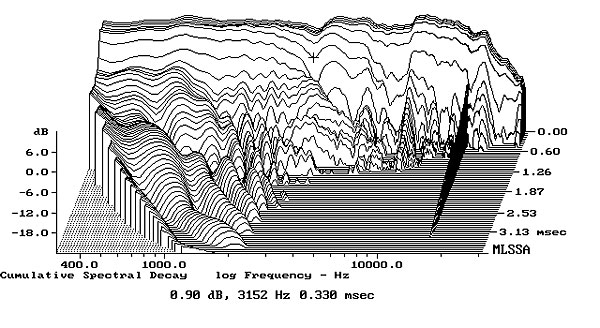
Fig.1 Elac Debut B6, electrical impedance (solid) and phase (dashed) (2 ohms/vertical div.).
A prominent discontinuity in the traces just below 200Hz suggests that the enclosure has a serious resonance at that frequency. While setting up the speaker on my turntable stand to measure it, I noted that the cabinet seemed very lively—investigating the panels' vibrational behavior with a plastic-tape accelerometer, I found a very high-level, high-Q resonant mode at 188Hz that was present on all surfaces but highest in level on the side panels (fig.2). As HR wrote of the sound through the B6es of a recording of male voice and double bass, "I heard that vibrating box—not a little, but a lot. . . . [The speakers] were vibrating like sex toys!" There are also some high-level resonant modes present in the midrange.
Fig.2 Elac Debut B6, cumulative spectral-decay plot calculated from output of accelerometer fastened to center of top panel (MLS driving voltage to speaker, 7.55V; measurement bandwidth, 2kHz).
The saddle centered on 48Hz in the impedance magnitude trace in fig.1 suggests that this is the tuning frequency of the flared port on the cabinet's rear panel. This is confirmed by the nearfield measurement of the woofer's response (fig.3, blue trace), which has a sharply defined notch at that frequency. (The port resonance holds the woofer stationary at its tuning frequency.) The port's own output (red trace) peaks between 35 and 70Hz, and its upper-frequency rollout is free from high-level resonant modes. However, there is a discontinuity in the port's rolloff, as well as a small glitch in the woofer's output, at the frequency of the strong panel resonance. The black trace in fig.3 is the complex sum of the woofer and port outputs; the broad peak in the upper bass is an artifact of the nearfield measurement technique, the B6's low frequencies extending cleanly down to the port tuning frequency, where the output is down by 6dB in textbook fashion.
Fig.3 Elac Debut B6, anechoic response on tweeter axis at 50", averaged across 30° horizontal window and corrected for microphone response, with nearfield responses of woofer (blue), port (red), and their complex sum (black), respectively plotted below 300Hz, 850Hz, and 300Hz.
Fig.4 Elac Debut B6, in-room frequency response on HF axis at 24", left sample (blue) and right (red) (1dB/vertical div.).
The top octave rolls off a little earlier than usual, and coupled with the fact that the B6's lateral dispersion narrows significantly above 7kHz (fig.5), the Elac might sound lacking in top-octave air in medium-to-large rooms or in rooms that are heavily furnished. Herb's listening room is both small and relatively undamped, which is probably why he was not concerned by the speaker's somewhat muted anechoic output in the high treble. In the vertical plane (fig.6), a sharply defined suckout in the crossover region develops more than 15° above and 10° below the tweeter axis.
Fig.5 Elac Debut B6, lateral response family at 50", normalized to response on tweeter axis, from back to front: differences in response 90–5° off axis, reference response, differences in response 5–90° off axis.
Fig.6 Elac Debut B6, vertical response family at 50", normalized to response on tweeter axis, from back to front: differences in response 45–5° above axis, reference response, differences in response 5–45° below axis.
Turning to the time domain, the Elac's step response on the tweeter axis (fig.7) indicates that both drive-units are connected in positive acoustic polarity. The cumulative spectral-decay plot on the same axis (fig.8) shows a commendably clean initial delay.
Fig.7 Elac Debut B6, step response on tweeter axis at 50" (5ms time window, 30kHz bandwidth).
Fig.8 Elac Debut B6, cumulative spectral-decay plot on tweeter axis at 50" (0.15ms risetime).
Other than that audibly significant enclosure resonance in the lower midrange, Elac's Debut B6 offers excellent measured performance, especially when you take into account its affordable price.—John Atkinson















