

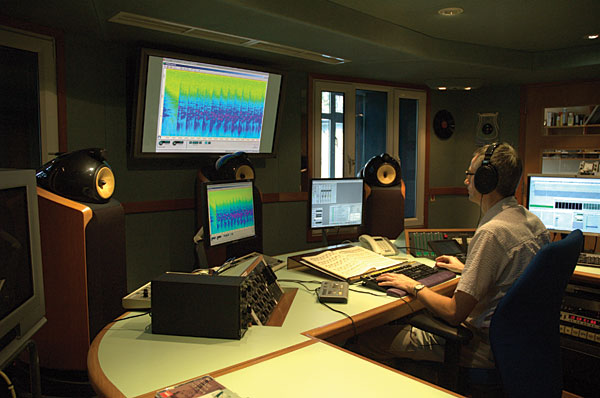
It's the first rule of being a stereophile: sound quality is serious business. Simon Gibson, one of the engineers at Abbey Road Studios who worked on EMI's new Signature Collection of hybrid SACD/CDs, knows the drill: remaster and change the sound of a much-loved classical recording from the label's glorious back catalog and you risk becoming a target of blogs and forums. Gibson's aware that the more hallowed the recording, the more quickly knives come out at the mention of remastering.
"We're not in the business of screwing with people's memories or trying to annoy people," Gibson says with a nervous laugh that tells you he's read his name, perhaps in unflattering contexts, on the Web. He's aware that the recordings of such artists as Otto Klemperer, Sviatoslav Richter, and Jacqueline Du Pré are held sacred by many. While it may not be a matter of life and death, the passions are still fervent: screw up Herbert von Karajan's Wagner recordings and you'll face a swarm of Web wrath. Butcher Bruckner and the chat-room denizens will come a-creepin'.
"People are very fond and very protective, if you like, of their favorite recordings. That's a historical thing, really, isn't it? People grow up with something—it's the first record they bought or the first record they fell in love with—and they feel very sort of personally responsible for it. And you can understand that—I have particular favorite recordings as well. We're just re-presenting EMI's fabulous back catalog."
Of course, giving the core classical catalog its first high-resolution remastering job amounts to more than a mere re-presentation. In the first batch of ten Signature Collection SACD/CDs to be released in the US and Europe—a small percentage of the 100 released so far in Japan, the market this project was originally conceived for—a familiar recording like Du Pré's famed reading of Elgar's Cello Concerto for example, does sound appreciably more alive than in its long-available CD edition. By all accounts, Gibson and the Abbey Road crew have done a wonderful job on this series. The book-style packaging for each release, which includes a 40-page color insert of notes and photos, is similarly successful. Ten more hybrid SACDs in the Signature Collection, variously listing for between $22 and $27, depending on the outlet, will be released in November.
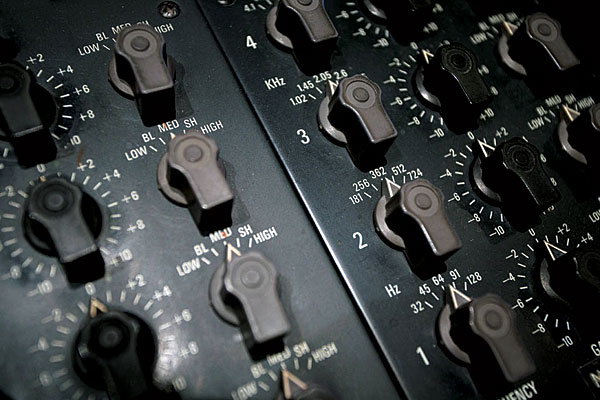 "It's a little bit like restoring a film frame by frame. Or cleaning an old master painting," Gibson says of remastering these recordings, some of which are over 60 years old. "You're trying to remove the layers of grime that have accumulated, and get back to the colors that the artist saw when he'd finished the painting in the studio. You're just trying to ease away some of the things that get in the way of hearing the music as the artists heard it when they recorded it."
As a Bruckner symphony that he's transferring to digital plays in the background, Gibson explains that, in contrast with the tape libraries and inventories of recording parts at most labels, EMI—which has wisely never allowed the Beatles' recording library to leave the secure confines of Abbey Road Studios—has been presciently meticulous over the years in the storage of the rest of its recorded archive. Housed in a purpose-built structure in West London, EMI's vault contains everything the label has ever recorded, from the earliest 78rpm records to the latest hard-disk drives.
"When we started this project for Japan, it was specifically for Furtwängler's recordings," Gibson says. "Now the period of recording for those was sort of 1940s–50s, so it straddled the end of the 78rpm era and the beginning of the analog tape era, so there were issues with sourcing the right original masters for some of those." He goes on to say that less than 10% of the Signature Collection is sourced from 78s. "Because these recordings have been worked on over the years, we are sort of familiar with the archives and what's there, and we were able to actually discover one or two tapes of Furtwängler that hadn't been used before, so we were able to use better sources for certain recordings: one of the Beethoven symphonies, I think, and the Brahms Violin Concerto, done live in Switzerland. That was a very early tape, from 1949, with Yehudi Menuhin.
"It's a little bit like restoring a film frame by frame. Or cleaning an old master painting," Gibson says of remastering these recordings, some of which are over 60 years old. "You're trying to remove the layers of grime that have accumulated, and get back to the colors that the artist saw when he'd finished the painting in the studio. You're just trying to ease away some of the things that get in the way of hearing the music as the artists heard it when they recorded it."
As a Bruckner symphony that he's transferring to digital plays in the background, Gibson explains that, in contrast with the tape libraries and inventories of recording parts at most labels, EMI—which has wisely never allowed the Beatles' recording library to leave the secure confines of Abbey Road Studios—has been presciently meticulous over the years in the storage of the rest of its recorded archive. Housed in a purpose-built structure in West London, EMI's vault contains everything the label has ever recorded, from the earliest 78rpm records to the latest hard-disk drives.
"When we started this project for Japan, it was specifically for Furtwängler's recordings," Gibson says. "Now the period of recording for those was sort of 1940s–50s, so it straddled the end of the 78rpm era and the beginning of the analog tape era, so there were issues with sourcing the right original masters for some of those." He goes on to say that less than 10% of the Signature Collection is sourced from 78s. "Because these recordings have been worked on over the years, we are sort of familiar with the archives and what's there, and we were able to actually discover one or two tapes of Furtwängler that hadn't been used before, so we were able to use better sources for certain recordings: one of the Beethoven symphonies, I think, and the Brahms Violin Concerto, done live in Switzerland. That was a very early tape, from 1949, with Yehudi Menuhin.
 "For the majority of the core catalog stuff that you see on Signature, these are all LP master tapes, well documented. Sometimes you will find that there is a question over the provenance of a particular, say, copy tape. So if it says it's a copy tape, then you say, 'Well, okay, so where's the original? Why isn't the original used?' That's when you need to do a bit of digging. When I say digging, basically we have files for each recording, which were put together at the time of the recording by the engineer and the producer and the editors. And they contain a variety of information, often useful information for us today, in terms of what EQ was used, when the LP was cut, and comments from the producer saying, 'I want this movement 2dB louder and this movement 4dB quieter.' So when the tape is played, [we can] take that into account."
The shedding problems associated with aging, ¼" two-track tape are well known, and that's where the ears of Gibson and his fellow mastering engineers, Ian Jones and Andrew Walter, come in. Classically trained as an organist and pianist, Gibson has been a mastering engineer at Abbey Road since 1990, during which time he's worked on the 2009 remasterings of the Beatles' back catalog, the Beatles version of the video game Rock Band, and the Harry Potter soundtracks in 5.1-channel surround and two-channel stereo; he also mastered Alexandre Desplat's score for the film The King's Speech for CD release.
"You make the transfer [using the Prism ADA-8 Converter], you hear it while it's transferring onto digits, and then you work through it on our digital editing system here, line by line, with the score. We fix the things that need fixing, and where we can, we make a reference to previous CD versions, possibly the original LP release, and get a feel for the sound this recording has had in its previous incarnations.
"On an analog tape, you've got joins, you've got edits, the tape is cut and spliced together. Sometimes the analog edits, despite the best intentions and skills of the editors in the past, sound a little bit less than seamless. There's a bump or a jump, so we hear that [and] we can fiddle around digitally and make that join more seamless—get rid of any bumps and pops and clicks and things. Analog dropouts, where there's a little bit of gunk or something on the tape and there's a slight loss of high frequency—that's where you notice it, particularly in the ambience, and you hear a slight dropout in the left channel or the right channel or both channels—we can fix that by interpolation or using a software tool and make it seamless again, join it up. Some of the things we worry about, frankly, some people wouldn't even notice. But because it's going to be out on a hi-rez format, we took the trouble to remaster to the best possible standard. With all of these sorts of changes—improvements, if you like—the bottom line is, you don't affect the recording. If it affects the music, you don't do it, or you've got to find a compromise."
"For the majority of the core catalog stuff that you see on Signature, these are all LP master tapes, well documented. Sometimes you will find that there is a question over the provenance of a particular, say, copy tape. So if it says it's a copy tape, then you say, 'Well, okay, so where's the original? Why isn't the original used?' That's when you need to do a bit of digging. When I say digging, basically we have files for each recording, which were put together at the time of the recording by the engineer and the producer and the editors. And they contain a variety of information, often useful information for us today, in terms of what EQ was used, when the LP was cut, and comments from the producer saying, 'I want this movement 2dB louder and this movement 4dB quieter.' So when the tape is played, [we can] take that into account."
The shedding problems associated with aging, ¼" two-track tape are well known, and that's where the ears of Gibson and his fellow mastering engineers, Ian Jones and Andrew Walter, come in. Classically trained as an organist and pianist, Gibson has been a mastering engineer at Abbey Road since 1990, during which time he's worked on the 2009 remasterings of the Beatles' back catalog, the Beatles version of the video game Rock Band, and the Harry Potter soundtracks in 5.1-channel surround and two-channel stereo; he also mastered Alexandre Desplat's score for the film The King's Speech for CD release.
"You make the transfer [using the Prism ADA-8 Converter], you hear it while it's transferring onto digits, and then you work through it on our digital editing system here, line by line, with the score. We fix the things that need fixing, and where we can, we make a reference to previous CD versions, possibly the original LP release, and get a feel for the sound this recording has had in its previous incarnations.
"On an analog tape, you've got joins, you've got edits, the tape is cut and spliced together. Sometimes the analog edits, despite the best intentions and skills of the editors in the past, sound a little bit less than seamless. There's a bump or a jump, so we hear that [and] we can fiddle around digitally and make that join more seamless—get rid of any bumps and pops and clicks and things. Analog dropouts, where there's a little bit of gunk or something on the tape and there's a slight loss of high frequency—that's where you notice it, particularly in the ambience, and you hear a slight dropout in the left channel or the right channel or both channels—we can fix that by interpolation or using a software tool and make it seamless again, join it up. Some of the things we worry about, frankly, some people wouldn't even notice. But because it's going to be out on a hi-rez format, we took the trouble to remaster to the best possible standard. With all of these sorts of changes—improvements, if you like—the bottom line is, you don't affect the recording. If it affects the music, you don't do it, or you've got to find a compromise."
"It's a little bit like restoring a film frame by frame. Or cleaning an old master painting," Gibson says of remastering these recordings, some of which are over 60 years old. "You're trying to remove the layers of grime that have accumulated, and get back to the colors that the artist saw when he'd finished the painting in the studio. You're just trying to ease away some of the things that get in the way of hearing the music as the artists heard it when they recorded it."
As a Bruckner symphony that he's transferring to digital plays in the background, Gibson explains that, in contrast with the tape libraries and inventories of recording parts at most labels, EMI—which has wisely never allowed the Beatles' recording library to leave the secure confines of Abbey Road Studios—has been presciently meticulous over the years in the storage of the rest of its recorded archive. Housed in a purpose-built structure in West London, EMI's vault contains everything the label has ever recorded, from the earliest 78rpm records to the latest hard-disk drives.
"For the majority of the core catalog stuff that you see on Signature, these are all LP master tapes, well documented. Sometimes you will find that there is a question over the provenance of a particular, say, copy tape. So if it says it's a copy tape, then you say, 'Well, okay, so where's the original? Why isn't the original used?' That's when you need to do a bit of digging. When I say digging, basically we have files for each recording, which were put together at the time of the recording by the engineer and the producer and the editors. And they contain a variety of information, often useful information for us today, in terms of what EQ was used, when the LP was cut, and comments from the producer saying, 'I want this movement 2dB louder and this movement 4dB quieter.' So when the tape is played, [we can] take that into account."
The shedding problems associated with aging, ¼" two-track tape are well known, and that's where the ears of Gibson and his fellow mastering engineers, Ian Jones and Andrew Walter, come in. Classically trained as an organist and pianist, Gibson has been a mastering engineer at Abbey Road since 1990, during which time he's worked on the 2009 remasterings of the Beatles' back catalog, the Beatles version of the video game Rock Band, and the Harry Potter soundtracks in 5.1-channel surround and two-channel stereo; he also mastered Alexandre Desplat's score for the film The King's Speech for CD release.















