

Once I'd loaded the N10 with all the tracks I expected to listen to for this review, I again faced two choices. First, I could use the N10's USB output, which, as the DV2's USB input operates in the asynchronous mode, would allow the DAC to act as the master clock and let me take full advantage of the DV2's playback options. Second, I could use its RCA and AES/EBU outputs, which Aurender's US tech-support person, Ari Margolis, assured me were the sonic jewels in its crown. He explained by phone: "Both the N10's AES and S/PDIF outputs are superior to its USB because the former are both governed by the unit's oven-controlled crystal oscillator (OCXO) clock, which determines the intervals at which information is sent to the DAC. The N10's clock solves the problem of jittery S/PDIF outputs, which can cause a phasey effect that blurs the soundstage and results in a less precise image."
I decided that to grok the DV2's ultimate sonic potential I would try all of the Aurender's outputs, as well as using the dCS Network Bridge.
While everything settled in, I e-mailed Al Rashid to ascertain which USB interfaces EMM Labs suggests to prospective DV2 owners. "Usually we would first recommend a computer/laptop as the source, with Roon, JRiver, or Audirvana as the playback software, depending upon the user's experience," he wrote. "Many users find the Roon interface easy to use, and JRiver has a computer-like interface that users who are well versed with computers prefer. From there, if a user wanted a standalone music player/server, they usually branch out to devices like Aurender, dCS Network Bridge, etc. We are currently developing our own standalone streamer that will be released in 2019."
Listening
Comfortable that I'd done everything I could to hear all the DV2 had to offer, I began to expend enough energy in comparisons and cable swaps to scale Mt. Everest. (Given how many interconnects my reference dCS gear requires, I probably have enough Nordost wire on hand to enable me to get up and back without losing a single digit.) By the time I'd finished my listening, which included reviewing several classical recordings for Stereophile.com, it had become clear that the DV2 is one of the finest-sounding DACs with volume control that I've ever heard in my reference system.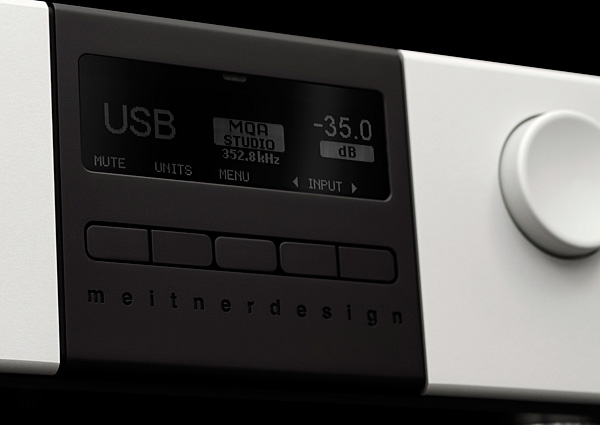 Even with a computer as the source, when I played Debussy's Trois Chansons de Bilitis, from our January 2019 "Recording of the Month," mezzo-soprano Joyce DiDonato's Into the Fire (24/96 WAV, Erato 573802), I was won over by the beauty of the DV2's extremely natural, warm, smooth, nonfatiguing sound. But when I ditched the computer and, using the Aurender N10's USB output, played JA's MQA-encoded file of Eric Whitacre's Lux Aurumque, from male vocal ensemble Cantus's While You Are Alive (24/88.2, CD Baby 5637240534), the music server's more color-filled sound assured me that this would be one joy-filled review. While the MQA version of this track confirmed the success of the DV2's implementation of MQA decoding and rendering—with additional natural-sounding clarity to the voices, and a more convincing perspective that placed the ensemble farther back on the soundstage—24/88.2 PCM sounded quite wonderful on its own.
With the Aurender N10 sending signals to the DV2 via USB, I sat entranced at the gorgeous rendition of Debussy's Sonata for Flute, Viola, and Harp, performed by Marie-Pierre Langlamet, Emmanuel Pahud, and Gérard Caussé (24/96 WAV, Erato 565142). Although I'd planned to listen to only a single movement, I was so mesmerized that I couldn't tear myself away from the DV2's spacious, colorful, superbly controlled sound.
But I'm a critic; more comparisons were in order. After wrenching myself free of Debussy's spell, I gave the Aurender a shelf of its own and began to compare the sound of its USB, coaxial S/PDIF, and AES/EBU outputs. Using S/PDIF may have limited me to PCM 24/192, DSD64, and no MQA, but it did allow me to determine that the sound from the N10's RCA and AES outputs was superior to that from its USB port.
I chose a track I know very well: the opening movement of Mahler's Symphony 3, in the sonically superb recording by Iván Fischer and the Budapest Festival Orchestra (DSD64, Channel Classics 38817). As much as the Aurender's USB output delivered lovely, warm sound, with excellent bass control and impact, a strong midrange, and appropriate bite on the horns, its AES/EBU and S/PDIF outputs let the DV2 deliver more three-dimensionality, deeper-reaching bass, and a more energetic sound. The BFO's glistening strings seemed to hold their heads higher when, after the symphony's first five or six minutes, their light finally pierced Mahler's relentless militant darkness.
How, I wondered, would the sound of music signals sent from the Aurender N10's S/PDIF and AES/EBU outputs to the DV2 compare to the sound of the dCS Network Bridge relaying signal from those two outputs? (Reminder: The Network Bridge has no USB output.) For reasons yet to be explained, the DV2 refused to recognize signals from the Network Bridge's AES/EBU output. Sending signals via S/PDIF, which was restricted to non-MQA PCM 24/192 and DSD64, was the only way to compare them.
The Roon->Network Bridge->DV2 via coax won out over the N10->DV2 via coax. With Mahler's Symphony 3, the Network Bridge delivered more saturated colors and, without question, greater transparency. The sounds of the first movement's blaring horns were fuller, and each instrument seemed to have greater body and presence on the soundstage.
I compared the N10's sound to the Network Bridge's on several other tracks, including the first movement of Spring, from Vivaldi's The Four Seasons, with violin soloist Rachel Podger and Brecon Baroque (DSD64, Channel Classics 40318); and Lou Harrison's clearly recorded, color- and percussion-rich Concerto for Violin with Percussion Orchestra, with violinist Tim Fain and Angel Gil-Ordóñez leading the PostClassical Ensemble (24/48 WAV, Naxos 8.559825/HDtracks). By the time I'd finished, the chain of Roon->dCS Network Bridge via Ethernet->DV2 via coax had won me over.
"I love the sound of this DAC," I scribbled in my notes. "The contrasting colors through the Network Bridge are just wonderful."
Could it get any better?
Even with a computer as the source, when I played Debussy's Trois Chansons de Bilitis, from our January 2019 "Recording of the Month," mezzo-soprano Joyce DiDonato's Into the Fire (24/96 WAV, Erato 573802), I was won over by the beauty of the DV2's extremely natural, warm, smooth, nonfatiguing sound. But when I ditched the computer and, using the Aurender N10's USB output, played JA's MQA-encoded file of Eric Whitacre's Lux Aurumque, from male vocal ensemble Cantus's While You Are Alive (24/88.2, CD Baby 5637240534), the music server's more color-filled sound assured me that this would be one joy-filled review. While the MQA version of this track confirmed the success of the DV2's implementation of MQA decoding and rendering—with additional natural-sounding clarity to the voices, and a more convincing perspective that placed the ensemble farther back on the soundstage—24/88.2 PCM sounded quite wonderful on its own.
With the Aurender N10 sending signals to the DV2 via USB, I sat entranced at the gorgeous rendition of Debussy's Sonata for Flute, Viola, and Harp, performed by Marie-Pierre Langlamet, Emmanuel Pahud, and Gérard Caussé (24/96 WAV, Erato 565142). Although I'd planned to listen to only a single movement, I was so mesmerized that I couldn't tear myself away from the DV2's spacious, colorful, superbly controlled sound.
But I'm a critic; more comparisons were in order. After wrenching myself free of Debussy's spell, I gave the Aurender a shelf of its own and began to compare the sound of its USB, coaxial S/PDIF, and AES/EBU outputs. Using S/PDIF may have limited me to PCM 24/192, DSD64, and no MQA, but it did allow me to determine that the sound from the N10's RCA and AES outputs was superior to that from its USB port.
I chose a track I know very well: the opening movement of Mahler's Symphony 3, in the sonically superb recording by Iván Fischer and the Budapest Festival Orchestra (DSD64, Channel Classics 38817). As much as the Aurender's USB output delivered lovely, warm sound, with excellent bass control and impact, a strong midrange, and appropriate bite on the horns, its AES/EBU and S/PDIF outputs let the DV2 deliver more three-dimensionality, deeper-reaching bass, and a more energetic sound. The BFO's glistening strings seemed to hold their heads higher when, after the symphony's first five or six minutes, their light finally pierced Mahler's relentless militant darkness.
How, I wondered, would the sound of music signals sent from the Aurender N10's S/PDIF and AES/EBU outputs to the DV2 compare to the sound of the dCS Network Bridge relaying signal from those two outputs? (Reminder: The Network Bridge has no USB output.) For reasons yet to be explained, the DV2 refused to recognize signals from the Network Bridge's AES/EBU output. Sending signals via S/PDIF, which was restricted to non-MQA PCM 24/192 and DSD64, was the only way to compare them.
The Roon->Network Bridge->DV2 via coax won out over the N10->DV2 via coax. With Mahler's Symphony 3, the Network Bridge delivered more saturated colors and, without question, greater transparency. The sounds of the first movement's blaring horns were fuller, and each instrument seemed to have greater body and presence on the soundstage.
I compared the N10's sound to the Network Bridge's on several other tracks, including the first movement of Spring, from Vivaldi's The Four Seasons, with violin soloist Rachel Podger and Brecon Baroque (DSD64, Channel Classics 40318); and Lou Harrison's clearly recorded, color- and percussion-rich Concerto for Violin with Percussion Orchestra, with violinist Tim Fain and Angel Gil-Ordóñez leading the PostClassical Ensemble (24/48 WAV, Naxos 8.559825/HDtracks). By the time I'd finished, the chain of Roon->dCS Network Bridge via Ethernet->DV2 via coax had won me over.
"I love the sound of this DAC," I scribbled in my notes. "The contrasting colors through the Network Bridge are just wonderful."
Could it get any better?
Given that the DV2 is EMM Labs' most expensive stereo DAC at $30,000, and its only DAC with a volume control, a comparison with dCS's top-of-the-line Vivaldi DAC with volume control ($38,000) seemed appropriate. Both models can play PCM up to 24/384 and DSD up to 128, and both can decode and render MQA, though by different methods. To play these high resolutions, the DV2 uses USB, the Vivaldi a dual-AES/EBU link. In fact, when the Vivaldi is paired with either the Network Bridge or a dCS transport, dCS recommends dual AES for PCM sampling rates of 88.2k and above, and DSD64 and DSD128.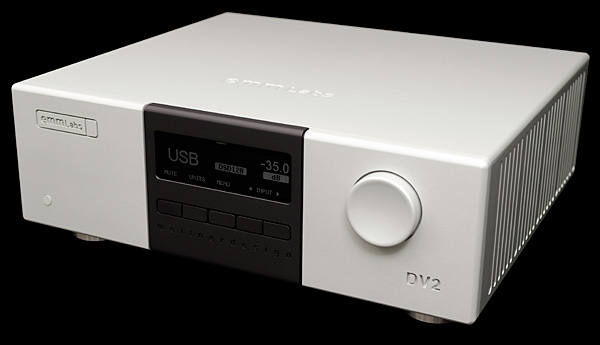 Using the dCS Network Bridge to feed both units via coaxial S/PDIF, I found the dCS Vivaldi's sound livelier. The Vivaldi revealed more of the leading edges of instruments' sound, and delivered great timbral contrast. This became especially apparent when I returned to Podger and Brecon Baroque's The Four Seasons and discovered that the DV2's sound was smoother, warmer, mellower than the Vivaldi's, and a mite toned down on top. In that regard it was a bit less "intrusive," and less demanding of attention. Bass, image size, and soundstaging, however, seemed equivalent from both units. Although these two DACs had different strengths, both sounded superb.
While signals sent to the Vivaldi through single S/PDIF and single AES/EBU produced pretty similar sounds—AES/EBU, to my ears, had a bit of an advantage, delivering somewhat rounder, more three-dimensional images—what the Vivaldi received through its dual-AES/EBU inputs produced more open, more 3D sound than anything I heard from the DV2. I first confirmed this using the recording of Mahler's Symphony 3 (DSD64). When I adjusted the Network Bridge to let me switch from single to dual-AES/EBU, the latter not only increased the soundstage depth and spaciousness, it also delivered fuller, rounder, more realistic images.
Which leads me to conclude . . .
Using the dCS Network Bridge to feed both units via coaxial S/PDIF, I found the dCS Vivaldi's sound livelier. The Vivaldi revealed more of the leading edges of instruments' sound, and delivered great timbral contrast. This became especially apparent when I returned to Podger and Brecon Baroque's The Four Seasons and discovered that the DV2's sound was smoother, warmer, mellower than the Vivaldi's, and a mite toned down on top. In that regard it was a bit less "intrusive," and less demanding of attention. Bass, image size, and soundstaging, however, seemed equivalent from both units. Although these two DACs had different strengths, both sounded superb.
While signals sent to the Vivaldi through single S/PDIF and single AES/EBU produced pretty similar sounds—AES/EBU, to my ears, had a bit of an advantage, delivering somewhat rounder, more three-dimensional images—what the Vivaldi received through its dual-AES/EBU inputs produced more open, more 3D sound than anything I heard from the DV2. I first confirmed this using the recording of Mahler's Symphony 3 (DSD64). When I adjusted the Network Bridge to let me switch from single to dual-AES/EBU, the latter not only increased the soundstage depth and spaciousness, it also delivered fuller, rounder, more realistic images.
Which leads me to conclude . . .
Of all the DACs I've heard in my reference system, the EMM Labs DV2 delivered the smoothest, most naturally warm, most consistently engaging and non-fatiguing reproduction of music. Its image size, resolution, and bass were up there with the very best. More than anything else, the difference in sound between the DV2 and other DACs at or near its price that I've heard was akin to the experience of hearing the same music performed by the same forces in different halls. If the DV2's sound is music to your ears, and it's within your price range, don't hesitate to audition it in your reference system. You may fall so deeply in love with its excellent sound that you end up upgrading some of your other components to better hear how good the DV2 is.
Comfortable that I'd done everything I could to hear all the DV2 had to offer, I began to expend enough energy in comparisons and cable swaps to scale Mt. Everest. (Given how many interconnects my reference dCS gear requires, I probably have enough Nordost wire on hand to enable me to get up and back without losing a single digit.) By the time I'd finished my listening, which included reviewing several classical recordings for Stereophile.com, it had become clear that the DV2 is one of the finest-sounding DACs with volume control that I've ever heard in my reference system.
Even with a computer as the source, when I played Debussy's Trois Chansons de Bilitis, from our January 2019 "Recording of the Month," mezzo-soprano Joyce DiDonato's Into the Fire (24/96 WAV, Erato 573802), I was won over by the beauty of the DV2's extremely natural, warm, smooth, nonfatiguing sound. But when I ditched the computer and, using the Aurender N10's USB output, played JA's MQA-encoded file of Eric Whitacre's Lux Aurumque, from male vocal ensemble Cantus's While You Are Alive (24/88.2, CD Baby 5637240534), the music server's more color-filled sound assured me that this would be one joy-filled review. While the MQA version of this track confirmed the success of the DV2's implementation of MQA decoding and rendering—with additional natural-sounding clarity to the voices, and a more convincing perspective that placed the ensemble farther back on the soundstage—24/88.2 PCM sounded quite wonderful on its own.
With the Aurender N10 sending signals to the DV2 via USB, I sat entranced at the gorgeous rendition of Debussy's Sonata for Flute, Viola, and Harp, performed by Marie-Pierre Langlamet, Emmanuel Pahud, and Gérard Caussé (24/96 WAV, Erato 565142). Although I'd planned to listen to only a single movement, I was so mesmerized that I couldn't tear myself away from the DV2's spacious, colorful, superbly controlled sound.
Given that the DV2 is EMM Labs' most expensive stereo DAC at $30,000, and its only DAC with a volume control, a comparison with dCS's top-of-the-line Vivaldi DAC with volume control ($38,000) seemed appropriate. Both models can play PCM up to 24/384 and DSD up to 128, and both can decode and render MQA, though by different methods. To play these high resolutions, the DV2 uses USB, the Vivaldi a dual-AES/EBU link. In fact, when the Vivaldi is paired with either the Network Bridge or a dCS transport, dCS recommends dual AES for PCM sampling rates of 88.2k and above, and DSD64 and DSD128.
Using the dCS Network Bridge to feed both units via coaxial S/PDIF, I found the dCS Vivaldi's sound livelier. The Vivaldi revealed more of the leading edges of instruments' sound, and delivered great timbral contrast. This became especially apparent when I returned to Podger and Brecon Baroque's The Four Seasons and discovered that the DV2's sound was smoother, warmer, mellower than the Vivaldi's, and a mite toned down on top. In that regard it was a bit less "intrusive," and less demanding of attention. Bass, image size, and soundstaging, however, seemed equivalent from both units. Although these two DACs had different strengths, both sounded superb.
While signals sent to the Vivaldi through single S/PDIF and single AES/EBU produced pretty similar sounds—AES/EBU, to my ears, had a bit of an advantage, delivering somewhat rounder, more three-dimensional images—what the Vivaldi received through its dual-AES/EBU inputs produced more open, more 3D sound than anything I heard from the DV2. I first confirmed this using the recording of Mahler's Symphony 3 (DSD64). When I adjusted the Network Bridge to let me switch from single to dual-AES/EBU, the latter not only increased the soundstage depth and spaciousness, it also delivered fuller, rounder, more realistic images.
Of all the DACs I've heard in my reference system, the EMM Labs DV2 delivered the smoothest, most naturally warm, most consistently engaging and non-fatiguing reproduction of music. Its image size, resolution, and bass were up there with the very best. More than anything else, the difference in sound between the DV2 and other DACs at or near its price that I've heard was akin to the experience of hearing the same music performed by the same forces in different halls. If the DV2's sound is music to your ears, and it's within your price range, don't hesitate to audition it in your reference system. You may fall so deeply in love with its excellent sound that you end up upgrading some of your other components to better hear how good the DV2 is.















