My thirst for vinyl can be blind and wild. I know this when I find myself dashing through the midday sun, from the Stereophile office and up Madison Avenue, into Grand Central Station, onto the 6 train to Astor Place, and into my favorite record shop, Other Music, like a man in lust or love or, worse yet, possessed wholly by need. But unlike some of my more dogmatic friends and colleagues, I have no real problem with the Compact Disc. It's just that CDs often lack a certain intangible charm, the ability to make my heart race.
Because we are audiophiles and because this is Stereophile, it might seem that my choice would, or even should, have something to do with sound. It doesn't. I have no strong opinion on the sonic characteristics of CDs and LPs—either can sound ravishing, dreadful, or anywhere in between—and I rarely make direct comparisons between CD and LP versions of a particular recording in an attempt to draw conclusions about the formats' relative sonic merits. (How would one do that properly, anyway? How do you eliminate the respective source components? Wouldn't you also be comparing a CD player to a turntable? What sense would that make?) Whether it's because I'm in the earlier stages of my audiophile journey or because I'm superficial or simply because I'm me, the fact remains that I am less concerned with sound than I am with beauty and soul. I see and feel a certain beauty and soul in LPs that I rarely perceive in CDs. In my mind and to my eyes, a CD is a small, cheap facsimile of the real thing, the true work of art: the magnificent and lovable LP.
Besides, as much as it is about anything, hi-fi is about creating and enjoying a memorable experience. I prefer the experience of listening to vinyl, with all its little rituals and demands intact.
All of which is why, when a particular piece of music is available on both formats, I will always choose the LP. But often, that choice does not exist, and a recording is available only on CD. Should I then forsake the music altogether, deny myself the pleasure of hearing that music at home on the hi-fi?
Of course not.
Although music has no easily identifiable adaptive function—civilization could go on without it—for me, it stands alongside food, shelter, clothing, and companionship as one of the ingredients essential to a complete and happy life: It feeds us, keeps us safe and warm, accompanies us through good times and bad. We need it.
And if it's music from, say, Alva Noto and Ryuichi Sakamoto, Mark Hollis, or Matthew Shipp, I need it any way I can get it.
In a machine-oriented way
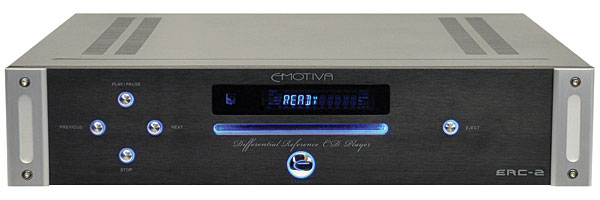
Because I am an audiophile, I want to hear that music through the best possible source component. Lately, I've been enjoying CDs through the Emotiva ERC-2 CD player ($449, footnote 1). The Emotiva ERC-2 measures 17? (435mm) wide by 4.25? (110mm) high by 14? (360mm) deep and, at 17.5 lbs (8kg), is the heaviest component to enter my listening room since the 25-lb Simaudio Moon i3.3 integrated amplifier ($3300, discontinued). The player's distinct appearance was developed by Emotiva's president and CEO, Dan Laufman, and VP of engineering, Lonnie Vaughn. In building the ERC-2, their goal was to "keep it simple, easy to use, and elegant . . . in a machine-oriented way." Indeed, the ERC-2 is clearly a machine. Its satiny black faceplate of brushed aluminum is capped at each end by a strip of stainless steel. To the left are four silver function buttons (Play/Pause, Next, Stop, Previous), arranged in a diamond; at center, from top to bottom, are the large display, a thin slot for loading discs, and a large Standby button adorned with Emotiva's distinctive E logo; to the right of these, all by itself, is the Eject button. This arrangement makes ergonomic sense, but it creates a louder, busier look than would a simple straight row of buttons.
Each button on the ERC-2's faceplate is lit by a halo of bright, clear blue that perfectly matches the bright, clear blue of the player's vacuum-fluorescent display. Like a Christmas tree, these blue lights set my small apartment aglow. Fortunately, the Dim button on the ERC-2's remote control softens the display and deactivates the halos. About that remote: It's a massive brick of milled aluminum designed to match the player's overall look and feel—in a word, manly.
Indeed, the ERC-2 and its hefty remote together exude an extremely masculine look and feel that I don't fully appreciate; I would prefer a quieter, more subtle appearance. To my eyes, the ERC-2's look is gaudy, boastful; I kept thinking that the women I know would find it unattractive. But every woman who entered my listening room and whose opinion I asked gave an ambivalent shrug. "As long as it works, I don't care," one said. "They all look the same to me." (And, yes, she was talking about the CD player.)
It took me a little while to get used to the ERC-2's slot-loading transport, which is made by Toshiba. First, it requires a careful touch: Line up the CD so that its edge is perfectly centered in the slot, begin to gently insert the disc, then let the player take the disc. If the disc is too far to either side of the slot, the player won't accept it. Second, the ERC-2's loading mechanism is slow: The review sample took up to 12 seconds to load a disc and up to four seconds to eject it, so be patient. Finally, once the player has loaded the disc, it immediately begins playing the disc from the beginning—if you want to hear track 5, you'll have to then select it using the front-panel buttons or the remote.
 On the rear panel are: a set of balanced outputs; two sets of analog outputs; S/PDIF, TosLink, and AES/EBU digital outputs; a trigger input; a rocker power switch; and a standard IEC three-prong power receptacle for the included AC cord. Despite my feelings about its appearance, the ERC-2's build quality is undeniably impressive, with a level of fit and finish appropriate to a component costing three to four times as much.
Correct from the ground up
On the rear panel are: a set of balanced outputs; two sets of analog outputs; S/PDIF, TosLink, and AES/EBU digital outputs; a trigger input; a rocker power switch; and a standard IEC three-prong power receptacle for the included AC cord. Despite my feelings about its appearance, the ERC-2's build quality is undeniably impressive, with a level of fit and finish appropriate to a component costing three to four times as much.
Correct from the ground up
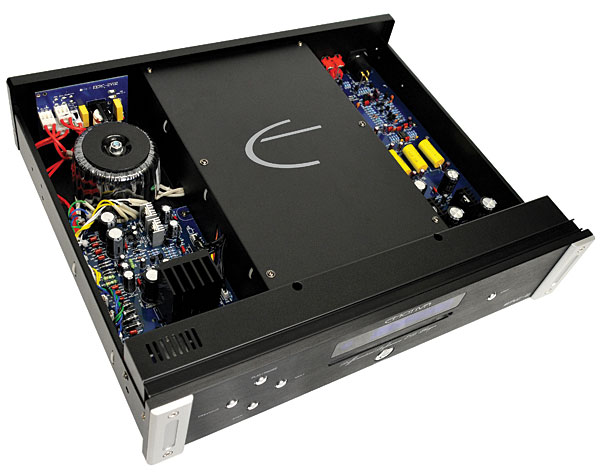
How does Emotiva keep their prices so low? According to Laufman and Vaughn, all Emotiva products are designed, distributed, and supported in Franklin, Tennessee, while manufacture and assembly take place in China. Laufman and Vaughn insist that their manufacturing partners are "totally committed to quality." I buy this. In addition to spending several weeks with the ERC-2, I've met and spoken with Laufman and Vaughn, and I trust that their enthusiasm and care for their company and its customers would be clearly communicated to Emotiva's colleagues overseas, ensuring that the company's values are appropriately respected. They take special pride in having built a loyal customer base and providing exceptional customer service, as is evident in their lively online community and events such as the annual Emofest: a weekend of factory tours, live music, and entertainment open to customers and friends. Informed by feedback from those customers, Laufman and Vaughn told me that they decided "to build a player that was correct from the ground up." Under the ERC-2's hood, four individually regulated and shielded power supplies drive the CD transport mechanism, VFD display, and digital and analog electronics. The result, according to Emotiva, is "dead-quiet ground-floor noise, extremely low distortion, and complete freedom from interaction between circuit elements." At the heart of the ERC-2 is a high-quality Analog Devices AD1955 24-bit oversampling DAC. The ERC-2 carries its balanced topology from the output of this chip straight through to the rear-panel XLR jacks.
Emotiva sells direct, with free shipping to anywhere in the continental US. All Emotiva products are backed by a 30-day "hassle-free" return policy and a five-year transferrable warranty.
Footnote 1: Emotiva Audio Corporation, 135 Southeast Parkway Court, Franklin, TN 37064. Tel: (615) 790-6754. Web: www.emotiva.com.
Because I am an audiophile, I want to hear that music through the best possible source component. Lately, I've been enjoying CDs through the Emotiva ERC-2 CD player ($449, footnote 1). The Emotiva ERC-2 measures 17? (435mm) wide by 4.25? (110mm) high by 14? (360mm) deep and, at 17.5 lbs (8kg), is the heaviest component to enter my listening room since the 25-lb Simaudio Moon i3.3 integrated amplifier ($3300, discontinued). The player's distinct appearance was developed by Emotiva's president and CEO, Dan Laufman, and VP of engineering, Lonnie Vaughn. In building the ERC-2, their goal was to "keep it simple, easy to use, and elegant . . . in a machine-oriented way." Indeed, the ERC-2 is clearly a machine. Its satiny black faceplate of brushed aluminum is capped at each end by a strip of stainless steel. To the left are four silver function buttons (Play/Pause, Next, Stop, Previous), arranged in a diamond; at center, from top to bottom, are the large display, a thin slot for loading discs, and a large Standby button adorned with Emotiva's distinctive E logo; to the right of these, all by itself, is the Eject button. This arrangement makes ergonomic sense, but it creates a louder, busier look than would a simple straight row of buttons.
On the rear panel are: a set of balanced outputs; two sets of analog outputs; S/PDIF, TosLink, and AES/EBU digital outputs; a trigger input; a rocker power switch; and a standard IEC three-prong power receptacle for the included AC cord. Despite my feelings about its appearance, the ERC-2's build quality is undeniably impressive, with a level of fit and finish appropriate to a component costing three to four times as much.
Correct from the ground upHow does Emotiva keep their prices so low? According to Laufman and Vaughn, all Emotiva products are designed, distributed, and supported in Franklin, Tennessee, while manufacture and assembly take place in China. Laufman and Vaughn insist that their manufacturing partners are "totally committed to quality." I buy this. In addition to spending several weeks with the ERC-2, I've met and spoken with Laufman and Vaughn, and I trust that their enthusiasm and care for their company and its customers would be clearly communicated to Emotiva's colleagues overseas, ensuring that the company's values are appropriately respected. They take special pride in having built a loyal customer base and providing exceptional customer service, as is evident in their lively online community and events such as the annual Emofest: a weekend of factory tours, live music, and entertainment open to customers and friends. Informed by feedback from those customers, Laufman and Vaughn told me that they decided "to build a player that was correct from the ground up." Under the ERC-2's hood, four individually regulated and shielded power supplies drive the CD transport mechanism, VFD display, and digital and analog electronics. The result, according to Emotiva, is "dead-quiet ground-floor noise, extremely low distortion, and complete freedom from interaction between circuit elements." At the heart of the ERC-2 is a high-quality Analog Devices AD1955 24-bit oversampling DAC. The ERC-2 carries its balanced topology from the output of this chip straight through to the rear-panel XLR jacks.
Footnote 1: Emotiva Audio Corporation, 135 Southeast Parkway Court, Franklin, TN 37064. Tel: (615) 790-6754. Web: www.emotiva.com.