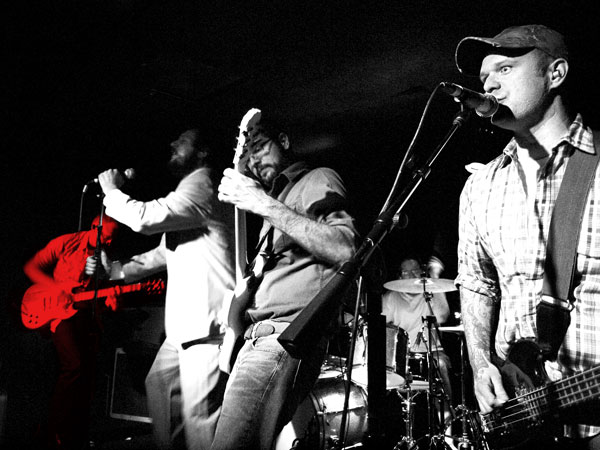
Playing a Compact Disc is nothing like playing a live show.
Wild, right? This is just the latest of the profundities to explode into my mighty brain as I slouch on the orange couch, staring at stacks of CDs, contemplating life and stuff. It came to me on a lovely Sunday morning. The sun was shining, the birds were cheeping, and I was still high from my band's performance two nights earlier.
If you've ever played music of any kind—but especially rock'n'roll—for a crowd of enthusiastic fans and friends, you know the rush I'm talking about. There's nothing like the energy that erupts from the live performance, the blissful marriage of process and product. The band makes music and the audience hears it—nothing between them but the lip of the stage. As the band gives, the audience, through cheers and flailing limbs, gives in return. One fuels the other, and a unique bond is formed. This is very different from, say, creating a magazine: The process occurs months ahead of the product, and there's often a great distance between the performers (writers and editors) and audience (readers).
I wish you could have been there to see our band, the Multi-Purpose Solution, play. The show took place at one of the finest rock venues on the planet, Maxwell's in Hoboken, New Jersey, and it was a wild success—a surprise to all involved for many reasons, none greater than the fact that our band pretty much doesn't exist anymore.
In May of last year, our old friend and rock colleague, Neil Sabatino of Mint 400 Records, had contacted our front man, Jim Teacher. Neil's band, Fairmont, would be celebrating their 10th anniversary with a show in November, and he wondered if our band, defunct since 2006, would reunite for the occasion. It was an interesting proposition. We'd been asked to play shows in the past, but we'd always found reasons to decline. This show, however, would be at Maxwell's (where bands eat for free), and we had six months to prepare. It seemed possible. Still, I was as surprised as anyone when we actually agreed to do it.
After accepting the offer, we tried our best to schedule regular rehearsals, but life and stuff—work, children, weddings, funerals, lower-back pain, upper-back pain, untimely snowstorms—conspired against us. Over the next six months, we managed to meet for only three full-band rehearsals, and the third one wasn't all that encouraging. We were rusty. So when the time came to actually play the show, each member of the band felt a certain degree of anxiety. It wasn't until we were at Maxwell's and had seen the bar fill up with fans, friends, and family that we knew nothing could go wrong. We packed the house and rocked furiously, this time knowing that we might never have another chance. The sound of the audience members as they sang along, their separate voices coalescing and growing into a massive, single voice raised high above the racket of guitar amps and crash cymbals, is something I'll never forget.
In the nights leading up to the show, I practiced diligently on my own. Standing in the center of my listening room, I tried to avoid knocking into my PSB Alpha B1 loudspeakers as I struck rock-star poses, snarled at my LP shelves, and riffed along on my Gibson SG to our band's debut CD, the mps (CD, Mint 400 M4R00 18). The CD player, NAD's C 515BEE, must've wondered what the heck was going on as I constantly paused and reversed, paused and reversed.
Totally neat
At $300, the C 515BEE is NAD's least expensive CD player (footnote 1). Designed to match the NAD C 316BEE integrated amplifier ($380), the compact C 515BEE measures 17 1/8" W by 2 3/8" H by 9½" D and weighs just 7.75 lbs. In terms of fit and finish, it falls short of the standard set by the big, hefty Emotiva ERC-2 ($449), which I reviewed in December, but there's nothing chintzy about the NAD. In fact, I prefer its simple, modest appearance over the Emotiva's busy, showy design. And anything that's easy on the back is a friend of mine. On the NAD's front panel, from left to right, are a power button, the disc tray, a modestly lit vacuum-fluorescent display, and two rows of three buttons each: on top, Play, Pause, and Stop; below those are Open/Close, and forward and backward Skip/Scan. So smooth and quiet was the NAD's tray that inserting and removing CDs was always a pleasure—not unlike opening or closing the door of a fine automobile. On the rear panel are an analog output, coaxial and optical digital outputs, and a simple AC power cord. The model's overall appearance is handsome and serene. The C 515BEE comes with a remote control that allows the user to do all sorts of fun stuff: program tracks, repeat a single track or a section within a track (handy for practicing your rock'n'roll moves), and adjust the display's brightness. The remote is small and light—you won't feel compelled to smash anyone over the head with it.
Surprisingly smart for a $300 CD player, the C 515BEE can play MP3- and WMA-formatted recordings burned to CD-R or CD-RW discs—a trick that even my $1100 Exposure 2010S can't pull off. Using the remote control, the user can select playback by scrolling through the MP3/WMA folders and files. Once a file is selected, the C 515BEE displays the file type and any available metadata (song title, artist, album). Totally neat.
Tech talk
The C 515BEE comes with a remote control that allows the user to do all sorts of fun stuff: program tracks, repeat a single track or a section within a track (handy for practicing your rock'n'roll moves), and adjust the display's brightness. The remote is small and light—you won't feel compelled to smash anyone over the head with it.
Surprisingly smart for a $300 CD player, the C 515BEE can play MP3- and WMA-formatted recordings burned to CD-R or CD-RW discs—a trick that even my $1100 Exposure 2010S can't pull off. Using the remote control, the user can select playback by scrolling through the MP3/WMA folders and files. Once a file is selected, the C 515BEE displays the file type and any available metadata (song title, artist, album). Totally neat.
Tech talk
I wondered if there were special design goals for the C 515BEE. NAD's director of technology and product planning, Greg Stidsen, explained that the company wanted to reach a high level of performance at an affordable price: "While $300 is not much in audiophile terms, it is a major purchase for many people, and we try to offer the best possible musical performance for the price." I appreciate Stidsen's acknowledgment of the real world: For most of my friends, $300 is a crazy amount of money for a CD player. He continued: "While perfection is not possible at $300, a highly engaging musical experience is entirely possible, if you know what you are doing." To that end, NAD developed a circuit layout to complement their chosen active devices: a Cirrus Logic 24-bit/192kHz sigma-delta digital-to-analog converter and an audio-specific Texas Instruments 5532 dual op-amp. More tech talk from Stidsen: "A lot of people don't realize that most DACs don't meet their potential performance due to manufacturing tolerances. A perfect 24-bit DAC should have a dynamic range of 144dB, yet in practice even the most expensive DACs only get to 135dB or so. Since CD is only 16-bit, even a moderately priced 24/192 DAC will easily accommodate the 96dB dynamic range required with perfect linearity. Circuit layout is supercritical, as [are] correct decoupling of power supply and choice of passive components and component values."
How does NAD keep its prices low? Stidsen explained that the company has never invested in its own manufacturing factories, but instead benefits from the economies of scale and production expertise offered by their overseas partners. The "BEE" in the component's name stand for Bjørn Erik Edvardsen, the man behind the brand, and NAD's director of advanced development. Leading a small team of hardware and software engineers at NAD's Ontario-based facilities, Edvardsen, along with senior engineer Steve Wilkins, fine-tuned the C 515BEE's audio circuitry "to achieve the best possible results within the set budget parameters."
Footnote 1: NAD Electronics International, 633 Granite Court, Pickering, Ontario L1W 3K1, Canada. Tel: (905) 831-6555. Fax: (905) 837-6357. Web: www.nadelectronics.com.
At $300, the C 515BEE is NAD's least expensive CD player (footnote 1). Designed to match the NAD C 316BEE integrated amplifier ($380), the compact C 515BEE measures 17 1/8" W by 2 3/8" H by 9½" D and weighs just 7.75 lbs. In terms of fit and finish, it falls short of the standard set by the big, hefty Emotiva ERC-2 ($449), which I reviewed in December, but there's nothing chintzy about the NAD. In fact, I prefer its simple, modest appearance over the Emotiva's busy, showy design. And anything that's easy on the back is a friend of mine. On the NAD's front panel, from left to right, are a power button, the disc tray, a modestly lit vacuum-fluorescent display, and two rows of three buttons each: on top, Play, Pause, and Stop; below those are Open/Close, and forward and backward Skip/Scan. So smooth and quiet was the NAD's tray that inserting and removing CDs was always a pleasure—not unlike opening or closing the door of a fine automobile. On the rear panel are an analog output, coaxial and optical digital outputs, and a simple AC power cord. The model's overall appearance is handsome and serene.
The C 515BEE comes with a remote control that allows the user to do all sorts of fun stuff: program tracks, repeat a single track or a section within a track (handy for practicing your rock'n'roll moves), and adjust the display's brightness. The remote is small and light—you won't feel compelled to smash anyone over the head with it.
I wondered if there were special design goals for the C 515BEE. NAD's director of technology and product planning, Greg Stidsen, explained that the company wanted to reach a high level of performance at an affordable price: "While $300 is not much in audiophile terms, it is a major purchase for many people, and we try to offer the best possible musical performance for the price." I appreciate Stidsen's acknowledgment of the real world: For most of my friends, $300 is a crazy amount of money for a CD player. He continued: "While perfection is not possible at $300, a highly engaging musical experience is entirely possible, if you know what you are doing." To that end, NAD developed a circuit layout to complement their chosen active devices: a Cirrus Logic 24-bit/192kHz sigma-delta digital-to-analog converter and an audio-specific Texas Instruments 5532 dual op-amp. More tech talk from Stidsen: "A lot of people don't realize that most DACs don't meet their potential performance due to manufacturing tolerances. A perfect 24-bit DAC should have a dynamic range of 144dB, yet in practice even the most expensive DACs only get to 135dB or so. Since CD is only 16-bit, even a moderately priced 24/192 DAC will easily accommodate the 96dB dynamic range required with perfect linearity. Circuit layout is supercritical, as [are] correct decoupling of power supply and choice of passive components and component values."
Footnote 1: NAD Electronics International, 633 Granite Court, Pickering, Ontario L1W 3K1, Canada. Tel: (905) 831-6555. Fax: (905) 837-6357. Web: www.nadelectronics.com.