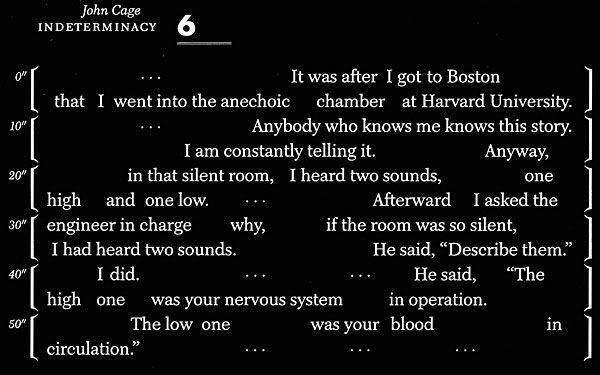
John Cage, Indeterminacy, C.F. Peters No.68142. Copyright 2009, by Henmar Press, Inc. Reprinted by agreement with Wesleyan University Press and the John Cage Trust.
When I began my junior year at Fairleigh Dickinson University, in Teaneck, New Jersey, I'd already fulfilled the main requirements for graduation, but still had a number of credits to put toward elective studies. The courses in yoga and bowling were already closed, so I devised an independent course in experimental music. Thinking about it now, it seems a strange miracle that the university allowed me to come up with such a thing. Fairleigh's music department had long been abandoned, forgotten, traded in for the money that comes with well-publicized investments in business, economics, and a fast-growing foreign-exchange program. To me, however, FDU's decision to neglect the arts was a blessing: There, in the quietest corridors of Weiner Library, was a world full of LPs, turntables, music journals, and more—all a bit dusty, perhaps, but nonetheless beautiful, and all seemingly reserved for me.
I spent mornings, afternoons, and nights moving between the library stacks, unoccupied turntable stations, and vacant classrooms, imagining myself a kind of detective, unearthing secrets not only of music and sound but of my school. Discovering that tightlipped FDU had once had a thriving, progressive music department was like discovering that my parents had once been happy together: I felt cheated, deceived, even slightly disgusted—but also inspired, relieved, restored. Suddenly, my decision to attend FDU made some sort of sense. It was now about more than the scholarship I'd received, more than my blind desire to get away from home, to be freed from the noise of my parents' life. Sitting in Weiner Library on that cloudy day, I was granted meaning and purpose. I was where I was supposed to be.
Along with Home Theater's Rob Sabin, AVGuide.com's Chris Martens, Sound + Vision's Al Griffin, and Electronic House's Robert Archer, I was invited by Lenbrook Group, the parent company of PSB and NAD, to visit the National Research Council, in Ottawa. Formed by the Canadian government at the height of World War I, the NRC was first meant to ensure Canada's place as a world leader in technology and military research. Today, with facilities in every Canadian province, the NRC comprises over 20 institutes and national programs that represent a diverse range of disciplines and employ over 4200 people. Most significant to audio enthusiasts, the NRC has provided invaluable resources to loudspeaker manufacturers such as Axiom, Energy, Mirage, Paradigm, and PSB. In 1965, a 27-year-old electrical engineer named Floyd E. Toole joined the NRC and took full advantage of the facility's anechoic chamber and listening room. Toole's pioneering research, documented in a series of papers published in the Journal of the Audio Engineering Society (footnote 3), led to three major discoveries: First of all, most people, most of the time, will agree on the relative qualities of a group of loudspeakers. Second, and most important to me, Toole found that musical appreciation, experience, and taste have little to do with a person's ability to judge good sound—a point that should come as a revelation to anyone who believes, modestly yet naïvely, that he or she isn't qualified to enjoy a high-quality stereo system. In other words, even if you've spent your entire life listening to MP3s through cheap earbuds, you can discern good sound from bad, and you do deserve to have it in your life. Your ears are perfectly fine. Finally, and perhaps most controversially, Toole found that a properly interpreted set of loudspeaker measurements should correlate extremely well with listener preferences. It's no exaggeration to say that Toole's research has radically impacted loudspeaker design. In fact, John Atkinson often says that Toole literally wrote the book on the topic: Sound Reproduction: Loudspeakers and Rooms (footnote 4, Oxford, UK: Focal Press, 2008). But I feel that Toole's research has also guaranteed the NRC's acoustics division a permanent place in hi-fi history. For me, at least, the NRC is sacred ground: It contains the main R&D facility for PSB Loudspeakers' chief designer, Paul Barton. And Barton, a Toole disciple, is the man who designed my own reference loudspeaker, the brilliant PSB Alpha B1.
That night, I slept restlessly. While it's not unusual for me to feel anxious when far from home, this time my nerves had little to do with the unfamiliar surroundings. Our hotel, the Fairmont Château Laurier, at 1 Rideau Street, Ottawa, was absolutely magnificent, and the view, overlooking the Rideau Canal, was gorgeous and calming. But my excitement over the next day's visit to the NRC had been turned upside down by a heavy dose of fear: Before dinner came to an end, Paul Barton had surprised us with a bit of "homework." He'd given each of us a four-page article titled "Instructions to Listeners," and a somewhat daunting "Listener Response Form." Barton said it would be a good idea to spend some time familiarizing ourselves with the documents, because after visiting the anechoic chamber we'd be participating in some blind listening tests—the very ones used by Floyd E. Toole to determine relationships between loudspeaker sound quality and listener performance. In my hotel room later that evening, just before turning out the lights, I remembered what Barton had said and reached for my packet:
The day dawned gray, but by afternoon was sunny and blue. It was a short but lovely drive from our hotel to the NRC, and, once we'd arrived, our hosts took us around the facility to give us a sense of its magnitude. The sprawling campus was indeed impressive. In light of its 60-odd buildings, including a particularly awe-inspiring aerospace center with a 75'-long wind tunnel, Paul Barton's section of the NRC's M-37 building seemed rather modest. But all the cool stuff was inside. I spotted the door to the anechoic chamber and felt pulled in that direction. Instead, Barton led us into the small, tidy corner of the building that makes up his test lab—a room full of cables, buttons, knobs, glowing screens, blinking lights. As he described his measurements procedure and showed us how each of his doodads and thingamabobs work (footnote 6), all I could think of were those two distinct sounds. Fifteen years after first reading John Cage's "Experimental Music" and being captivated by the idea of a silence so deep I could hear the blood running through my veins, I stood just feet away from a real anechoic chamber. I couldn't wait to get inside. The NRC's anechoic chamber measures approximately 24' long by 17' wide by 17' high and is echo-free down to 80Hz. Every surface of the chamber, including what might be considered the "floor," is covered by large acoustic wedges. Industrial grating is suspended above the floor and extends beyond the chamber's entrance, providing just enough room for three or four adults to move about safely. There's enough room near the edge of the grating to accommodate a test subject—a loudspeaker, for instance, or a KEMAR dummy head. An array of microphones hangs from the ceiling and faces the entrance to the chamber, while a video camera sends signals from the chamber to a computer in the outer lab. There, from the comfort of his desk, Barton can manipulate the placement of the speaker, run through a number of test signals, and monitor the results.
Footnote 1: These words come to mind every time someone asks me about the future of hi-fi. Worrying about the future of hi-fi is, in my opinion, a waste of time. As long as music exists, hi-fi will exist. Incidentally, this September 5th would have been John Cage's 100th birthday. Visit www.johncage.org for a calendar of celebratory events. Footnote 2: I exaggerate. The truth is, I choose not to distinguish music from sound. Why would I want to? Footnote 3: "Listening Tests: Turning Opinion into Fact," presented at the 69th Convention of the Audio Engineering Society (12–15 May 1981). Preprint 1766. JAES, Vol.30 No.6, p.431 (June 1982). "Subjective Measurements of Loudspeaker Sound Quality and Listener Performance," JAES, Vol.33 No.1/2, p.2 (January/February 1985). "Loudspeaker Measurements and Their Relationship to Listener Preferences: Part 1," JAES, Vol.34 No.4, p.231 (April 1986); "Part 2," JAES, Vol.34 No.5, p.323 (May 1986).