In a recent e-mail exchange, Henry explained, "I recorded Salsa Subterránea in New York with my own group this time and I like it a lot better than the previous album. With this album, I feel like I'm finally zeroing in on the sound that I've been looking for: 't°pico,' yet hip and understated and not as strident and abrasive to the ear as most salsa recordings. One of the hardest things to achieve musically is to swing without sounding loud and tacky, and I think we got close to that in this recording."
Try "En Boca Cerra" for a taste of Fiol's trademark sound; for more on his background and his music, check out my conversation with him here.
The music seemed to propel the patrons of Santos y Ana's Social Club into a frenzy: As Henry shouted "Juega billar!" (Play pool!), the partiers' own shouts became louder and more jovial, pool balls clacked with extra force, women leapt from their bar stools and transformed into colorful, enticing blurs. I stood outside, my back to the bright blue walls, and danced to the music until it was over.
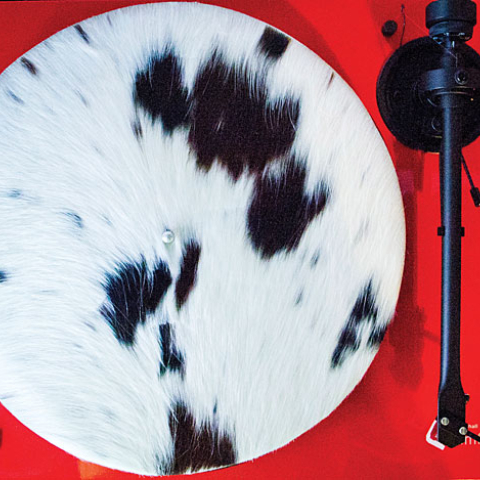
Back at home, I had to hear it again—on the hi-fi, of course. I cued up the record and raced to the orange couch. The music sounded wonderful, but, without the party atmosphere, it couldn't match the fire and urgency I'd experienced only moments earlier on Coles Street. I considered frying up some empanadas and inviting all of Santos y Ana's members over to my place, but I had some "serious" listening to do.
Of G-Snakes and Giant-Killers
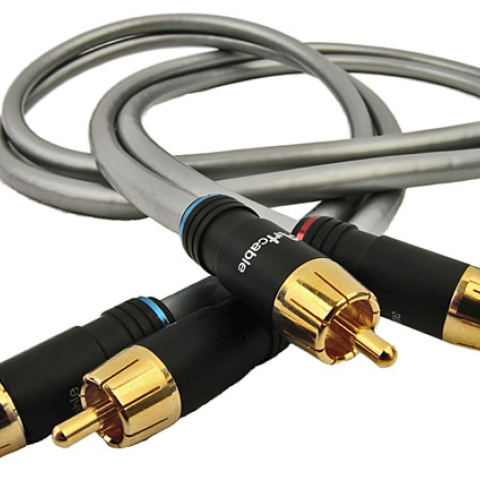
Last month, I briefly mentioned that Giant-Killer Cables' Ultra-Pure interconnects (ú49/0.5m pair) had helped me reach some conclusions about AudioQuest's G-Snake ($34/0.5m pair) and Signal Cable's Analog One ($36/2' pair) interconnects. Now I'll mention more. Giant-Killer Cables is a UK company, based on the Isle of Wight. Their modest-looking Ultra-Pure interconnects use oxygen-free copper in a coaxial shielded design and have gold-plated Neutrik RCA plugs. The company's Quad-Core Silver interconnect (ú99/0.5m pair) seems much more complex: Each of its four conductors of silver-plated copper is enclosed in an air-gapped Teflon tube, then hand-braided with the other three. Giant-Killer Cables claim that their Quad-Core architecture is better than conventional shields at rejecting outside noise, and provides a more natural, open sound while eliminating time-smearing effects.
I decided to get acquainted with the Giant-Killer Cables using "Play with My Heart," from FaltyDL's You Stand Uncertain (LP, Planet Mu ZIQ286), a wonderful album both musically and sonically. FaltyDL is really just one man, Drew Lustman, a young NYC musician and producer who obviously knows a great deal about music and sound. "Play with My Heart" is a slithery dance track that hangs handclaps, male and female voices, South American flute, and intricate cymbal work over a snaking 6/8 rhythm for a fascinating, adventurous sonic trip. When I first listened to it with my cheap RadioShack interconnects (catalog #42-487, $6.99/3' pair), the handclaps sounded fairly realistic, voices were solid and appropriately alluring, the bass had good weight and impact, and everything seemed to move at a steady pace. I was surprised—the RadioShacks didn't seem to have any trouble following this music's many subtle rhythmic shifts.
 After switching to Giant-Killer's Ultra-Pure interconnects, however, I wondered if "Play with My Heart" now sounded louder, faster, more propulsive and rhythmically certain. The flute suddenly sounded more like a flute—woodier and more resonant—and the handclaps had more flesh and slap. Images within the soundstage were more clearly focused and delineated, giving me the impression that more musicians were involved. Overall, the music had greater weight and impact. The Giant-Killers seemed to offer a happy combination of speed, body, and timbral truth for an intense, exciting listening experience. This was turning into a party not unlike that at Santos y Ana's Social Club.
I reinserted the RadioShacks. Tonal colors seemed suddenly dull and muted, voices were compressed and less robust, handclaps were more plastic than flesh, and the overall sound was slower and less involving.
I then compared Giant-Killer's Ultra-Pure interconnects with their more expensive Quad-Core Silvers. The latter seemed to provide a bigger, more enveloping soundstage, with tons of low-level detail and even greater bass weight, but with a slower, less rhythmically assured sound overall. In fact, the Quad-Core Silver's ample bass seemed to seep into the rest of the music to overload my small listening room. For a brief while, it was fun to experience this wealth of bass energy, but it soon became a distraction. I kept hoping that the Quad-Core Silver's low end would tighten up, giving me the opportunity to simply revel in all the newfound detail, but it never happened—at least, not in my room with my system.
Comparing Giant-Killer's Pure-Silver with AudioQuest's G-Snake interconnects proved frustrating and fascinating: frustrating because differences were often extremely difficult to hear, fascinating because the effects of those differences seemed to depend entirely on the music that was playing. "Engines in the City," the spacious and languorous opening track of Jenny Hval's captivating Viscera (LP, Rune Grammofon RLP 3108), gained vibrancy and realism from the airy top end and transient speed of the Giant-Killer interconnects, while "MindKilla," the aggressive and densely layered lead single from Gang Gang Dance's genre-blurring Eye Contact (LP, 4AD CAD3107), seemed to appreciate the deeper silences and more deliberate, controlled presentation provided by the AudioQuest interconnects. It was a toss-up.
After switching to Giant-Killer's Ultra-Pure interconnects, however, I wondered if "Play with My Heart" now sounded louder, faster, more propulsive and rhythmically certain. The flute suddenly sounded more like a flute—woodier and more resonant—and the handclaps had more flesh and slap. Images within the soundstage were more clearly focused and delineated, giving me the impression that more musicians were involved. Overall, the music had greater weight and impact. The Giant-Killers seemed to offer a happy combination of speed, body, and timbral truth for an intense, exciting listening experience. This was turning into a party not unlike that at Santos y Ana's Social Club.
I reinserted the RadioShacks. Tonal colors seemed suddenly dull and muted, voices were compressed and less robust, handclaps were more plastic than flesh, and the overall sound was slower and less involving.
I then compared Giant-Killer's Ultra-Pure interconnects with their more expensive Quad-Core Silvers. The latter seemed to provide a bigger, more enveloping soundstage, with tons of low-level detail and even greater bass weight, but with a slower, less rhythmically assured sound overall. In fact, the Quad-Core Silver's ample bass seemed to seep into the rest of the music to overload my small listening room. For a brief while, it was fun to experience this wealth of bass energy, but it soon became a distraction. I kept hoping that the Quad-Core Silver's low end would tighten up, giving me the opportunity to simply revel in all the newfound detail, but it never happened—at least, not in my room with my system.
Comparing Giant-Killer's Pure-Silver with AudioQuest's G-Snake interconnects proved frustrating and fascinating: frustrating because differences were often extremely difficult to hear, fascinating because the effects of those differences seemed to depend entirely on the music that was playing. "Engines in the City," the spacious and languorous opening track of Jenny Hval's captivating Viscera (LP, Rune Grammofon RLP 3108), gained vibrancy and realism from the airy top end and transient speed of the Giant-Killer interconnects, while "MindKilla," the aggressive and densely layered lead single from Gang Gang Dance's genre-blurring Eye Contact (LP, 4AD CAD3107), seemed to appreciate the deeper silences and more deliberate, controlled presentation provided by the AudioQuest interconnects. It was a toss-up.
 For my money, I'd force myself to forget about the speed, impact, and vibrancy provided by the humble-looking Giant-Killers, and opt for the clarity and control of the sexier, AudioQuests. If you're curious about Giant-Killer Cables, however, keep in mind that the company pays shipping costs to anywhere in the world, and offers a 21-day, "no quibble," money-back guarantee on all of their products.
Of Lackies and Renoites
For my money, I'd force myself to forget about the speed, impact, and vibrancy provided by the humble-looking Giant-Killers, and opt for the clarity and control of the sexier, AudioQuests. If you're curious about Giant-Killer Cables, however, keep in mind that the company pays shipping costs to anywhere in the world, and offers a 21-day, "no quibble," money-back guarantee on all of their products.
Of Lackies and Renoites
Recently, in our online forum, "Lackie" posted a simple question: "Does anyone have any recommendations for cables for a $1000 system? I know that they are important and I'm willing to spend some $$$ but I don't want to overspend." Answers soon popped up, and one in particular surprised me. "Renoite" recommended RadioShack cables, and explained: "Don't spend a lot. I've researched this over and over. Plenty of information out there to the contrary on cables. Don't expect to find a negative review in many magazines, they can't break the hand that feeds them." Let's toss aside Renoite's skepticism, arrogance, and prejudice, and focus instead on his research. Let's take for granted that that research included listening to RadioShack cables and then comparing them with other, well-known, readily available cables. I'm surprised by Renoite's findings because, having just spent the last several weeks listening to and comparing cables, I've come to a very different conclusion: RadioShack cables are fine for the money—after all, they're cheap as hell—but they leave a lot of room for improvement.
Minutes ago, I replaced my RadioShack 14AWG, braided Flat Megacable speaker wire (catalog #278-1273, $24.99/50') with AudioQuest's 14AWG, solid-core Rocket 33 speaker cable ($269/8' pair). It was yet another of those Holy shit moments—an exciting leap in performance, the kind of leap that I never could have expected, but one that I will now crave with every component swap I make. I'm damned.
I heard more low-level resolution, transient speed, extended decays, bass (the taut, glorious kind), air, clarity, detail, overtones, harmonics, soundstage height and width, physicality, bloom, body, grace, ease, confidence, startling dynamic range—all that good stuff, everything I need. I heard more music, more music, more—delicious—music.
And the AudioQuest cables look and feel so much cooler than the RadioShacks.
I know that everyone is different, and that each of us is entitled to our opinions and stuff, but I'm shocked to think that the improvements wrought by the AudioQuest cables aren't completely, immediately, almost painfully obvious to anyone who listens. Yes, the AQs are much more expensive than the RadioShacks—66 times as costly per foot—but the AudioQuests are worth the extra money. In fact, for what they do, I think they're a bargain. I can't imagine going back to the cheap RadioShack stuff. Why would I?
And now I think I'll throw a listening party. I'll invite Natalie, Nicole, Henry Fiol, my friends at Iris Records, and the whole crew from Santos y Ana's Social Club. We've got lots to celebrate.
Share your stories.
Last month, I briefly mentioned that Giant-Killer Cables' Ultra-Pure interconnects (ú49/0.5m pair) had helped me reach some conclusions about AudioQuest's G-Snake ($34/0.5m pair) and Signal Cable's Analog One ($36/2' pair) interconnects. Now I'll mention more. Giant-Killer Cables is a UK company, based on the Isle of Wight. Their modest-looking Ultra-Pure interconnects use oxygen-free copper in a coaxial shielded design and have gold-plated Neutrik RCA plugs. The company's Quad-Core Silver interconnect (ú99/0.5m pair) seems much more complex: Each of its four conductors of silver-plated copper is enclosed in an air-gapped Teflon tube, then hand-braided with the other three. Giant-Killer Cables claim that their Quad-Core architecture is better than conventional shields at rejecting outside noise, and provides a more natural, open sound while eliminating time-smearing effects.
After switching to Giant-Killer's Ultra-Pure interconnects, however, I wondered if "Play with My Heart" now sounded louder, faster, more propulsive and rhythmically certain. The flute suddenly sounded more like a flute—woodier and more resonant—and the handclaps had more flesh and slap. Images within the soundstage were more clearly focused and delineated, giving me the impression that more musicians were involved. Overall, the music had greater weight and impact. The Giant-Killers seemed to offer a happy combination of speed, body, and timbral truth for an intense, exciting listening experience. This was turning into a party not unlike that at Santos y Ana's Social Club.
I reinserted the RadioShacks. Tonal colors seemed suddenly dull and muted, voices were compressed and less robust, handclaps were more plastic than flesh, and the overall sound was slower and less involving.
For my money, I'd force myself to forget about the speed, impact, and vibrancy provided by the humble-looking Giant-Killers, and opt for the clarity and control of the sexier, AudioQuests. If you're curious about Giant-Killer Cables, however, keep in mind that the company pays shipping costs to anywhere in the world, and offers a 21-day, "no quibble," money-back guarantee on all of their products.
Recently, in our online forum, "Lackie" posted a simple question: "Does anyone have any recommendations for cables for a $1000 system? I know that they are important and I'm willing to spend some $$$ but I don't want to overspend." Answers soon popped up, and one in particular surprised me. "Renoite" recommended RadioShack cables, and explained: "Don't spend a lot. I've researched this over and over. Plenty of information out there to the contrary on cables. Don't expect to find a negative review in many magazines, they can't break the hand that feeds them." Let's toss aside Renoite's skepticism, arrogance, and prejudice, and focus instead on his research. Let's take for granted that that research included listening to RadioShack cables and then comparing them with other, well-known, readily available cables. I'm surprised by Renoite's findings because, having just spent the last several weeks listening to and comparing cables, I've come to a very different conclusion: RadioShack cables are fine for the money—after all, they're cheap as hell—but they leave a lot of room for improvement.